Category: Chemistry

Empirical formula

Empirical formula

Empirical formula

09/30/16

“How can we obtain the structure of a chemical just by knowing the percentage of it’s components?”
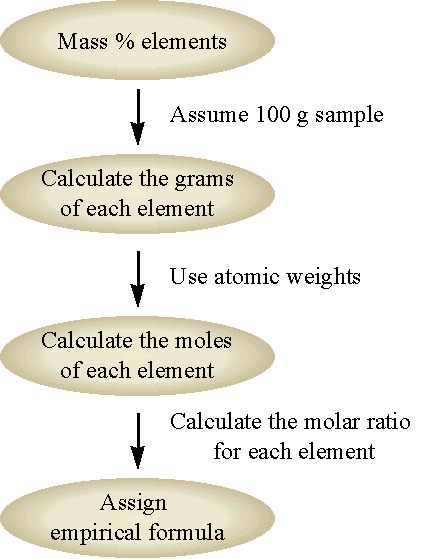
Wouldn’t it be really cool if just by knowing the percentage composition of the different atoms in a compound, you could obtain the chemical formula? Well, let’s figure out how to do it by completing an example. Let’s say that you obtain a chemical with percentage 58.64% Carbon [C], 8.16% Hydrogen [H], and 43.20% Oxygen [O]. The first step we must take is to change this percentage into something more realistic, such as mass. To make the math easy, let’s use a mass sample of 100g. This means that this compound will have 58.64 grams of carbon[C], 8.16 grams of hydrogen [H], and 43.20 g of oxygen [O]. The second step will be to take these masses and change it into moles. After doing the math, we will end up with 4.409 moles of carbon [C], 8.905 moles of hydrogen [H], and 2.7 moles of oxygen [O]. if you notice, all of the moles are in “messy” values, so we need to simplify this somehow. We can accomplish this by dividing the moles by the lowest number (In this case, the lowest number is 2.7). After we do the math, we will end up with 1.5 moles of carbon [C], 3 moles of hydrogen [H], and 1 mole of oxygen [O]. Now, we simply have to make everything a whole number. We could do this by multiplying all of mole values by 2, giving us 3 moles of carbon [C], 6 moles of hydrogen [H], and 2 moles of oxygen [O]. Our final compound formula will be C3H6O2, which just so happens to be the chemical formula for Acetate. Since this process will always give you the formula with the simplest amount of proportions, it is called the empirical formula.

Kidney stones

Kidney stones

Kidney stones

09/25/16

“What are Kidney stones?”


You have probably heard of Kidney stones, those mysterious solid objects that cause major pain to everyone. But what are they and how do they form? Well, it turns out that kidney stones is caused by simple chemistry, insoluble compounds. When your urine contains too many insoluble components such as calcium, they begin to build up and cause kidney stones to form. In order to avoid Kidney stones, you should commit to regular exercise and avoid diets that are too high in protein, sugar, and sodium.

How to solve oxidation-reduction reactions

How to solve oxidation-reduction reactions

How to solve oxidation-reduction reactions

09/21/16

“How can we solve these complex oxidation-reduction reactions?”


Oxidation reduction reactions can be quite difficult to grasp for many new students in Chemistry due to the long process often involved. However, I will show you how even through working through these problems might be convoluted at first, they are actually very intuitive if you think about how it works from a systematic point of view.

Let us start with an example oxidation-reduction reaction, CrO4 -2 + I- → I2 + Cr +3. The first thing we must do is split the problem into two half reaction, I- → I2 and CrO4 -2 → Cr+3. Now that we have isolated these problems into separate forms, we now have to balance the equation with the exception of hydrogen, oxygen, and charges! (Which we will come to later). So our new half reactions will be 2I- → I2 and CrO4 -2 → Cr+3. Now, you are probably curious about how oxygen is present on the left side of the second equation but not on the right! But before we give up, it is possible to add hydride ions to both sides. So what we do is take hydride, add enough to balance out the charge of the oxygen, and then add the corresponding amount of H2O on the other side. Now that we have done this, we have to account for the extra charges on both side. To solve this, we simply add extra electrons to the more positive sides of the reactions. To illustrate, the first equation will become 2I- → I2 + 2e-, and the second one will become CrO4 -2 → Cr+3 + 5e-. Now that both equations are fully balanced, it would seem logical to just combine them again, right? Well, not quite yet. If we would do that, there would be an imbalance in electrons. To solve this, all we have to do is multiply each side by a numerical constant to the lowest common factor of the electron charges to balance the electron charges. Since we have 2 electrons for the first equation and 5 for the second, the lowest common factor between them will be 5 and 2 respectively. So then our equation will be 2(CrO4 -2) + 5(2I-) + 10e- →2(Cr+3)  + 2(4H20) + 5I2 + 10e-, and after crossing out the electrons on both sides, our final answer will be 2(CrO4 -2) + 5(2I-) →2(Cr+3)  + 2(4H20) + 5I2

Once you have completed this process a few times, you will realize how logical and systematic it can be!

Guide to the chemical hazard diamond

Guide to the chemical hazard diamond

Guide to the chemical hazard diamond

09/18/16

“What does that multi-color diamond near each chemical symbol represent?”


Have you ever noticed how this a multi color diamond near many chemical containers? And have you ever wondered what it represented? Well, it turns out that that geometric object is simply a chemical hazard diamond. A chemical safety diamond is an indicator of the types of hazards that are found in the contained chemical. The yellow diamond on the left indicates the reactivity, the red diamond on the top indicates the flammability, the blue diamond on the left indicates the toxicity, and the white diamond indicates the specific hazard. The first three use a 0-4 numbering system to indicate the danger level, 0 being the lowest and 4 being the highest, while words and symbols will be written on the bottom white diamond to attest to it’s specific danger. Manufacturers by law are required to print the diamond on each container to inform the users about the safety precautions they must make.

Aqueous solution

Aqueous solution

Aqueous solution

09/17/16

“What makes solutions in water so unique?”
During one’s study of chemistry, one will come across the fact that many substances dissolve in water. However, how can Chemists classify this, and how are they unique? Well, this phenomena is usually termed an aqueous solution (Aqueous coming from aqua-, Latin for water). However, what is truly special about aqueous solutions is that  allow for the substances to be dissolved into ions within it. This gives rise to electrolytes, which can make water conductive, and this is where acid and base reactions take place. In fact, this ability to dissolve substances into ions is one of the reasons that makes water the prime factor for life, as different substances can be transformed and reacted within it.

Chemical precipitation

Chemical precipitation

Chemical precipitation

09/16/16

“Why does a solid sometime forms when you mix two chemicals?”


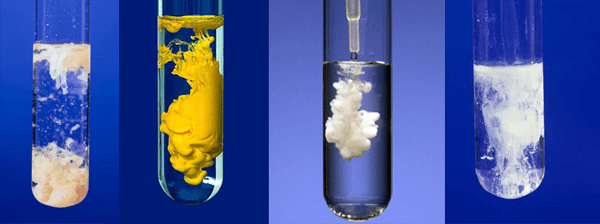
Have you ever wondered why sometimes when you mix two aqueous solutions together, a solid will sometimes form? Well, the explanation for this very simple. When two aqueous solutions mix, their atoms will dissociate and recombine into new chemicals. Sometimes one of the products might be insoluble, meaning that it will not be dispersed into the surrounding substance. As a result, a solid will form. Chemical precipitations are a very common phenomena, for example, did you know that kidney stones are actually the results of chemical precipitation, and also pipe clogging?

Strong and weak acids and bases

Strong and weak acids and bases

Strong and weak acids and bases

09/12/16

“How do different types of acids and bases dissolve in water?”


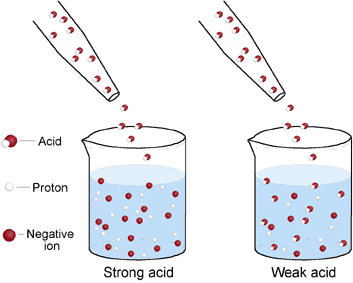
Acids and bases are like two sides of the same coin, the former have too much hydrogen anions, while the former have too much oxalate cations. When some of these substances are poured into water, the acids will ionize (decompose) and the base will disassociate (decompose). However, these compounds do not always dissolve in the same way. Some of them completely dissolve, while some of them will only partially dissolve. When an acid/base fully decomposes, it is called a strong acid. Strong acids and bases produce a lot of electrolytes, which makes the resulting solution especially conductive. The 6 strong acids include Hydrochloric acid [HCl], Hydrobromic acid [Hbr], Hydroiodic acid [HI], Nitrous acid [HNO3], Chloric acid [HClO3], Perchloric acid [HClO4], and Sulfuric acid [H2SO4]. By contrast, acids that only partially dissolve are called weak acids/bases. Since only part of the weak acids and bases decompose, the solutions are not especially conductive. Therefore, the difference between the two types are just about how much they dissolve.

Reverse osmosis

Reverse osmosis

Reverse osmosis

09/04/16

“How can we use pressure to purify seawater?”

Already humanity is facing a major water problem. As the water reservoirs start to dry up, there will be entire areas with no hydration to speak of. So what is one way we could solve this? Well, how about we look to the most plentiful form of water, the ocean, to solve our problems. Ocean water is normally unusable for humanistic concerns due to it’s salty nature, but what if we were to desalinate it to make it usable?

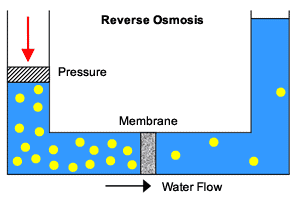
Now that we have the idea, let’s think about how we could make this a reality. Well, first of all, we should notice that salt water probably has other elements in it that are a result from exposure to the rest of the environment, such as seaweed and dead animals parts. These items are usually larger than the molecules of water and salt, so they can be filtered away easily through the use of a permeable layer. We can accomplish this by extracting sea water, and then using pressure to force it through a permeable layer. However, the leftover water will still have a high concentration of salt. But to our luck, it is still possible to separate the salt if we notice one factor, that both water and salt have different evaporation points, and more specifically, water has a lower point of evaporation. So what we can do with this leftover salt water is boil it until the point of evaporation for water, and then pass this steam off into another area, and then cool it until it solidifies again. After all of this, we will finally have ourselves some freshwater! This process is known as reverse osmosis, and plants are currently being used in arid regions such as California, Israel, and Saudi Arabia to create a usable water supply.

Galvanic cells

Galvanic cells

Galvanic cells

08/27/16

What is the simplest possible battery?


Batteries are some of the most omnipresent electrical components in human civilization. However, what is the most simple form of them? Well, in order to do that, we have to put everything into it’s most basic parts.

Well, let’s suppose we have a slab of zinc and a slab of copper, both occupying space in separate dishes of water. Both of them have some of their substance dissolved in the water. The electrons on the zinc solvent want to leave the element, while the copper solvent (with a charge of +2) wants to obtain electrons. If we connect both the copper and the zinc slab with a conducting wire, then the extra electrons on the zinc side will sense the voltage potential on the other side, creating a current, with the zinc side being the cathode and the copper side being the anode. The zinc increasingly becomes oxidized, while the copper becomes increasingly redoxed. However, as this process progresses, more zinc cations will be generated along with the disappearance of more anions, leading to a short life time!. To solve this problem, a salt bridge is instituted connecting the zinc and lead sides. This salt bridge is made up of Potassium Chloride [KCl] in a pseudo-aqueous solution (meaning that it is viscous to a point that the salt will not immediately react with the surrounding elements). As the process goes on and both sides become more charge neutral, the salt will break up bit by bit to have the positive potassium ions replenish the charge of the copper and the negative chloride will replenish the charge of the zinc


This in turn creates a simple battery, called a galvanic cell (Also termed a voltaic cell, after the Two Italian scientists Luigi Galvani and Alessandro Volta, respectively).