Category: Chemistry

Liquid fluoride thorium reactors

Liquid fluoride thorium reactors

Liquid fluoride thorium reactors

04/17/17

“How can we actually make thorium energy a reality?”
Thorium energy is definitely not like your grandparent’s form of nuclear energy. Because of this, the engineering design for its reactors must be significantly different. First, instead of using liquid water to power this system, why not use liquid fluoride? This element is chemically stable, strong against radiation damage, have a high volumetric heat capacity, and can operate at high temperatures while remaining at normal pressures. Next, let’s think about how to implement this. First, let’s feed the salt into the reactor core. The fission from the thorium/uranium decomposition will heat this salt, which can then be transferred through a pipe to heat up a gas which drives a turbine which created electricity. We can then use the excess salt to flow back into the core to be recycled, and the waste heat from the gas can then be used to desalinate water

Thorium energy

Thorium energy

Thorium energy

04/15/17

“Wait, there’s another way to make nuclear energy?”
Traditional nuclear power plants use the decomposition of uranium 235 through fission to generate energy. However, This process is unstable and dangerous. But is there another way that we can generate nuclear energy? Well, let’s use our engineering mindset to find out. If look into fundamental chemistry, we will run into a most peculiar atom known as thorium. When Thorium is hit by an extra neutron, it will begin a decay process that ends with a transformation into uranium 233, which will produce energy when the object itself is hit by a neutron.  One of the primary benefits of thorium energy is that it does not produce Uranium 238, therefore being much less pollutive on a 10,000-year scale, as well as being more plentiful. Many countries (notably India and China) are looking in to develop their own Thorium energy systems, and it might prove to be the nuclear power of the future.

Body centered cubic crystal structures

Body centered cubic crystal structures

Body centered cubic crystal structures

04/10/17

“Is there a crystal structure that can hold 2 atoms per unit cell?”
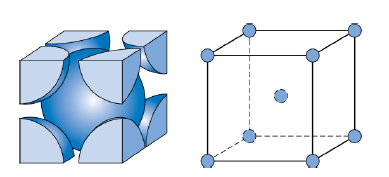
Just as there is a litany of different types of chemicals and bonding types in the universe, there is also a vast array of different types of crystal structures. One such crystal structure is the Body centered cubic crystal structure. In this type of crystal structure, atoms are located at all eight corners of a unit cube with another atom at the center. The atomic packing factor of a body-centered cubic crystal structure is 0.6802 and is commonly found in elements such as sodium

Substitutional solid solutions

Substitutional solid solutions

Substitutional solid solutions

04/01/17

“What happens when an element that follows the Hume-Rothery rules dissolves into another element?”
Given the right set of conditions, elements can dissolve into others elements. This means that the solute will lose its own pre-defined structure and are fused into the solvent. However, how does the solute merge into the solvent on a microscopic level? Well, let’s do as scientists do and observe. If an element follows the Hume-Rothery rules, then it probably has a similar size atomic size, packing structure, electronegativity, and affinity, and it probably looks and acts much like the solvent atoms. And if we observe closer, wouldn’t it be logical that an element so similar could pass itself off as the solvent atom and substitute itself into the original structure? Well, it turns out that such phenomena exist, and solutions of this type are known as substitutional solid solutions, and can be used to strengthen a material through impurities

Hume-Rothery rules

Hume-Rothery rules

Hume-Rothery rules

03/31/17

“How can we know if how an element will dissolve in a metal?”
I don’t know about you but all of the different types of elements simply astounds me. Just to think that by changing only a single proton of an atom the entire set of properties can change drastically. What’s even more exciting is that these different properties mean that elements can also combine in a myriad of different ways, such as by dissolving. And not only this, but there are even different ways in which atoms can dissolve in one another, specifically by forming a substitutional solid or an interstitial solid. So how can we predict which will happen? Well, let’s think about substitutional solids for a moment. We know that in order for an atom to be on the same lattice in a material (the substitute in substitutional), it must be of similar size (around 15%), have a similar crystal structure, be of the same valency, and have similar electronegativity. And if we want the element to be interstitial, we know that the element must be smaller than the original by at least 15%, show similar valency, and have the same valency. After working with such patterns for many decades, materials scientists have decided to term these rules the Hume-Rothery rules.

Tempering

Tempering

Tempering

03/29/17

“How can we apply heat treatment to strengthen a material?”
When doing practical engineering, we may have to strengthen the material of steel using artificial means. One method is to apply a heat treatment to change the inner structure of a material. But what is one such example of a heat treatment? Well, let’s think about it. We know that if we were to heat steel up to below the critical point, it will become a homogeneous solution of austenite (a solution of iron and carbon). If we were to then rapidly quench this steel, the internal structure would turn into a body-centered tetragonal framework. Finally, let’s “temperthis material at high temperatures such the steel becomes an ultrastrong phase known as pearlite. This process is known as tempering and is used to strengthen steel materials.

Heat treatment

Heat treatment

Heat treatment

03/28/17

“Can we make a material stronger using heat?”
Oftentimes, when we receive a material, it is not strong enough for any practical purposes. Because of this, there exists multiple material hardening methods to make up for such a case. One such method is known as heat treatment. Heat treatment involves the use of heat to change the physical properties of a material to more desired properties. Cold working (despite being based on cooling the object) is one example of a heat treatment process.

How crystal grains form

How crystal grains form

03/26/17

“How exactly do crystal grains form?”
The existence of crystal grains is one of the foundational aspects of materials science and engineering. However, how exactly do such phenomena form? Well, let’s use our scientific mindset to analyze it. We know that when a material is in its liquid form, it has no crystalline structure. However, as it cools down, a definite structure begins to formalize. However,  this process does not happen uniformly throughout the material but instead begins in a few points within this substance. As time goes on, these points will grow in their respective directions, and eventually will collide with the other crystal structures, forming crystal grains.

Lamellar microstructure

Lamellar microstructure

Lamellar microstructure

03/25/17

“What is the microstructure of materials during the Eutectic phase?”
For each material, it is well known that when the eutectic point is reached, the material will melt and decompose. However, have you ever wondered what the microstructure of this substance looks like during the reverse process? Well, let’s make an investigation. When a eutectic quickly cools down into two substances, the once conjoined phases must now be separated. This cause bands of alternating phases to be formed, thus forming a lamellar microstructure!