Author: Isaac Gendler

Power Homogeneous DE

Power Homogeneous DE

Power Homogeneous DE    02/16/16
Power homogeneous Differential equations are differential equations that can be written as a function of yx. One can easily recognize a power homogeneous Differential equation if it is written in the form y’= G(x,y)H(x,y). If the equation is in this form, then we can make a substitution v= yxand then put in all in terms of Y.

First Order Linear Differential Equations

First Order Linear Differential Equations

First order Linear Differential Equations   02/15/16
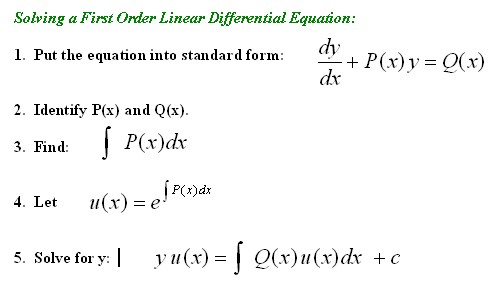
First order Linear Differential equations are some of the most fundamental types in equations found in an advanced calculus course. Differential Equations can be summarized in the form dydt +p(t)y=g(t). F.O.D.Es can be solved by using a handy teqnique known as the integrating factor, or (t) = ep(t). By multiplying both sides of the equation by this constant, the left hand side will be in the form of a result of a product rule derivative, and then can be neatly integrated

The Electric force

The Electric force

The Electric force         02/14/16
A most useful riveting concept found in the study of electromagnetism is the electric force. The electric force is defined as the at-a-distance interaction between two charge particles, described by the equation Felec=q1*q24**0*r2 . As one can discern, the Force is proportional to the strength of the two charges, a constant,  and the square of the distance between them. This equation is kindred in nature to the Universal Gravitation equation, substituting mass for electric charge and changing around the constants, a most intriguing symmetry found in physics. However, there is one glaring incongruity in the fact that the electrically charged particles can be either positive or negative, while mass can only exist in a positive value.

P N type semiconductors

P N type semiconductors

P N type semiconductors                  02/13/16
Silicon has an octet structure chemical structure, which means that it’s outer shell has four valence electrons. When sunlight strikes silicon, one of the electrons are jettisoned from the outer shell and is free to move around randomly within the material. However, for practical purposes, humans want it to move in one direction. This is accomplishable with the use of P and N type semiconductors. There  are two types, N and P type semiconductors. With the latter, a paltry amount of elements with 5 outer electrons are added, forming a bond with silicon as well as leaving one electron free. This free electron can be knocked in in a perfunctory manner by sunlight. P type semiconductors are bonded with elements that are one electron short ( a hole), therefore allowing for easy acceptance of an extra electron. N-type semiconductors conduct electric current through the transfer of electrons, while P-type conducts current through the transfer of “holes”. P and N types can then be amalgamated to create a P-N junction. In P-N junctions, the two types are put right next to each other, first causing an electrical exchange (the P-type will receive electrons and become negative and vice versa for N-types). When sunlight strikes the material, the free electron will be repulsed by the negatively charged P-type and be attracted to the positive N-type. And that is how solar panels work

Air resistance

Air resistance

             Air resistance                  02/12/16
An interesting conundrums appears for students of physics when considering Newton’s first law. If objects are supposed to go on forever in the vacuity of a net force, then why do objects on Earth slow down in the horizontal direction? The answer lies in the fact that when objects move through Earth’s atmosphere, they experience a phenomena called air resistance. Because air is a fluid, solid objects can be suffused in it as a surrounding medium. Analogous to objects moving in water, when one moves through the atmosphere, it comes into contact with air particles, causing minor but emergent impinging effects on an object’s motion. When all of these collisions amalgamate, a phenomena known as a drag force appears. This drag force is what causes all of the impinging effects. Because drag force is based off collisions with air particles which in turn are based off Newton’s third law, the drag force is contingent on an object’s velocity, so the faster one moves, the more resistance one experiences. An application of this is terminal velocity in free fall, a peculiar phenomena that all objects in free fall experience. When an object is in free fall, it accelerates which in turn causes it’s velocity to rise, However, as it’s velocity rises, so does it’s drag force, and consequently the velocity of the object will reach an apex, with the drag force balancing out the gravitational force, therefore causing constant velocity as a result of Newton’s first law.

Nuclear force

Nuclear force

Nuclear force             02/11/16
One comes in to an interesting quandary while studying the atom under Newtonian physics, if the protons and electrons are of opposite charges, then why don’t they attract each other and collide? The answer lies in the fact that there is a force present in the universe called the Nuclear force. The nuclear force is an enigmatic phenomena, being one of the most powerful forces in the universe but only present between particles at distances up to 1 ferometer (1*10^-15 m!). When active, this force is what keeps the electrons floating around in the orbit of the nucleus.

Neutrons

Neutrons

         Neutrons                      02/10/16
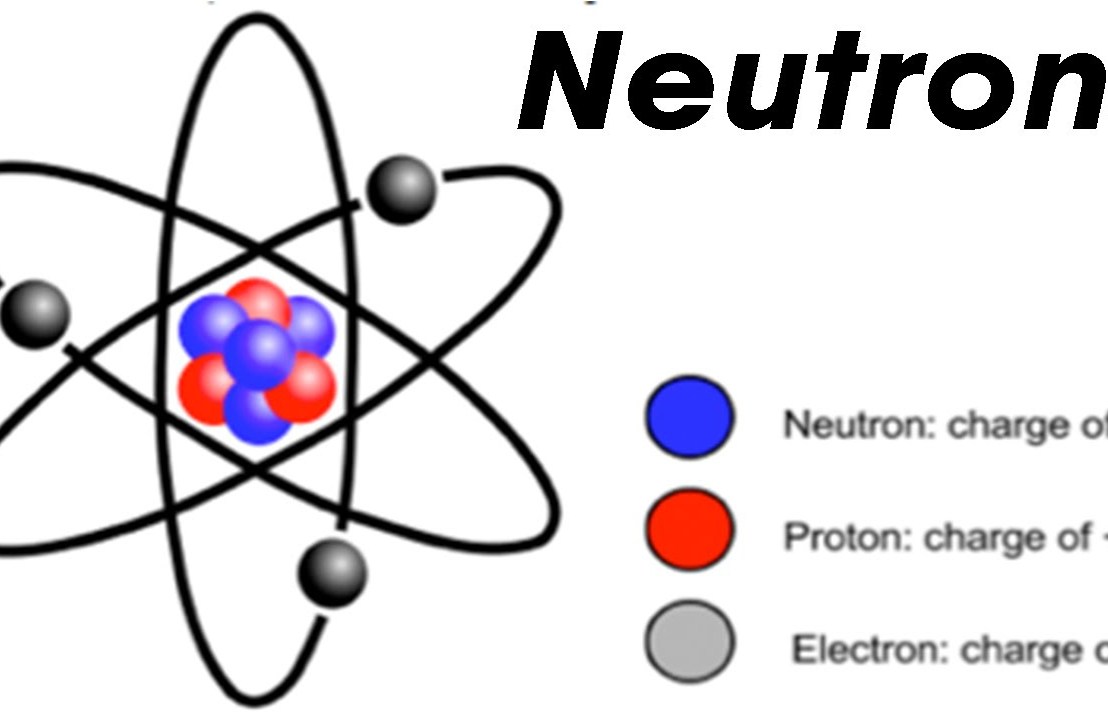
Neutrons are one of the most fundamental particles in the universe.Neutrons are located in the nucleus (along with protons) and have no observed electric charge, hence the name Neutron. Neutrons, protons, and electrons are bound together by the nuclear force, which will be explained later. An excess of neutrons in an element can make an atom a heavy one, which in turn makes it more prone to radioactive decay.  

Conservation of momentum

Conservation of momentum

Conservation of momentum  02/09/16
One of the most fundamental principles of Physics is the conservation of momentum. The theory of the conservation of momentum states that there is a quantity called linear momentum which is proportional to the product of an object’s mass and translational velocity. In addition, there is also angular velocity which is proportional to an object’s moment of inertia and angular momentum. This concept is one of the most pertinent to a student’s knowledge.