Author: Isaac Gendler

Hooke’s law

Hooke’s law

   Hooke’s law  02/25/16


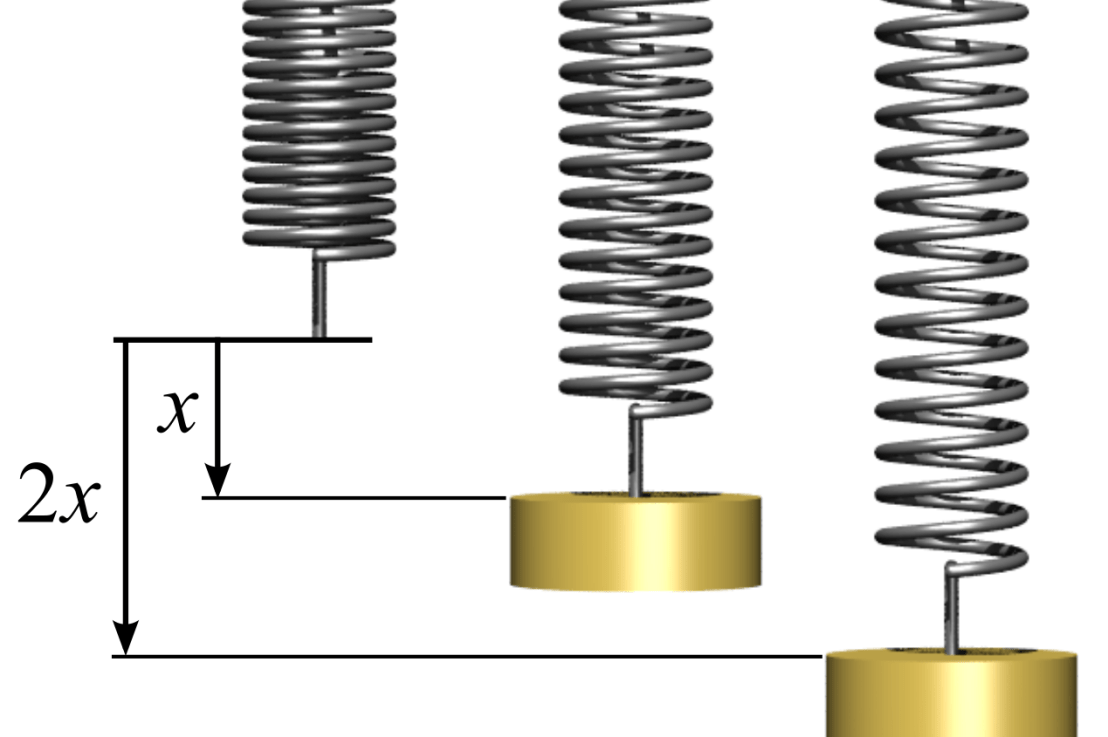
Have you ever wondered why the force of a spring appears to grow stronger as you pull it out? This physical phenomena can be explained with the simple use of Hooke’s law. Hooke’s law states that the force of a string can be measured with the equation Fspring=k*x, with k being the spring constant and xbeing the change in distance from the resting point. The Spring constant can be found empirically by measuring the force’s change over a distance and finding the slope. we can integrate this equation in respect to x to find the potential energy of the object to obtain Uspring=12*k*x2. As one can infer, the more we stretch it out, the more potential energy is in the system, and consequently the more kinetic energy it will have when it reaches the starting point, allowing it to reach a further displacement once again.
Young’s modulus

Young’s modulus

Young’s modulus        02/24/16
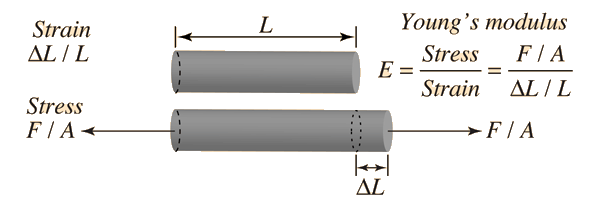
Have you ever wondered why a solid body deforms when stress is applied to it? This is a consequence of Young’s modulus. To get the big picture, Young’s modulus is a property of mechanical bodies that defines how much the body deforms under stress. Before we begin, we must define the terms stress and strain. Stress is the internal forces that neighboring molecules of an continuous material apply to each other (equation is ()=FA0, Force over original area), while strain is the measure of deformation of a material (=LL0, change in length over original length). Young’s modulus is the measure of the proportion of these factors E=()which results in F*L0A0*L. The higher a bodie’s young modulus is the more resistant it is.

Wind turbines

Wind turbines

Wind turbines         02/23/16


Wind turbines are one of my favorite parts of Engineering. Wind turbines work by transferring energy from the wind into a spinning shaft (mechanical energy) which rotates a generator which converts all of that into electrical energy. There are two types of wind turbines, vertical axis and horizontal axis. In the latter, the larger profile allows it to catch more wind but the tower is higher and it is more complicated to build, while the former is easier to build/design/maintain but catches less energy as an offset. The part of the turbine that catches wind with blades and converts it to mechanical energy is called the rotor. One possible design for a wind turbine is known as the drag design, which uses a turbine whose axis of rotation is perpendicular is to the movement of the wind to catch the drag force provided by the wind as energy. This design is slower moving but provides a heavier torque, making it useful for tasks such as lifting water or hay 9 your stereotypical dutch farm activities) A more modern design is the lift design, which uses a rotor facing the wind movement to use the lift force caused by an asymmetric blade profile. Lift based mechanisms have a much higher rotation speed than drag types and therefore make excellent candidates for electricity generation.


The number of blades on a wind turbine can have a multitude of effects on a wind generation system. Increasing the number of blades increases efficiency at a diminishing rate. Going from one to two blades gives us a 6% increase in efficiency while going from two to three blades gives us a 3 percent efficiency. typically, the less amount of blades, the lower material and torque needed. Rotor blades are always twisted to account for a changing angle of attack, explaining the curved structure. The theoretical power generated by a wind turbine is given by the equation Power = 1/2**A*v3, with being the wind density Abeing the area of the profile andvbeing the wind velocity. The Betz limit is the theoretical efficiency of a wind turbine, given at 59.3 percent. However, most commercial systems operate at around 10-30 percent.
Wind turbines have contain a generator which converts mechanical energy into electrical energy, and transmission which increases the rotation rate of a generator to accomplish an efficient electricity generation rate. The cut in speed is the speed in which a turbine will generate usable power, typically between 7 -15 mph. The Rated speed is the speed in which a wind turbine will generate it’s designated power, typically at around 25-25 mph. To account for dangerously high wind speeds at around 45-80 mph, most wind turbines have a cut out speed feature which shuts down the wind turbine using a versatile repertory of methods. Tower heights are usually two to three times the blade diameter to account for efficiency.

Angular momentum

Angular momentum

  Angular momentum   02/21/16
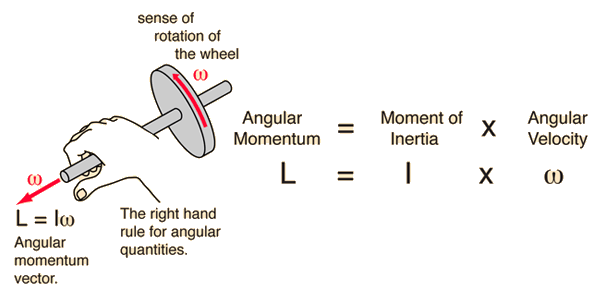
During one’s course of study of physics, one may encounter a concept known as angular momentum. Since momentum is defined as the product of the mass and movement of an object, wouldn’t it follow that there would be a special type of momentum for rotational systems, even if there was no translational movement? This quantity is known as Angular momentum. The mathematical formulation for angular momentum is given as L=I, where Iis the moment of inertia of the system and is the rotational velocity. Angular momentum can also be reformulated as L=r x p, where r is the radius, pis the linear momentum and the angular momentum is the cross product between them. Like linear momentum, Angular momentum is always conserved.

Energy Efficiency

Energy Efficiency

Energy Efficiency 02/21/16

As a result of the second law of thermodynamics, the phenomena of a one hundred percent energy efficient system exists in human imagination only. Consequently, the energy efficiency of systems can be measured. If you take the percentage difference between the input power of a system and the amount of work it does, then you have just measured the energy efficiency. This has a pertinent application to the field of Engineering, where maximum efficiency is paramount. For example, the energy efficiency of most commercial solar cells is between 15-20%, so 15-20 percent of the energy taken in from the sun is transferred into usable work.

Differential Equations

Differential Equations

Differential Equations    02/20/16


During one’s study of calculus, one may encounter a peculiar set of derivatives known as Differential equations. Differential equations ae equations in which the derivative of the function is proportional to the function itself, examples including dydx=kyand dydx=y+x. These equations can not be solved through ordinary integration since we would be integrating in respect to a separate variable (yand dx), so one must use a method called separating and integrating, which involves moving the dxto the right side and all of the y’s to the left side (our first example would become dyy=kdx)and then integrate in respect to their variables. This is how the Exponential function comes into existence. Differential equations have an extensive range of application to other branches of science, particularly Physics, Economics, Biology, and Engineering. In fact, Differential Equations are so useful that there is an entire class at Universities dedicated to them that all Physics and Engineering majors must take!

Electric force

Electric force

Electric force 02/20/16

A most usefull riveting concept found in the study of electromagnetism is the electric force. The electric force is defined as the at-a-distance interaction between two charge particles, described by the equation Felec=q1*q24**0*r2 . As one can discern, the Force is proportional to the strength of the two charges, a constant,  and the square of the distance between them. This equation is kindred in nature to the Universal Gravitation equation, substituting mass for electric charge and changing around the constants, a most intriguing symmetry found in physics. However, there is one glaring incongruity in the fact that the electrically charged particles can be either positive or negative, while mass can only exist in a positive value.

Exact Differential Equations

Exact Differential Equations

Exact Differential Equations 02/19/16


During a course of study through Differential Equations, one may encounter a set of problems known as exact differential equations. Exact Differential equations are usually from a result of a differentiation of a multivariable function, and usually come in the form M(x,y)+N(x,y)dydx=f(a,b)’=0 with f(a,b)=c and M(x,y)is assumed by be the partial with respect to x and N(x,y)is assumed to be the partial in respect to y. One can check if this is an Exact DE by differentiating M in respect to y and N in respect to x and checking if it’s valid (Since f(x,y)xy=f(x,y)yx). If these are equal, we then integrate M(x,y)in respect to x to get back f(x,y). However, instead of a constant, we use a function of y h(y)since differentiating a y-based function in respect to x will nullify it. We then derive our new f(a,b)in respect to y and set f(a,b)’=n(x,y)and use the remainder to find h(x,y)’. Once we do that, we integrate h(a,b)’with respect to y and then add it to our equation and set it all equal to 0 to complete everything. That is how we solve such equations

CAD software

CAD software

CAD software 02/18/16


In my humble opinion, CAD software is one of the single greatest inventions created by the human species. CAD is short for Computer Aided Design, and this software allows for humans to accomplish one very important goal, the geometric design of Engineering systems. For all of human history, humans were limited to simple 2-dimensional sketches which required abstract visualization and therefore was more taxing on the brain. CAD software, however, allows a user to edit a 3-D model of an object with a repertory of different tools, Which consequently allows Engineers to be more free form and dynamic in image generation. One starts by making a 2-dimensional “sketch” and then protruding to create a 3-dimensional image.One can also sweep and revolve an sketch for other forms of 3-dimensional manipulation. CAD software really brings out the creative side of Engineering in designing parts and tools for use. CAD software also lets users simulate stresses to test ut different parts of an element.