Author: Isaac Gendler

Magnetic fields

Magnetic fields

     Magnetic fields  03/05/16
The study of magnetic fields are one of the most pertinent applications to the study of physics. Magnetic fields emanate out of the “North pole” of a magnet and emanate towards the south pole of a magnet (so technically the naming of the poles of the Earth are switched around). As a consequence of Maxwell’s equations, moving charges emit electric fields, so there is always magnetism around currents. The magnetic field only has an effect on moving charged particles that are not parallel in direction to it, since the equation for magnetic force is  F=qv x B, With q being the charge v being the charge velocity and B being the magnetic field.

Incandescent light bulb

Incandescent light bulb

Incandescent light bulb 03/04/16
One of the most important inventions ever created in human history was the incandescent light bulb. The incandescent light bulb works works by passing an electric current through a filament and heating it until it reaches an extremely high temperature. Once this high temperature is reached, light will start radiating out of the light bulb due to spectrum emission. Incansdescent lightbulbs are highly inefficent, as they only use 2.2% of the energy passed in to them.

Gauss’ law

Gauss’ law

Gauss’ law 03/03/16


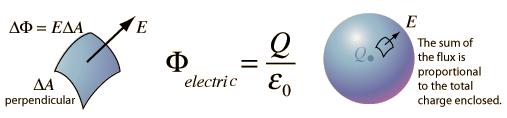
A very interesting way to find the number of charges in an electromagnetic system is to use a technique known as Gauss’ law. Gauss’ law states that if you were to create a geometric surface surrounding the charge distribution and if you were to summate the normal of the total number of electric field lives going through the surface, you would obtain the charge divided by the vacuum permittivity. To put this symbolically, Eda=q0, We can use this concept to find the electric fields in a much simpler fashion that using coulomb’s law.

Birefringence

Birefringence

Birefringence  03/02/16


One of the most perplexing phenomena in the field of optics is that of birefringence. Birefringence is an optical property that depends on the polarization and direction of light. As a result of a peculiar chemical lattice structures, when light strikes birefringent materials, the light splits into two angle of incidences, causing two beams of light to shine. This effect can be induced in a number of ways, one of which is mechanical stress being applied. This effect was stdied by Sir Isaac Newton when he decided to investigate a material known then as the Iceland Spar.

The Rutta Kunga method

The Rutta Kunga method

The Rutta Kunga method        03/01/16

Numerical analysis is one of the most pertinent topics in the field of applied mathematics. The first technique a student learned, euler’s method, is often too inchoate and ineffective for higher accuracy problems. Consequently, the Rutta Kunga methods was developed in response for such a problem. suppose we have a differential equation y’=f(x,y). We then use this really complicated equation yn+1=yn+x6*(k1+2k2+2k3+k4), with k1 =f(xn,yn), k2=f(xn+12x,yn+12*k1*12*x), k3=f(xn+12x,yn+12*k2*12*x), k4 =f(xn+x,yn+k3x). And then magic happens and you get a really really accurate answer after you account for all of the step sizes

Existence and uniqueness for differential equations

Existence and uniqueness for differential equations

Existence and uniqueness for differential equations   02/29/16


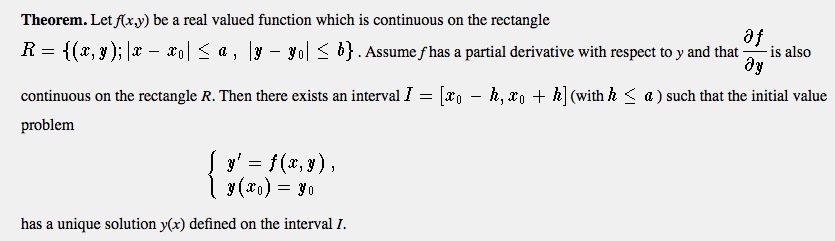
One of the quandaries that a student of mathematics must face is proving existence and uniqueness for differential equations. Suppose we come across a differential equation dydx=f(x,y)with the initial value y(a)=b. If we want to prove that a solution exists for some xvalue, then we just have to discern if f(x,y)is continuous “near” some value (a,b) then a solution does in fact exist. Furthermore, if we would like to find if the solution is unique same near the same (a,b) value we have to take the partial derivative f(x,y)yand observe if it is continuous near (a,b)

Turbines

Turbines

   Turbines   02/28/16
During one’s study of Mechanical Engineering, one of the most pertinent aspects of focus is turbines. Turbines are mechanical devices that are used to collect useful energy from fluids and turn it into usable work. Usually, when a fluid becomes contingent with the blades of a turbine, then some of the kinetic energy is imparted on to the turbine, causing it to spin and thereby creating work. Turbines are used for a plethora of tasks, such as making energy through steam turbines or propelling ships such as dreadnoughts.

Dreadnoughts

Dreadnoughts

        Dreadnoughts      02/27/16

One of the most riveting ships in all of naval design is the dreadnought. The dreadnought uses a steam turbine driven engine to propel itself at great speeds. In addition, the dreadnought had a “big gun” design in which much of the focus of construction went into manufacturing a vast array of insurmountably powerful heavy weapons. In addition, the metallic armor made shielded the dreadnought from many potentially fatally lethal attacks. This combination of speed and power encased in a metallic fortress made the dreadnought strike fear into the hearts of all enemies. Dreadnoughts were introduced by the British navy in 1906, and were soon retired after WW1.

Electric current

Electric current

Electric current 02/26/16


Have you ever wondered how electricity flows? This phenomena has been labelled by Scientists and Engineers as electric current. When there is a voltage difference within a conductive wire, a flow of electrons occur between this voltage difference. The formula for current is given by the equation I=dqdt, where qis the amount of charge flowing and tis the time. There are two types of current found in Engineering, DC (direct current) and AC (alternating current). In direct current, the flow of electrons is a constant, perpetual unidirectional motion, while in Alternating current it oscillates back and forth.