Author: Isaac Gendler

Microscopic scale

Microscopic scale

  Microscopic scale               04/28/16


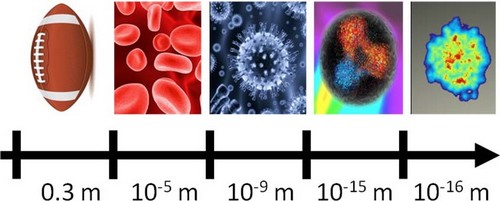
One of the most bewildering properties of the material world is that of the microscopic scale. Objects in the microscopic scale are often unable to be viewed by the human eye, and require advanced instruments such as microscopes to be observed. If one goes miniscule enough, then the realm of quantum mechanics will come in to effect, heavily distorting all known conceptions of reality.

 

Macroscopic scale

Macroscopic scale

Macroscopic scale        04/27/16


In the study of thermodynamics, the Macroscopic scale is defined as the scale in which phenomena can be seen by the naked eye. This stands in contrast to objects on the microscopic scale, which requires the use of advanced equipment to observe. Examples of phenomena on the macroscopic scale include newtonian objects, smoke, and quite frankly everyday life.

Fundamental matrix

Fundamental matrix

Fundamental matrix  04/26/16


A Fundamental matrix is a very interesting application f matrixes. Suppose you have a matrix solution x(t) y(t) = C1[A(t),C(t)]+ C2[B(t),D(t)], then you put the following into a 2×2 matrix (t)=[A(t),B(t),C(t),D(t)]and multiply by the inverse matrix evaluated at 0, or (0)-1

Hydrostatics

Hydrostatics

Hydrostatics                  04/25/16


Hydrostatics is the study of the physics and applications of incompressible fluids at rest in stable equilibrium. The weight of a fluid displaced in water can be expressed symbolically as F=*V*g, where is the fluid density (assumed to be constant) Vis the volume, and g is gravity of the planet. The pressure on a liquid submerged in a fluid can be calculated at P= gh+P0, where Pis the pressure his the vertical displacement and P0is the atmospheric pressure (or the pressure at the top of the fluid surface). The study of hydrostatics is of fundamental importance to the field of Mechanical Engineering

Environmental stress cracking

Environmental stress cracking

   Environmental stress cracking                 04/24/16


One of the most common unexpected brittle failures of all thermoplastic materials is environmental stress cracking. ESC occurs when polymers are exposed to liquid chemicals that accelerate the crazing process, which results in cracking at pressures below standard air temperature. The study of ESC has application within the automobile industry, where the need to keep polymers stable is paramount

Brittleness

Brittleness

Brittleness          04/23/16


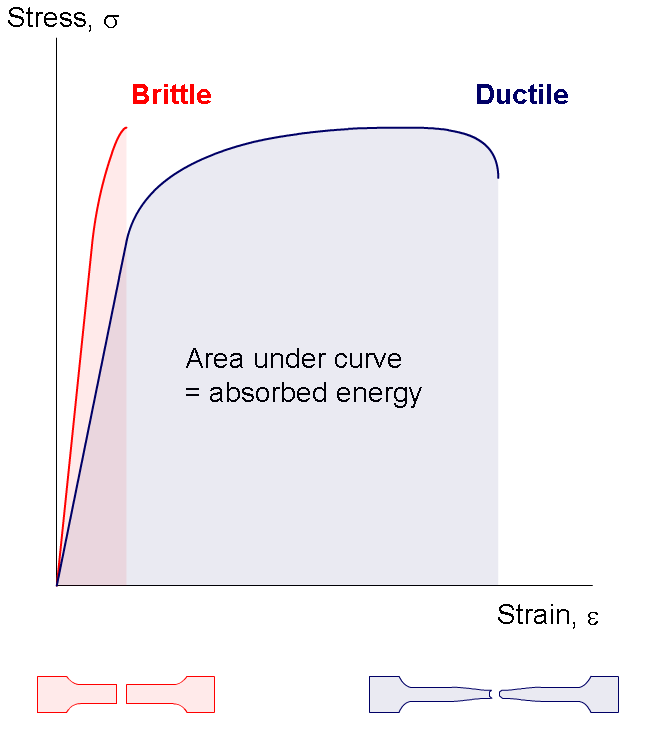
An object is considered brittle if it breaks from stress without significant deformation. Such an object requires little energy to be broken. The brittle strength of an object can be increased by subjecting it to pressure.

Thermoplastics

Thermoplastics

Thermoplastics         

        04/22/16


Thermoplastics are plastic materials that become pliable once a certain temperature threshold has been reached and revert back to being rigid once cooled to a certain temperature. The amorphous nature of thermoplastics are less susceptible to chemical attacks and environmental stress cracking due to lacking such a clearly defined structure. Teflon is an example of an application of thermoplastics

Solving first order systems using matrices

Solving first order systems using matrices

      Solving first order systems using matrices               04/21/16


Suppose we have a first order system with equations x(t)’ =ax(t)+by(t)and y(t)’=cx(t)+dy(t). We can solve these equation by putting the equations into a matrix form. The matrix will end up with a, b, c, and din progressing order. By taking the determinant, we can find the eigenvalues. We then transform this in to what looks like a solution to a second order differential equation C1*e1t*V1+C2*e2t*V2. We then solve for x(t)and y(t), with the front and bottom rows for the vectors are correlated with the x(t)and y(t)respectfully.

Auxiliary view

Auxiliary view

Auxiliary view                          04/20/16


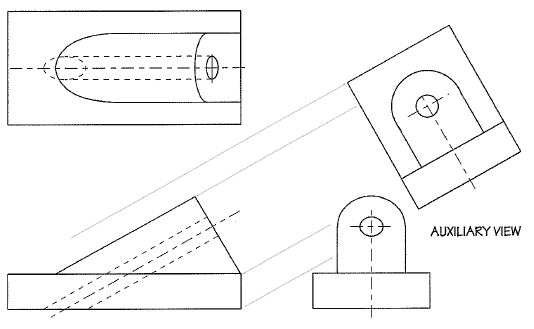
When doing Mechanical Engineering design, many parts often have slanted platforms. These platforms usually become distorted when created using the standard top-front-right views, so Auxillary views were created in response. Auxiliary views take a snapshot of the object from a viewpoint that is centered on the slanted object. This makes it so the object is much easier to visualize. Often, a partial auxillary view is often used so only the important details of the slant are seen (much of the non slanted slide of the part is often unnecessary and becomes distorted itself when viewed through the auxiliary view).