Month: March 2018

Solar Water Disinfection

Solar Water Disinfection

Solar Water Disinfection

03/22/18

“How can we use solar energy to purify water?”


Water is one of the most vital parts of human life. Whether it be for quenching our thirst, cooking our food, or running our industrial processes, water is somewhere to be found. However, in many communities around the world, not only safe drinking water difficult to come by but also access to electricity. So how can we use our engineering mindset to solve both of these problems in a sustainable manner? Well, what if we were to use a solar panel to power an electrolysis device? This way, we can purify water anywhere we are at a low cost. This process is known as Solar Water Disinfection and is a smart method to help solve access to clean water.

Hot-filament Ionization Gauge

Hot-filament Ionization Gauge

Hot-filament Ionization Gauge

03/21/18

“How can we measure the pressure in a vacuum?”


Vacuums are some of the most important phenomena in modern day engineering and physical science research. By being able to measure them, we can determine what is and what is not a vacuum. One way to do this is by using a hot-filament ionization gauge. Hot-filament ionization gauges work by running electrons through a wire coil, which are then attracted to a central grid. These electrons will collide with gas molecules and will ionize. A measurement of the amount of ionization will tell us how many molecules are in the vacuum, and therefore what percentage of the surrounding medium is a vacuum.

Platform Thinking in Energy

Platform Thinking in Energy

Platform Thinking in Energy

03/20/18

“What is the next paradigm shift in consumer utilities?”


The world of consumer utilities is changing very rapidly. The days of centralized, controlled distribution are dying to make way for the new peer-to-peer sharing networks. Consumer utilities are starting to take note, and a new type of business governed by platform thinking is starting to take hold. Platform thinking is where businesses start thinking about making platforms instead of products. Take twitter for example. Twitter does not make any actual content but instead allows others to make it for no charge. The same type of thinking can be applied to energy, instead of focusing on making the actual electricity, utilities can instead focus on helping consumers distribute it to each other.

Thermocouple Reference Junctions

Thermocouple Reference Junctions

Thermocouple Reference Junctions

03/19/18

“How can we properly calibrate thermocouples?”


Thermocouples are very useful for measuring temperature differences due to their quick response times and low costs. However, in order to operate accurately, they must be connected to a zero degree reference point. So how can we use our engineering knowledge to solve this? Well, what if we were to simply connect the thermocouple leads to copper wires in ice water. These would create reference junctions in which the thermocouple leads would be compared against values at 0 degrees Celsius. This system calibrates the thermocouples to much greater accuracy, but extra care must be taken.

Hexadecimal Numbering

Hexadecimal Numbering

Hexadecimal Numbering

03/18/18

“How can we use a base 16 numbering system?”


Binary numbers are fundamentally a one-bit system, either on or off. However, computational systems are now so large that sometimes reading all of those bytes can be difficult. So is there a way that we can shorthand it? Well, what if we were to use a system that could represent 4 bytes at a time? This is known as Hexadecimal Numbering. Hexadecimal Numbers 0-9 are represented by their respective numeric values, while 10 -15 are represented by A-F. Hexidecimal numbers are an underpinning of modern computational systems.

MOSFETs

MOSFETs

MOSFETs

03/17/18

“Can we control the conductivity of a circuit with Voltage?”


When working with electrical systems, sometimes we may want the conductivity of an element to change for different applications. However, how can we do that without doing too much work? Well, let’s use our engineering mindset to think of a solution. First, let’s build a semiconductor with two n-type depletion layers that are disconnected from each other by a p-type substrate. Then let’s position a metallic “gate” near to the two n-type inversion layers. Finally, let’s put a current source to one and a drain to the other. When we apply an electrical voltage to the gate, negative particles from the positive substrate will be pulled in its direction and p-type pushed out. This will create a bridge between the two n-type regions, and allow current to pass through. The more voltage applied, the more current can be passed. If no voltage is applied, then no current can pass! This device is known as a metal-oxide-semiconductor-field-effect transistor, or MOSFET for short. MOSFETs are some of the most used components in electronics and can be found everywhere from microcontrollers to voltage amplifiers.

Picomotors

Picomotors

Picometers

03/16/2018

“How can we turn a screw with high-precision?”


When working with high-precision machinery, we often want to be able to turn a screw in a very controlled manner. However, doing so manually is quite a complicated task. So how can we use our engineering mindset to solve this problem? Well, let’s start with some mechatronic theory. We know that if we energize a motor, it will move rotationally. And if it does so in a belt-train system, then the entire system will move. Furthermore, if we attach a piezo on the lower chain, then it can push back in response to pressure. So what if we were to combine all of these aspects into one unified system? Well, we would then obtain a very useful engineering instrument known as a picomotor, and can be found in precision motion devices everywhere.

How California Might Share its Renewable Resources

How California Might Share its Renewable Resources

How California Might Share its Renewable Resources

03/15/18

“Why and how might California share its renewable energy resources?”


For decades, the vast majority of energy in California has been controlled on it’s regional grid called CALISO. Because only California appointees can sit on its board, other U.S states have been reluctant to join. However, with the exponential rise of its solar energy resources, too much energy is being generated during the daytime. So much so, that California is thinking about working with its close neighbors Oregon, Washington, and Nevada to set up a regional energy grid. This way, overflowing energy from California can be sent to these states, and other forms of renewable energy can be traced back to California to manage its own demand!

Hawking Radiation

Hawking Radiation

Hawking Radiation

03/14/18


To the great sorrow of the world, the great physicist Stephen Hawking has passed away today. To celebrate his life, we here at Isaac’s Science Blog thought that it would be appropriate to write about his most famous work, Hawking Radiation.


“What was Stephen Hawking’s crowning achievement?”


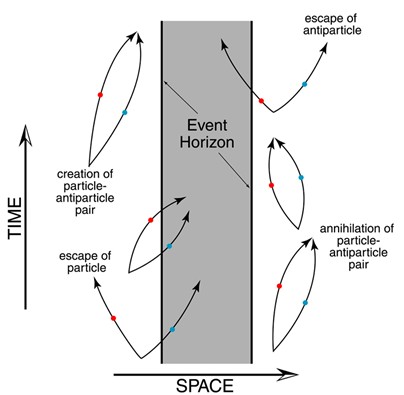
Let’s think about something for a second. Black Holes are usually thought of as sinks where nothing, not even light can escape. But a few decades ago a very different thinker with the name Stephen Hawking came and looked at these phenomena very closely. After some further research, he found that these black holes actually emit something called Hawking Radiation, or a collection of photons, neutrinos, and other massless particles. An astonishing consequence of this is that since black holes lose this matter over time, they actually shrink and shrink until they completely disappear! This development led to Stephen Hawking receiving many prizes and honors. So on this day forward, let’s take some time to think about all of the contributions this great mind has done for science.