Month: March 2017

Diffraction grating

Diffraction grating

Diffraction grating

03/04/17

“What happens when we shine wave through a large chain of small holes?”
Optics is a most enjoyable branch of science. And one of it’s most peculiar facets occurs from a most simple setup. Suppose that one were to have two sheets of metal facing each other. Then one were to cut a large number of rectangular holes evenly spaced throughout one sheet and finally shine a light upon it. What exactly would happen? Well, let’s use our knowledge of science to figure this out. We know that when a ray of light hits a small opening, a wave will be produced. And we also know that when waves interfere with one another, a superposition will be produced. Now let’s apply this to this physical system. The light incident upon these holes will produce many waves, which will then collide on the opposing sheet. These waves will then either interfere constructively or destructively with one another, causing a pattern of bright and dark spots to occur. These spots will be spaced from one another in a ratio corresponding to the wavelengths of the light beams, the width of the diffraction gratings, and the distance between the two sheets
Screw dislocation

Screw dislocation

Screw dislocation

03/03/17

“What happens when a shear stress acts upon a crystal lattice?”
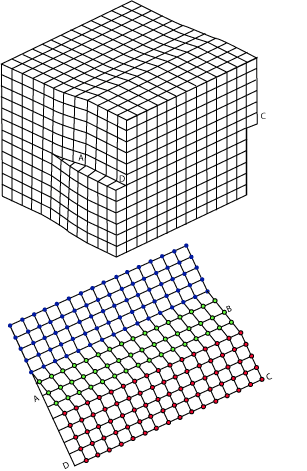
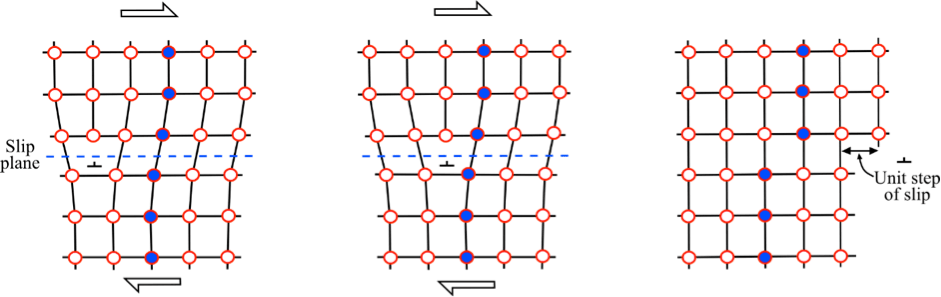
Crystal lattices are prone to imperfections, such as line defects. However, what happens when the crystal pattern experiences a shearing effect? Well, let’s use our scientific mindset to investigate this issue. Well, this will cause a rupture in the geometry which will result in a phenomenon known as a screw defect. Screw defects are so named due to the fact that if one were to walk from one edge of the dislocation to the other without jumping or falling, a screw like path would be formed.

Line defects

Line defects

Line defects

03/02/17

“How do we classify one-dimensional defects in crystals?”
Crystals are well-known for their ever repeating structure. However, because of the intricacies of nature, these patterns are bound to have flaws. One such flaw is when the repeating pattern fails to be in a straight line, curving and bending. So how do materials scientists and engineers classify these materials? Well, after many years of hard work and research, these phenomena have been termed line defects. Owing to the fact that these defects are one-dimensional in a three-dimensional world, there are numerous forms of different line defects out there

True Stress-Strain diagrams

True Stress-Strain diagrams

True stress-strain diagrams

03/01/17

“Why is there a negative slope on a stress-strain diagram and how can we fix it?”
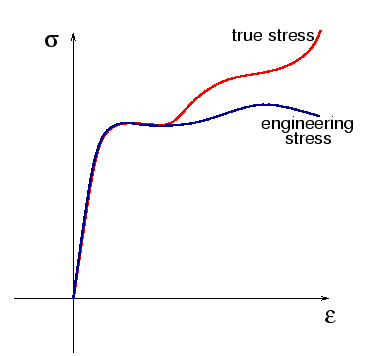
The stress-strain diagram is probably one of the most used concepts in all of engineering. However, there seems to be one counterintuitive aspect to it. Specifically, after the ultimate strength is reached, the stress-strain slope seems to become negative. This can’t be, since the stress can only increase with strain, not the other way around. So what exactly is behind this incongruity? Well, it all comes down to one simple fact. When constructing an engineering stress-strain curve, the cross-sectional area of the object is assumed to be static. However, due to the law’s of Poisson’s ratio, an elongation in length must be countered by a decrease in the associated cross-sectional area. And since this cross-sectional area will have s smaller capacity to carry force, the force distribution will go down. Therefore, if we do not include an updated area with the force, the stress will decrease with strain. Structural Engineers and Materials Scientists have recognized this flaw and have created true stress-strain diagram in response, which uses an ever-changing cross-sectional area. True stress-strain diagrams never have negative slopes, and are commonly used for research purposes.