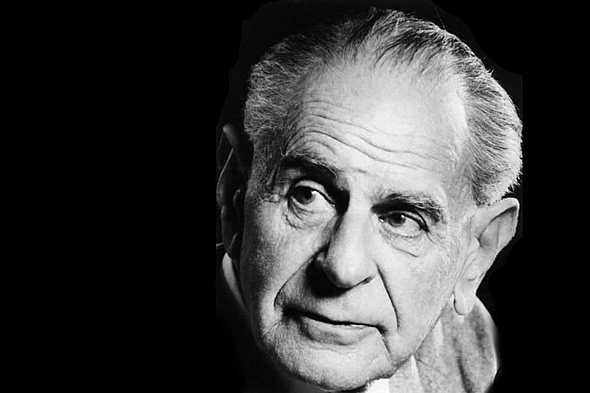
Karl Popper’s theory of falsification
11/03/16
“How can we tell if a theory is scientific?”
In the world, you probably hear the word “theory” tossed around alot. And in many cases, these proposed “theories” masquerade themselves as scientific when in reality they are nothing more than mere confabulations. So how can we discern what is and is not a true scientific theory?
Well, thanks to the work of the great philosopher of science Karl Popper, we have a tool known as falsification to assist us. The primal idea behind this idea states that a theory can only be scientific if you can falsify it. In plain terms, this means that if you are unable to construct a tenants or experiment that could disprove one of the tenants of a theory, then the theory is not scientifically valid. To illustrate, let’s take a scientific theory (Einstein’s theory of relativity) and a non-scientific one (Freudian repression) and compare them. Einstein makes a very specific claim that massive objects will cause light to noticeably bend around them. If we were to construct an experiment that would show that this phenomena does not occur under the prescribed conditions, then you would effectively be able to disprove Einstein! However, innumerable experiments have been carried out and none have succeeded in destroying Einstein, therefore showing that Einstein’s theory holds empirical rigor. In contrast, it is impossible to set up an experiment to show that Freud’s theory of repression has any factual strength, therefore becoming unusable. With this tool, we can clean all of the grime of misconceptualization that pollute the machinery of our critical thinking ability. So to summarize, when it comes to scientific theories, if you can’t reject it than you can’t accept it.

 Isaac's Science Blog