Month: October 2016

Osteoporosis

Osteoporosis

Osteoporosis

10/13/16

“What happens when bones weaken as they get older?”


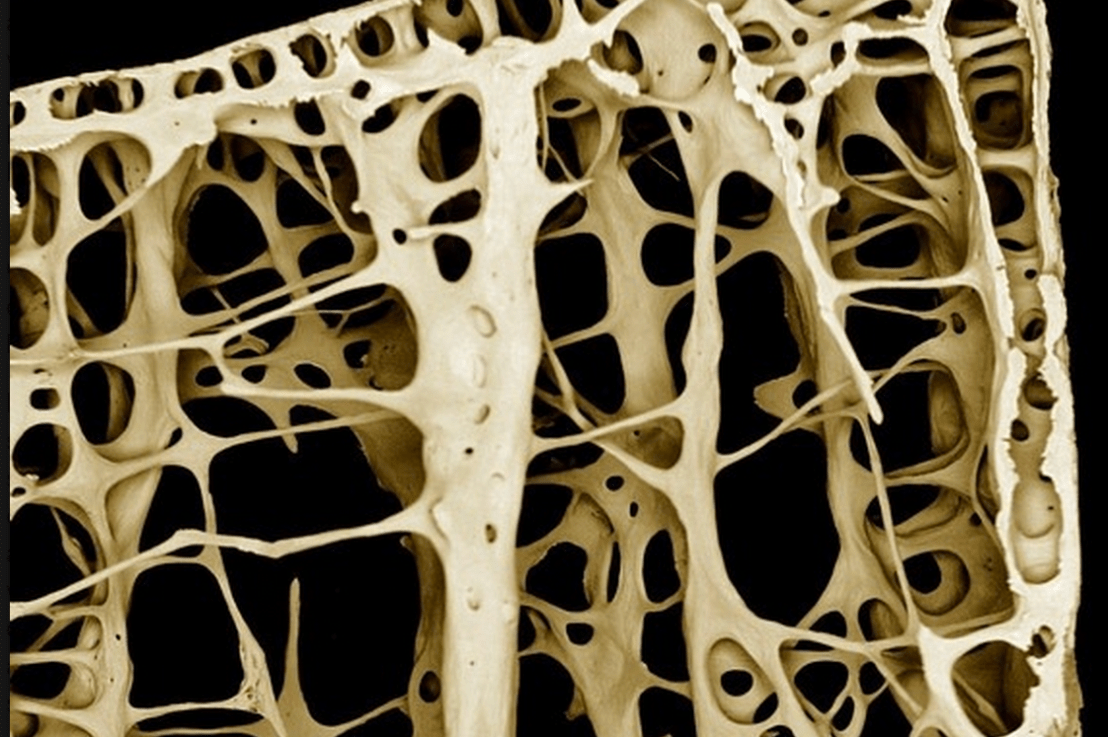
The human body changes throughout it’s lifetime. And as one approaches an older age, the bone structure in the body begin to weaken. Specifically, the holes in cancellous bones will become exacerbated and largen, causing a loss in bone density. This loss in bone density reduces the strength of human bones. This brittleness could lead to bone fracture in case of an unforseen accident, such as a falling event. Doctors have termed this condition osteoporosis. To prevent the onset of osteoporosis, one should commit to a weight-bearing exercise and a diet full of vitamin-D and calcium

 

Bone joints

Bone joints

Bone joints

10/12/16

“What holds all of the different parts of a skeleton together?”
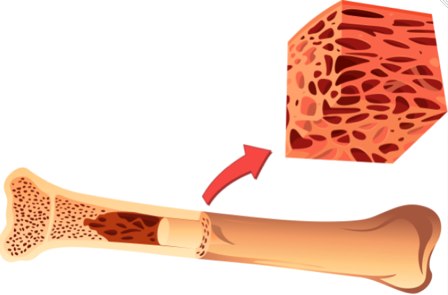
Skeletons are quite complex structures. The average adult human skeleton holds around 206 individual bones in it’s composition! However, how what connects these bones all together, and what allows for their range of movement? Well, much like a mechanical machine, these bones are connected to each other through the use of elements called bone joints. Bone joints come in three different types of varieties: Fibrous (allowing for no movement between the connections,), cartilaginous (allowing for limited movement), and synovial (allowing for full movement). Fibrous joints are utilized in skull connections, cartilaginous joints in back vertebrae, and synovial joints are used in the knees.

Bone marrow

Bone marrow

Bone marrow

10/11/16

“What is the tissue that fills the center of bones?”


Bones are quite sturdy structures. A cubic inch of this material can sustain the weight of five pickup trucks. However, what exactly is at the center of bones and what functions do they perform? Well, it turns out that a quite peculiar bone marrow is what fills the interior of bones. Bone marrow is a soft and spongy in nature, and it contains stem cells. Stem cells are analogous to workers that have not yet been given a function. These cells are nascent and have no use, but they can be specialized to perform become cells that create new parts of the body such as cartilage, muscles, blood cells, and even other bones! Bone marrow is vital for the health of a human body.

Cancellous bone

Cancellous bone

Cancellous bone

10/10/16

“How can something as rigid as bones allow for flexibility?”
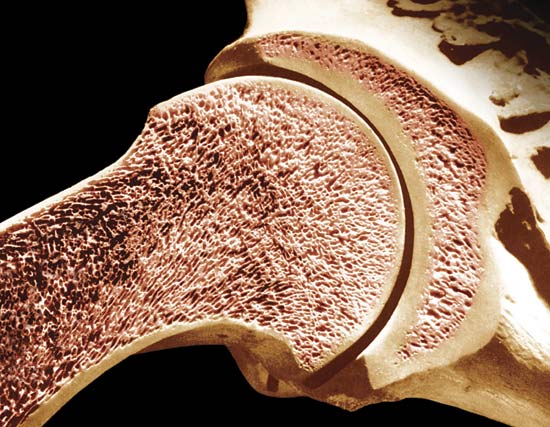
Bones are one of the most fundamental aspects of human physiology. Without them, the human body would just be a pool of flesh, tissue, and organs! However, this rigid quality of bones has potential drawbacks, such as inflexibility and weakness to sudden stresses, and as a result, the body will require some form of flexibility from these structures. However, how does the body solve this problem? Well, luckily for us, human physiology have evolved past this problem through the use of cancellous bones. Cancellous bones are bones that contain sponge-like holes through throughout their structure. These holes not only allow for blood vessels to be transported through them, but most importantly allow for structural flexibility. These holes can be likened to a biological shock absorber, absorbing and damping incoming shocks to prevent the breakdown of the structure. These cancellous types make up 20 percent of the human bones, the other 80 percent being the standard solid compact bones. What is most interesting is that to maximize both flexibility and cohesion, cancellous bones are sometimes enveloped by a shell of compact bones!

Turbogenerators

Turbogenerators

Turbogenerators

10/09/16

“How can we use turbines for generating power?”
Turbines are excellent machines for extracting power. However, how can we use this knowledge to further apply it to generate large amounts of electric power? Well, let’s think about it. We know that turbines are able to produce mechanical energy when a fluid passes through their blades. And we also know that we can convert mechanical to electrical energy through the use of electric generators. So what if we hooked up a turbine to an electric generator? With this set-up, we would be able to extract large amounts of electric power. Due to the usefulness of such a contraption, it has become the operating principle behind wind turbines and hydroelectric power plants

Normal stress

Normal stress

Normal stress

10/08/16

“What happens when stress acts upon an area parallel to the axis of an object?”
The concept of stress is one of the premier foundations of all of engineering science. So, what happens when a stress is applied to an area that is parallel to the axis of the object? Well, this type of action is very simple. Since all of the stress acts through the axis of an object, the only deformations will be parallel to the axis as well. This type of stress would cause tensile or compressive deformations (depending on the direction and strength of materials). Scientists and Engineers have termed this phenomena normal stress. You can find the magnitude of normal stress very simply, as the stress is just the force distributed over the area that it is acting upon (we can represent this symbolically with the equation (sigma)=F/A, with being (sigma) the stress, F being the force, and A being the geometric area)

Eccentric loads

Eccentric loads

Eccentric loads

10/07/16

“What happens when a non-axial load occurs on a column?”


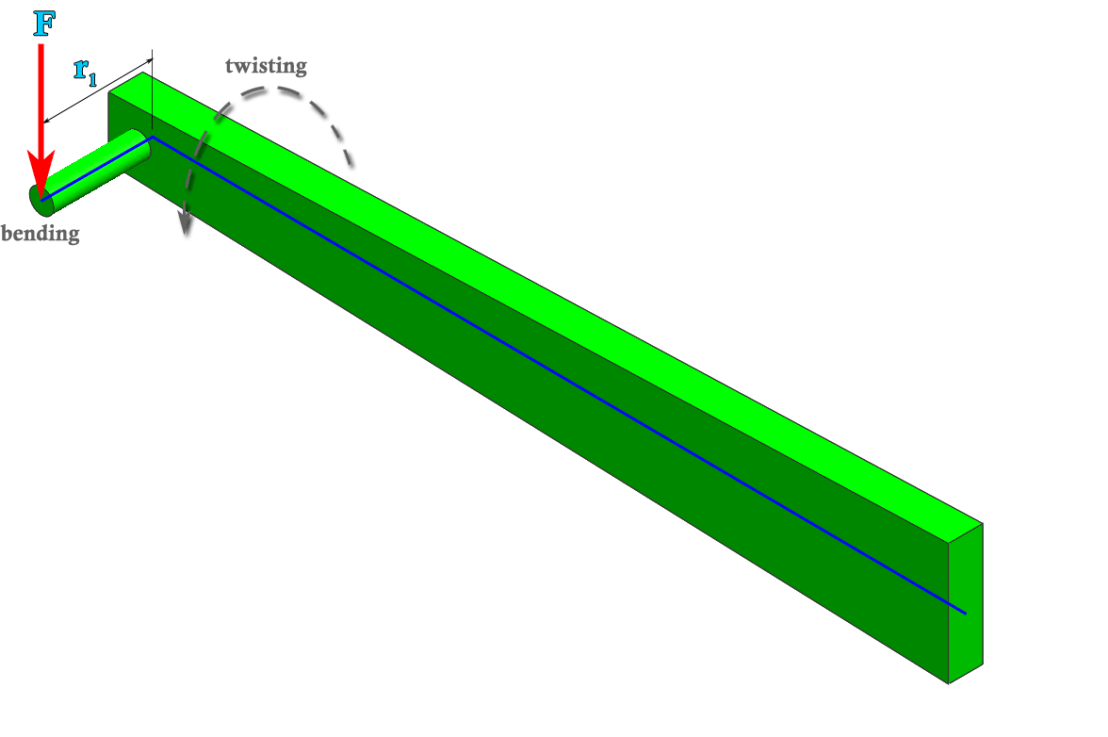
When working with  columns, we often have to analyze loads that impinge on the structure. However, what happens when a load acts in a direction not parallel to the axis? Well, what will happen is that the strength of the material will not be completely able to resist the force, thereby resulting in bending. Engineers have termed this type of load an eccentric load.

Cold formed steel

Cold formed steel

Cold formed steel

10/06/16

“Can we ever find a replacement for wood in construction”


Humanity is running into a problem. Wood, one of the most used materials in construction, is being depleted an exponential rate. Sooner or later, we must find a substitute for our needs. But what can possibly replace something as unanimous as wood? Well, luckily for us, engineers have already come up with another innovative solution, cold formed steel. But what exactly makes this material so special? Well, it all has to do with the fabrication process. Most steel is manufacturing using the hot formed procedure, in which the steel geometry is formed by being push baked at high temperatures. However, cold-formed steel gets it’s name due to the fact that is formed at room temperature. This greatly increases the yield strength of cold formed steel, makes it lighter in weight, smoothens its topology, and makes it more precise for detailing. But most importantly, cold formed steel is actually a recyclable material! And not only this, but it is also cheaper than lumber! Add on the fact that with steel you won’t have to worry about termites or rot, ad you’ve got yourself one amazing deal. In summation, cold formed steel is the way of the future, and it holds nearly limitless applications for future construction.

Spin quantum number

Spin quantum number

Spin quantum number

10/05/16

“How can we describe the angular momentum of an electron?”


The orbits of electrons around the central nucleus of an atom is a very complex matter. And because of this, we will have think to think of creative ways to describe the myriad of elements that make it up. So to make things simpler break this problem down into smaller components, such as the angular momentum. When an electron transits around the central nucleus, it has both an angular momentum from the orbit and another one resulting from the spin around it’s own axis. The combination of these two elements will result in a vector quantity called the spin quantum number. The spin quantum number represents the magnitude (½) and the direction 9+ or -) hat the angular momentum of the current electron. When electrons enter into subshells, they enter each orbital that is currently unoccupied. If the elements only has unpaired electrons, then this spin quantum number will be considered positive, and if the electrons begin to pair up, then the spin quantum number will be considered negative.