Tag: Thermodynamics

Thermal resistance

Thermal resistance

Thermal resistance

04/12/17

“How can we measure how the flow of heat will be impeded in a material?”
All objects have a temperature. And this temperature can change whether by convection, conduction, or radiation. However, because of an object’s material makeup, this flow of heat may not be uniform. So how can we measure how much an object will resist a change in temperature? Well, let’s use our scientific mindset to think about it. We know that temperature consists of a measure of the random kinetic motion of particles and that a change in this value is caused by energy entering or exiting the system. Rationally speaking, it would follow that materials with different forms of internal properties have more or less impediments in the way of this heat flow. After years of research, scientists have quantified this property as thermal resistance and is one of the bedrocks of thermodynamic physics.
Latent heat

Latent heat

Latent heat

03/17/17


“How do we quantify the energy released or absorbed during a constant temperature process?”
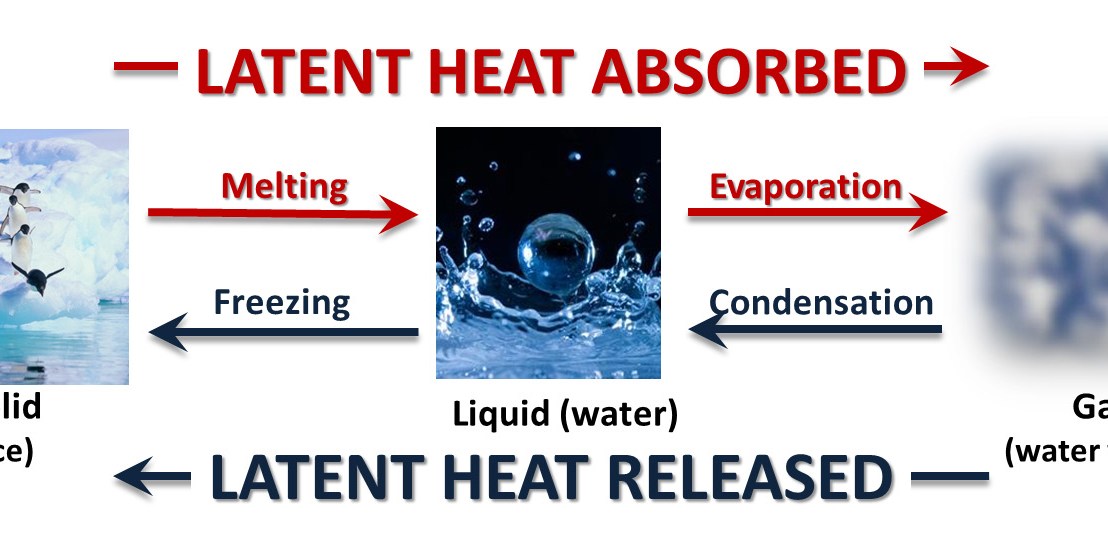
When we deal with energy and heat problems, we typically think of the system of having a change in temperature. However, when it comes to phase transitions it is possible to have a change in energy of a system without a corresponding change in temperature. So how have scientists and engineers decided to describe this phenomenon? Well, after much research into the subject, this process has been termed latent heat and is proportional to the energy required to change the phase of a substance divided by its mass, which can be symbolically described by the equation L=q/M.

Internal energy

Internal energy

Internal energy

12/08/16

“How can we quantify the energy of internal molecules in a system?”


There seems to be a problem. Scientists and engineers often need to analyze the energies associated with objects. However, the atoms of all material are not contiguous with one another but are moving in many directions, each with their own potential and kinetic energy. So how can we quantify such system? Thankfully, after many decades of long research, a most useful concept known as internal energy has been developed. The internal energy of a system is defined by the summation all of the energies arising from the microscopic components of a system, which is often summarized symbolically by the equation U_internal = U_potential+U_kinetic, with U standing for energy

Enthalpy

Enthalpy

Enthalpy

12/03/16

“How can we model the total energy inside a thermodynamic system?”


As a scientist or engineer, if you ever work with thermodynamics systems, then you will have to understand the amount of energythat you are working with. However, how can we represent this concept in more concrete terms? Well, luckily for us, after many years of hard labor, scientists and engineers have formulated the very concept of enthalpy of this very matter. Enthalpy can be defined as the amount of energy stored within a thermodynamic system, which can be symbolically defined as H = u + p*V, with H being the enthalpy, u being the internal energy of the system, p being the pressure and V being the volume.

Operating temperature

Operating temperature

Operating temperature

Isaac Gendler

“In what temperatures can a machine operate?”


As a modern civilization, we operate and use machinery everyday. Whether it be something as simple using an alarm to wake us up in the morning or something as exciting taking as plane to another continent, technology has firmly integrated itself into the nuances of human life. However, as engineers, we must realize that such machines have constraints to them. One such constraint is the temperature that the system can operate in, also known as the operating temperature. Since objects and materials have different properties at different temperatures, a system will change depending on the temperature input. And since machines, (both mechanical and electrical) require all parts to work in a highly precise manner, such perturbations in properties could cause drastic failures. To illustrate, let’s analyze a device very familiar to us, the computer. If the internal temperature of a computer exceeds the operating temperature, then component failures will ensue, causing a shutdown. As a result, when designing as an engineer, one must always take into account the operating temperature.

Thermal expansion

Thermal expansion

Thermal expansion

08/12/16

“What happens to the volume of objects upon a temperature change?”


Let’s think about something. All objects are composed of vibrating atoms. And when an object is heated, those vibrations become more powerful, and the lengths of their vibration increase. So, what does this imply on the macroscopic scale? Well, if an object’s volume is determined by the volume of space that this volume of atoms takes up, and this volume increases, then the volume object should increase as well, therefore, heating causes (most but not all) objects to expand. Scientists and Engineers have named this phenomena thermal expansion. Thermal expansion is a very omnipresent physical phenomena, and can have dire implications for works of engineering if not taken care of.

Joule heating

Joule heating

Joule heating

07/09/16

What effects does dissipated current have on a wire?

Let’s think about something. When particles move through a conductor, we know that they do not move in a straight line, but instead in a semi-random and chaotic pattern of colliding off the walls of the material. During the collision process, some of the kinetic energy of the electrons is converted into thermal energy inside the conductor. After a while, this process (Which scientists and engineers have termed joule heating) will have a macroscopic effect on the temperature of the material. We can quantify Joule heating by using the formula H = k* I^2 *R * T, where H is the heat, K is a constant I is the current, and R is the resistance of the material. One very pragmatic application of joule heating is in a technology that we all know of, the incandescent light bulb. The increased temperature of the filament in the light bulb causes it to glow, which gives off light to the surrounding area.

Pressure volume diagrams

Pressure volume diagrams

Pressure volume diagrams              06/13/16

“How can we empirically model the change in pressure and volume of a gas?”

In order to model the change in pressure and volume of a gas, Scientists and Engineers have created a framework known as Pressure volume diagrams. P-V diagrams are very simple, the Pressure and volume of an object will be represented by a cartesian coordinate system with the Pressure on the vertical axis and the Volume on the horizontal. When work is added to the system, the change in volume and pressure is recorded along an arc length. The volume under this curve represents the change in work in the system. The return process does not have to be symmetric, so often a P-V diagram could possibly have a different return curve.
Let us illustrate with the following example. Imagine gas with a piston in a machine.The state of the gas gas starts at point 1 on the graph. Heat is then added, which the increase the pressure. The normalization process then starts, which decreases the pressure and increases the volume, causing the state to go to poin 2. Heat is then extracted, which causes the state to go to point 4, and the reverse normalization process starts, which causes everything to go back to the begining at point 1.