Tag: Sustainable Engineering

Offshore windpower

Offshore windpower

Offshore windpower

11/30/16

“How can we use coastal winds to enhance wind power?”

One of the primary criticisms launched against sustainable energy advocates is the systems for extrapolating such energy forms are too limited in geography, time of day, and energy density. However, thanks to the strong willpower of renewable energy engineers, we could have a new technology that could fundamentally upset this paradigm. In the past, wind turbines were only built on solid terrain. Even though this was the simpler way of doing things, it had a major drawback due to the fact that wind is not omnipresent. However, thanks to the flat and low friction nature of water, winds currents are much stronger and consistent over the ocean. And since higher wind current means higher wind power, wouldn’t it be logical to have wind turbines placed in the ocean? This is the exact behind offshore wind power. Offshore wind turbines only have 2 percent of the energy payback time as regular onshore turbines, are less noticeable to the common public, and can be located near a high number of population centers. However, like with everything in engineering, there are always drawbacks with offshore windpower, such as the fact that it takes much more materials to construct such turbines, and the technology is only nascent, requiring further development. But even with this, the future of offshore windpower looks bright, and many countries have already begun investing in to it, such as the gargantuan 630MW London array in the United Kingdom, the 600 MW Viking wind farm in Scotland, and the 400 MW Anholt windfarm in Denmark.

Reverse osmosis

Reverse osmosis

Reverse osmosis

09/04/16

“How can we use pressure to purify seawater?”

Already humanity is facing a major water problem. As the water reservoirs start to dry up, there will be entire areas with no hydration to speak of. So what is one way we could solve this? Well, how about we look to the most plentiful form of water, the ocean, to solve our problems. Ocean water is normally unusable for humanistic concerns due to it’s salty nature, but what if we were to desalinate it to make it usable?

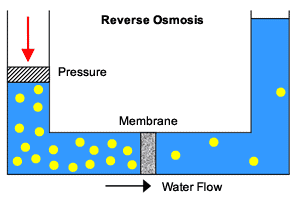
Now that we have the idea, let’s think about how we could make this a reality. Well, first of all, we should notice that salt water probably has other elements in it that are a result from exposure to the rest of the environment, such as seaweed and dead animals parts. These items are usually larger than the molecules of water and salt, so they can be filtered away easily through the use of a permeable layer. We can accomplish this by extracting sea water, and then using pressure to force it through a permeable layer. However, the leftover water will still have a high concentration of salt. But to our luck, it is still possible to separate the salt if we notice one factor, that both water and salt have different evaporation points, and more specifically, water has a lower point of evaporation. So what we can do with this leftover salt water is boil it until the point of evaporation for water, and then pass this steam off into another area, and then cool it until it solidifies again. After all of this, we will finally have ourselves some freshwater! This process is known as reverse osmosis, and plants are currently being used in arid regions such as California, Israel, and Saudi Arabia to create a usable water supply.

Hydropower

Hydropower

Hydropower

08/26/16

“Can water be used to create useful energy?”

Water is one of the most omnipresent substances found on this planet.An entire three-quarters of the planet is covered by it. Water often moves not in small streams but with large flows, piling through it’s path with titanic levels of energy. So one might think, is it possible to capture some of this energy to transfer it into useful forms?

Well, let’s think about how we could do so. First of all, we know that turbines can extract energy from moving fluids to power a generator to create electricity. Second of all,  We know that water flow can be controlled through the uses of dams. So what if we placed a damn near a flowing path of water, and directed all of that energy so it would move a turbine that would power human infrastructure? Well, this is the operating principle behind hydropower.

Hydropower is the use of the kinetic energy of water to power electricity. The power generated by a hydropower plant can be calculated with the following equation P=Mu*rho*Q*g*h, with Mu being the efficiency of the turbines, rho being the density of the water passing through, (Kilograms per cubic meter), Q being the flow (Cubic meters per second), g being the acceleration by gravity, and h being the height difference between the inlet and outlet in meters. Hydropower is clean, renewable, and affordable form of energy. Hydropower produces almost one fifth of the world’s electricity, the primary contributors being China, Canada, Brazil, The United States, and Russia. Notable hydroelectric projects include the three gorges damn in China and the Grand Coulee Dam on the Columbia River in northern Washington in the U.S. However, one has to be cautious when developing such systems, and the infrastructure may disrupt local wildlife and natural resources.

In summation, hydropower is a fascinating subject, and engineers around the world are dedicating themselves to the study and application of this form of power.

Flywheels

Flywheels

Flywheels

06/23/16

“Is there such thing as a battery solely made out of mechanical parts?”

With the current climate change crisis, there is a greater need for clean ways of storing energy. In face of this trouble humanity has invented a most peculiar device called the Flywheel. In essence, Flywheels are massive wheels use rotational motion to store energy. Now, let’s get into the details. The wheel flywheel has a large mass, which in turn causes the object to have a high inertia. This high inertia is what allows the flywheel to store a high amount of kinetic energy (Due to the laws of angular momentum). To make sure that this energy is not lost to friction, flywheels are encased in near-vacuum conditions to minimize air resistance and use magnetic bearings to reduce internal friction. Power is supplied to the flywheel through an electric motor, and during discharge the flywheel will spin in the other direction, causing it to shift into a generator.

The advantages of using flywheels include a high power density, a high lifetime, and the disadvantages include a low energy density and a high potential for danger in case of an accident (the wheel could become unhinged, which would cause it to fly out with dangerous levels of kinetic energy). All in all, flywheels are a innovative way to store energy for further use. In fact, the Los Angeles metro system is planning to incorporate flywheel technology to store the energy from their regenerative braking system, and a current student research project in the bay area is considering doing the same thing.

Regenerative braking

Regenerative braking

Regenerative braking

06/16/16

“Is it possible to convert the energy used by the breaks of the car into something useful?”

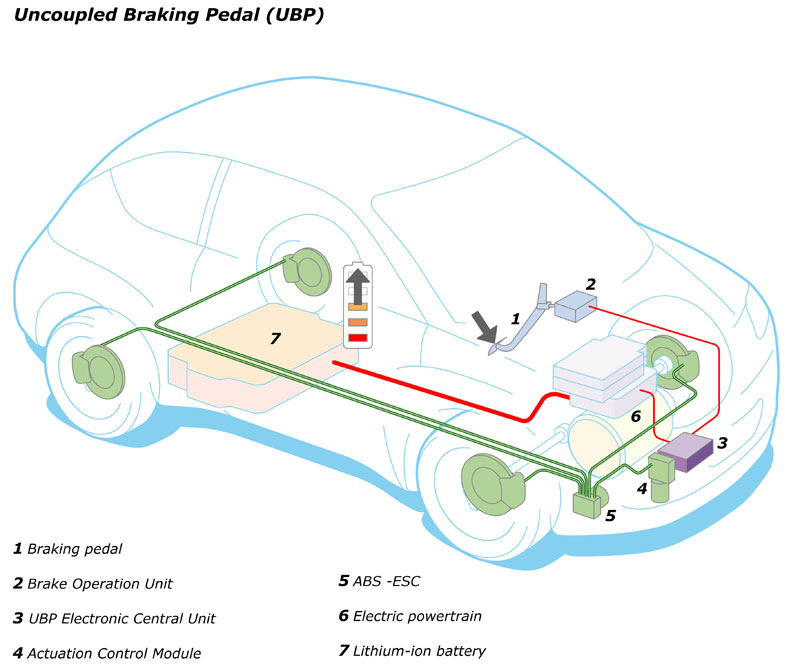
Motorized transportation manufacturers have always had to deal with braking systems. One annoying aspect of friction-based technologies is that all of the kinetic energy leaves the system once the motion has to come to a stop. However, wouldn’t be really practical if we transfer this energy somewhere else?  This is the basic idea behind regenerative braking.

In automobile systems, an AC motor is used to transfer energy from the car’s battery into the motion of the wheels. However, once the brakes are activated, the motion of the car’s wheel will reverse. This effectively transform the systems from a motor into a generator, with the new motion causing the current the flow in the opposite direction, therefore charging the battery! Even with an efficiency of only around 20%, the extra energy can be used to allow hybrid engines to have better mileage or allow electric cars to go farther

Regenerative braking systems are controlled by regenerative braking controllers. The regenerative braking controllers monitor how fast the vehicle is moving and how much torque is able to generate electricity to be fed back into the batteries. This information allows the controller to decide to if the speed is to high for the regenerative braking system to handle (in which case the old-fashioned friction braking system will take over).

In summation, regenerative breaking is an ingenious technology that uses creative ways to recover power. In fact, these machines have been found powerful enough to convince companies and organizations such as Tesla and the New Dehli metro to implement them in their products!

Material recovery facility

Material recovery facility

Material recovery facility          06/11/16

“How are recyclable materials sorted?”

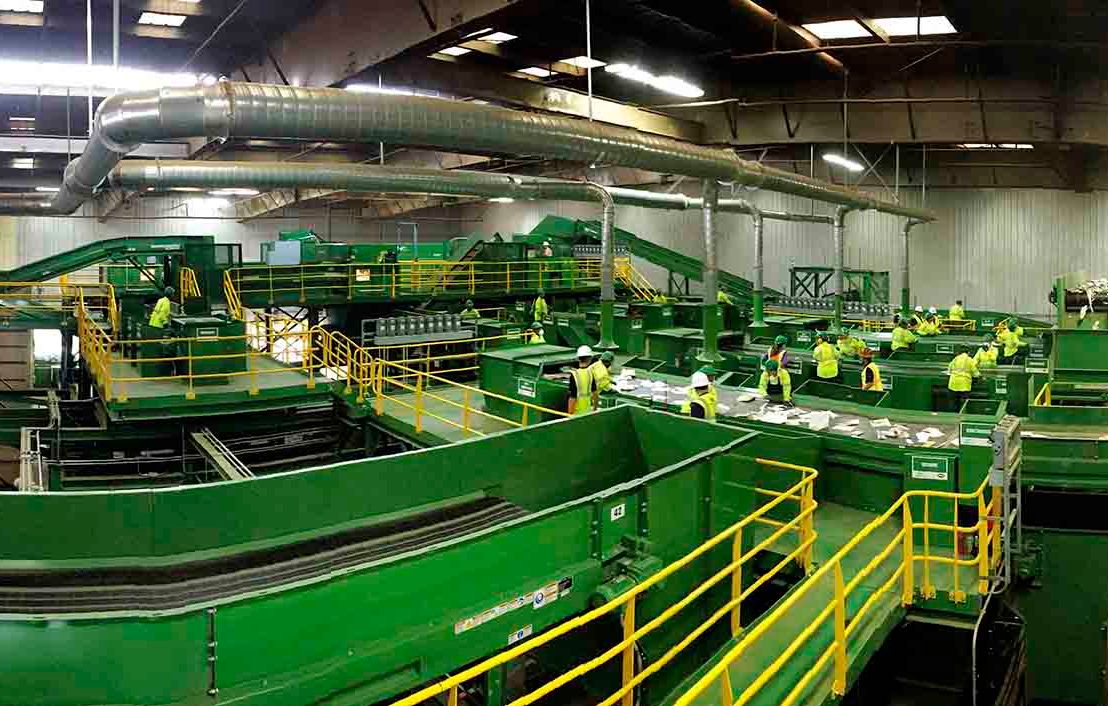
With the advent of mass recycling, there has to be some sort of way that recyclable material is properly sorted to ensure that everything goes in it’s place. The solution is called a Material recovery facility, or MRF. MRFs are specialized plants dedicated to taking in recyclable material and making them reusable. There are two types of MRFs, clean and dirty. Clean MRFs take in purely recyclable waste and turn it into usable material, while dirty MRFs accepts “mixed” waste (i.e partially reusable and partially corrosive) and separates the recyclable material from the non-recyclable.

Solar maximizer

Solar maximizer

Solar maximizer           06/05/16

“How can we maximize the effects of a solar panel?”

This a pertinent question for any renewable energy engineer. Let us illustrate one potential problems with solar panels. When a solar cells are in series, they are all linked together. Since they often cover a long distance, external effects such as temperature and dust will vary. Consequently, each solar panel will have a different temperature, and the higher the temperature, the less efficient it is. Since a series of solar cells are only as efficient as the hottest one, then we run into a major problem.

Luckily, humanity had the ingenuity to invent the solar maximizer. The Solar maximizer optimizes the solar cells to mitigate the impinging effects of solar cells in series.  

Wave power

Wave power

Wave power           05/06/16

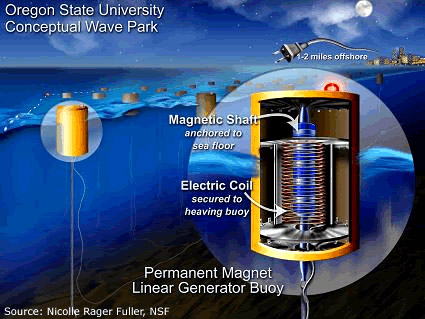
What if I told you that Engineers have built machines that are able to convert the kinetic energy of waves into usable power? This is the very principle behind Wave energy. By capturing the energy propagated by these waves, we can power up to around 40% of humanity’s energy needs.

Solar power

Solar power

Solar power          03/21/16

Let one consider this. The earth receives around 3.86*1026joules of energy hits the Earth every second. The Earth directly receives1.74*1017of those joules. This number is over 35,000 times the amount  of energy that all of human civilization consumes every second. If we are able to receive this much energy from the sun, wouldn’t it be logical to create a system to harness this energy? This is where Solar Power comes in. Solar power uses Solar panels which in take the energy of the sun and uses the photoelectric effect to transform this into usable energy. Most commercial solar panels have an efficiency rating of 15-20 percent, so research in to higher efficiency solar power is paramount.