Tag: Periodic table

Non-metals

Non-metals

Non-metals

07/26/16

“What are some of the properties of non-metals?”

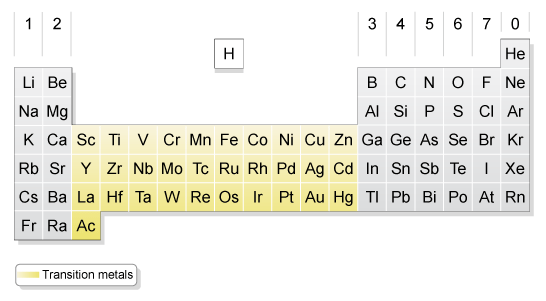
After reviewing the different type of metals and metalloids, you might be wondering, “What are some of the objects that are not metals at all, what are their properties?. Well, when one thinks about it logically, if metals have one type of behavior, then it would not be too far fetched for the opposite type of material to have opposite properties? This is in fact the case with non-metals. Nonmetals in groups 12-14 in the periodic table. Non-metals do not conduct heat or electricity very well, and are very brittle. Non-metals usually have oxidation numbers of +/-4, -3, and -2 as a result of being on the far-right side of the periodic table. The elements that make up the non-metal category include hydrogen [H], carbon [C], nitrogen [N], oxygen [O], phosphorus [P], sulfur [S], and selenium [S]

Metalloids

Metalloids

Metalloids

07/25/16

“What’s a metalloid?”

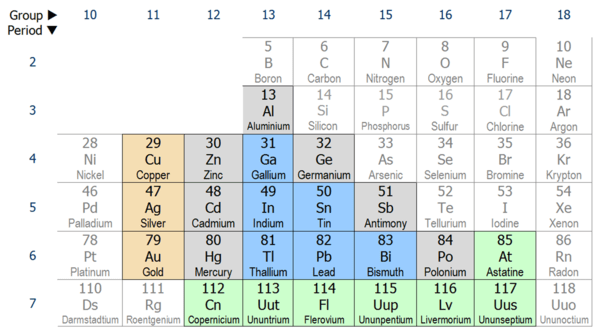
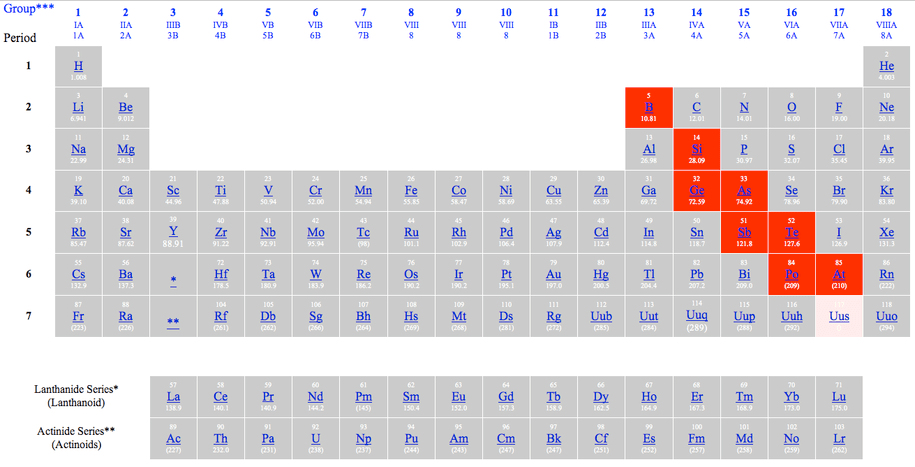
When browsing through the periodic table, you might see a group of elements that have a very strange description called metalloids. In short, metalloids are elements that have properties of both metals and non-metals. The elements that make up the metalloid group include boron [B], Silicon [Si], Germanium [Ge], Arsenic [As], Antimony [Sb], Tellurium [Te], Polonium [Po], and Astatine [At]. These elements are typically very brittle and have a fair amount of electrical conductivity. What makes metalloids especially interesting is that some of them (such as Germanium and silicon) have the properties of being semiconductors.

Post transition metals

Post transition metals

Post transition metals

07/24/16

“What properties do the non-transition metals on the periodic table have?”

We are about to enter one of the most controversial parts of the periodic table. What happens with the group of elements in between the transition metals and the metaloids? Well, let’s think about it for a moment. These elements typically have higher electronegativities and lower melting points, as well as a softer structure. Examples of metals in this group include aluminum [Al], gallium [Ga], lead [Pb], tin [Sn], thallium [Tl], and Indium [In]. Occasionally the group 12 metals are also included in this classification.

Transition metals

Transition metals

Transition metals

07/23/16

“What properties do those metals in the middle of the periodic table have?”

Something very interesting happens with the elements in the middle of the periodic table. The 38 metals from groups 3-12 have valence electrons present in more than one shell. This makes them able to have more than one oxidation state, or that they have different ionic forms (which is why we must use roman numeral for their naming scheme). Some of the metals in this group include copper [cu], manganese[Mg], and zinc [Zn]

Ion naming convention

Ion naming convention

Ion naming convention

07/22/16

“How do we name ionic chemicals?”

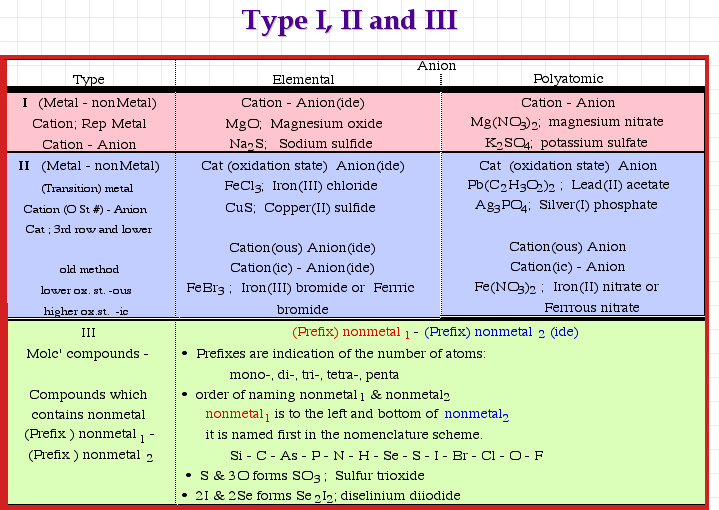
When Chemists started describing elements, they ran into a problem. It turns out that keeping track of which element they are working with is an ion and which is not proved to be very difficult. So , they decided to create a few rules to keep track of everything. Let us their methods with the three cases for cations (positive charge ions), and then move to the three cases for anions and wrap up with the convention for molecular compounds containing both cations and anions.

If the cation in question is a metal who only has one ionic form such as lithium[Li] or potassium[k], then one will simply add ion to the end. For example, lithium[li] would become Lithium ion [Li+], and potassium[K] would become potassium ion [K+].

If the cation is a metal that can have multiple ionic forms, then a roman numeral indicating charge combined with the ion suffix will be added. For example, copper[Cu] could be copper(I)[Cu+] with an ionic charge of +1 or copper(II)[Cu+2] with an ionic charge of +2.

If we are dealing with non-metal compounds then we will have the last syllable be -ium. For example, [H3-O] will be called hydronium, and [NH4] will be called Ammonium.

Now, let us begin with the negatively charged anions. If the anion in question is monoatomic (having only one atom), then we will take the ending of the atom’s name and replace it with the -ide. For example, the anionic form of hydrogen[H] will be hydride[H-], and Oxygen[O] will become Oxide[O-].

If the anion in question is polyatomic (multiple atoms), then we will take the ending of the compound’s name and replace it with the suffix -ite for compounds with a net charge of -2 (For example, CO2- will become chlorite and CO3- will become chlorate). Continuing on, polyatomic atoms that have a -1 charge will have the prefix hypo- attached to the -ite form (For example, CO- will become hypo-chlorite) and ones with a -4 charge will have -per prefix attached to the -ate form (For example, CO4- will become per-chlorate).

If the Anion contains an Hydrogen ion [H+] within the name, then the prefix Hydrogen or Dihydrogen in the case of double will be added. For example, HCO3- will become the hydrogen carbonate ion, and H2PO4- will become dihydrogen phosphate ion

If the molecule in question is multiple forms of the same atom bonded to itself, then you would put a prefix before it’s name (pre- for two, tri- for three, and so on) to represent the atom. For example, O2 becomes peroxide, and O5 is pentaoxide

Now, finally, how do we name the element if they consist of a cation+anion? Well, we simply put the name of the cation first and anion last! For example, [CaCl2] will be Calcium Chloride and [AL(NO3)3] will be aluminum nitrate.
Alkaline Earth metals

Alkaline Earth metals

Alkaline earth metals

07/21/16

“What do Chemists mean when they talk about the Alkaline earth metals?”

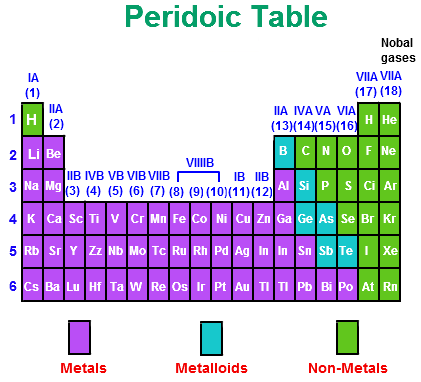
To continue with our tour of the periodic table, a group that definitely needs attention is the alkaline earth metals. The alkaline earth metals are the second group on the left of the periodic table. The elements that make up this group include beryllium [Be], magnesium [Mg], calcium [Ca], strontium [Sr], barium [Ba], and radium [Ra]. All of these elements share many peculiar properties, such as the fact that they hold two valence electrons, silver colored and soft, have low melting points, boiling points, and densities, and all of their valence electrons are in the 2s range.

Alkali metals

Alkali metals

Alkali metals

07/20/16

“What are some of the special properties of the first group of elements on the periodic table?”

As a child, you may have looked up at the periodic table, saw that it was organized column by column, and asked why Chemists decided to construct it in that matter? Well, it turns out that each of the columns have been arranged together because they share many qualities with one another! So let’s begin with the first group, the Alkali metals. The alkali metals are the metals that sit on the far left of the periodic table. These elements include  lithium (Li), sodium (Na), potassium (k),cesium (cs), and francium (Fr) , and they all share kindred characteristics. First of all, they have only one valence electron in their outer shell, which makes them highly reactive with other elements. Second of all, when they do react, they usually turn into a positive cation.

How to predict if chemical bonding will be ionic or covalent

How to predict if chemical bonding will be ionic or covalent

How to predict if chemical bonding will be ionic or covalent

Isaac Gendler

07/19/16

“How can we predict if chemical bonding will be  ionic or covalent?”

During one’s study of chemistry, one will come across two distinct forms of chemical bonding, ionic and covalent. However, how can we predict which one the elements will undergo? Chemists have discovered that a simple rule of thumb is that can determine which one is which. If the two elements have significantly different group numbers (such as one one on group 1 or 2 on the periodic table and another on group 5-7) then an ionic bond will take place as a result of the difference of electronegativity. If the two chemical are in a similar group, then a covalent bond will take place.