Tag: Material science

Eutectic point

Eutectic point

Eutectic point

03/20/17

“What is the lowest possible melting point for a composite material?”
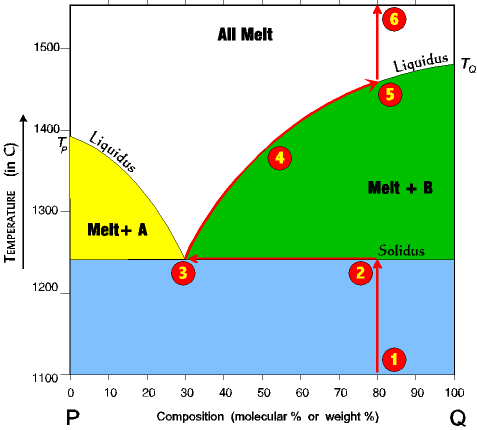
Pure elements always have a fixed melting point. However, when mixed, their melting point can change drastically. Let’s say we have a crystal composed of elements A and B. If element A is predominant, then B will melt first and vice versa for element B. So is there a single point of possible element combinations in which both elements will melt? Well, after years of research, Materials Scientists have came up with the definition of the eutectic point to describe this scenario. The eutectic point is not only the point of complete melting but the point of lowest possible melting since both elements will be melted!
Recrystallization

Recrystallization

Recrystallization

03/19/17

“How can we purify a crystal by dissolving it?”
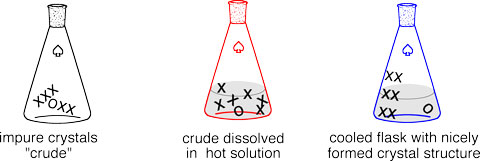
Crystals are some of the most omnipresent structures in the universe. However, often times such crystals will have impurities to be found inside their crystal lattice, changing the properties of the material. So what is one way that we could get rid of such an impurity? Well, let’s think about it. We know that crystal lattice element and the impurities are made from different molecules, therefore having different melting and cooling points. We also know that if we were to dissolve this compound into a hot solvent, we could effectively decouple the elements from one another. So what if we were to take these two concepts, combine them, and make a system in which the crystal with the impurity would be dissolved and then cooled down to the point that the crystal reforms but the impurity does not? Well, it turns out that this is a process known as recrystallization, and is used by chemists and material scientists to purify crystal elements.

Slip (materials science)

Slip (materials science)

Slip (materials science)

03/13/17

“How does plastic deformation in a material affect the internal defects?”
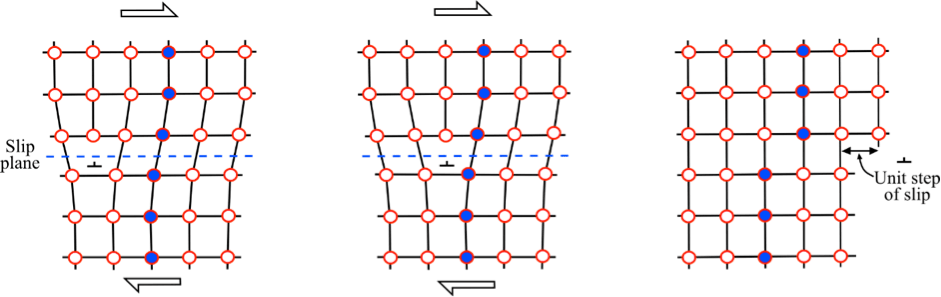
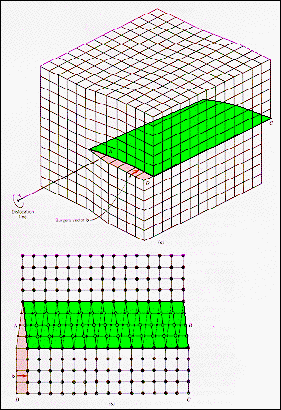
All physical materials have defects within their crystal structure. Furthermore, plastic deformations can cause the internal structure of a material to shift. So what happens when a plastic deformation is applied to a material with edge dislocations? Well, let’s use our scientific mindset to think about it. We know that these edge dislocations represent an absence of atoms along a chain. We also know that applying plastic deformations will cause a plane of atoms to move in the direction of the force. So logically, wouldn’t this plastic deformation cause the edge deformation to move within the lattice? This is the fundamental idea behind a phenomenon in Materials Science and Engineering known as a slip and can be used to characterize the internal movement of atoms.

Grain size reduction

Grain size reduction

Grain size reduction

03/11/17

“Is it possible to increase the strength of a material by reducing the grain size?”
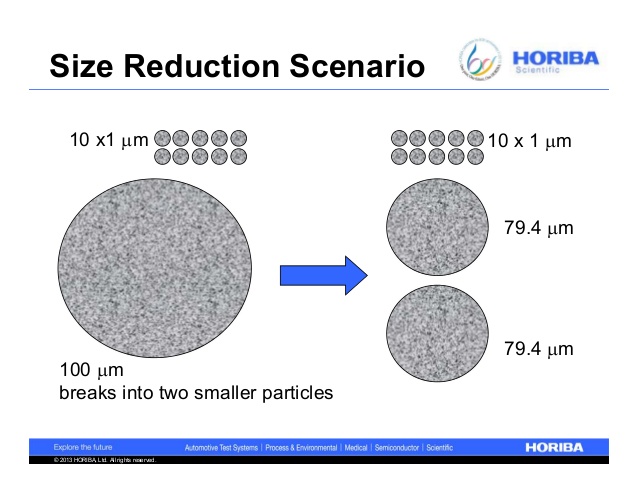
Many materials in their original form are not strong enough for practical engineering purposes. However, is there a way in which we could strengthen a material by modifying its grain structure? Well, let’s look into it. We know that the strength of a material is contingent upon its grain size. Specifically, the smaller the grain sizes are, the more of them will be able to be present within a material. So wouldn’t it logically follow that if we were to reduce the size of grains, the stronger our material would be? This is the fundamental principle behind grain size reduction, and modifies the yield strength of a material by the equation sigma =sigma_0+kdx, where sigma  is the new yield stress, sigma_is the original yield stress, k is a constant, and d is the grain size.

Precipitate hardening

Precipitate hardening

Precipitate hardening

03/10/17

“How can we use heat treatment to increase the strength of a material?”

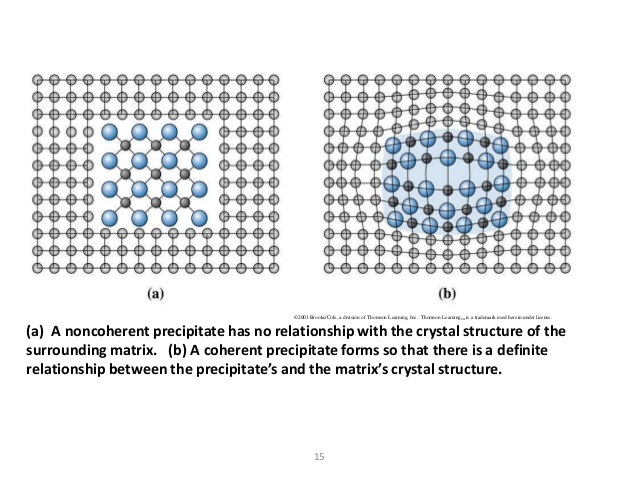
Often times, when we receive a material, it is not durable enough for our needs. So how can we use a readily available process to increase the strength of a material? Well, let’s use both of our engineering and scientific mindset to find out. Well, we know that if were to introduce an alloy into the crystal structure, then the material would be strengthened. However, if we were to increase the temperature of a material and then rapidly cool it, the material would form a highly regular crystal and the precipitates would seep into the grain boundaries, therefore greatly strengthening the material. This process is known as precipitate hardening and is used to make a variety of materials stronger ranging from everyday aluminum to the internal wing structure of a Boeing 767

Solution hardening

Solution hardening

Solution hardening

03/09/17

“What happens to a crystal structure when alloys are introduced?”
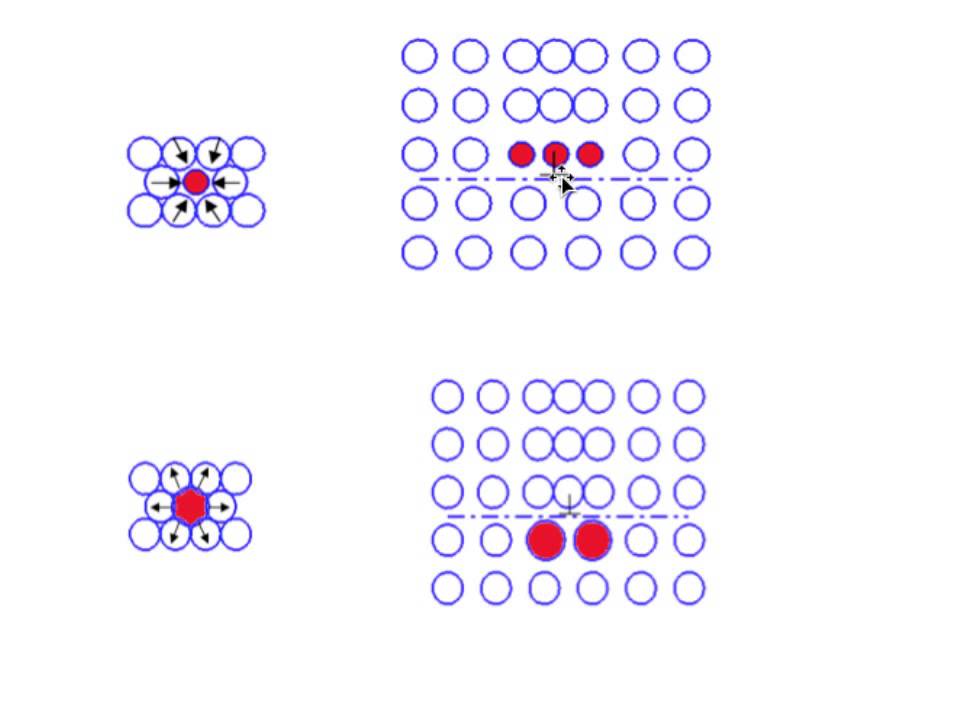
As pure elements, most crystal structures are fairly linear and homogeneous in nature. However, what happens when another element with a different atomic radius is introduced, disturbing this uniformness? Well, let’s use our scientific mindset to find out. We know that when these due to intermolecular forces that like elements will be more attracted to like elements. From this standpoint, we also can observe that this interlocking will impede further dislocations and lock the movement and slip of the atoms. This form of material hardening has been termed solution hardening my Materials Scientists and Engineers, and is dependent on the size of the inserted atoms.

Screw dislocation

Screw dislocation

Screw dislocation

03/03/17

“What happens when a shear stress acts upon a crystal lattice?”
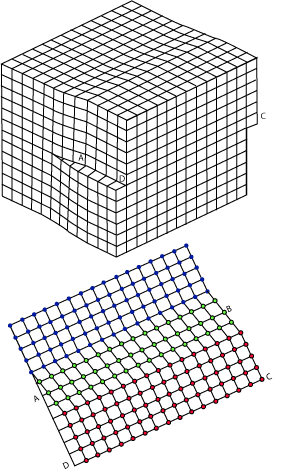
Crystal lattices are prone to imperfections, such as line defects. However, what happens when the crystal pattern experiences a shearing effect? Well, let’s use our scientific mindset to investigate this issue. Well, this will cause a rupture in the geometry which will result in a phenomenon known as a screw defect. Screw defects are so named due to the fact that if one were to walk from one edge of the dislocation to the other without jumping or falling, a screw like path would be formed.

Line defects

Line defects

Line defects

03/02/17

“How do we classify one-dimensional defects in crystals?”
Crystals are well-known for their ever repeating structure. However, because of the intricacies of nature, these patterns are bound to have flaws. One such flaw is when the repeating pattern fails to be in a straight line, curving and bending. So how do materials scientists and engineers classify these materials? Well, after many years of hard work and research, these phenomena have been termed line defects. Owing to the fact that these defects are one-dimensional in a three-dimensional world, there are numerous forms of different line defects out there

True Stress-Strain diagrams

True Stress-Strain diagrams

True stress-strain diagrams

03/01/17

“Why is there a negative slope on a stress-strain diagram and how can we fix it?”
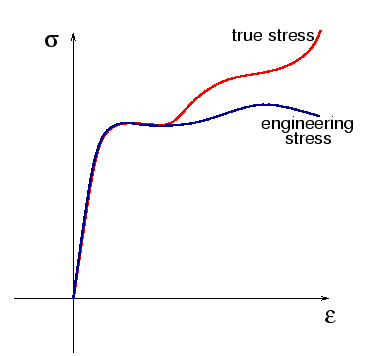
The stress-strain diagram is probably one of the most used concepts in all of engineering. However, there seems to be one counterintuitive aspect to it. Specifically, after the ultimate strength is reached, the stress-strain slope seems to become negative. This can’t be, since the stress can only increase with strain, not the other way around. So what exactly is behind this incongruity? Well, it all comes down to one simple fact. When constructing an engineering stress-strain curve, the cross-sectional area of the object is assumed to be static. However, due to the law’s of Poisson’s ratio, an elongation in length must be countered by a decrease in the associated cross-sectional area. And since this cross-sectional area will have s smaller capacity to carry force, the force distribution will go down. Therefore, if we do not include an updated area with the force, the stress will decrease with strain. Structural Engineers and Materials Scientists have recognized this flaw and have created true stress-strain diagram in response, which uses an ever-changing cross-sectional area. True stress-strain diagrams never have negative slopes, and are commonly used for research purposes.