Tag: Material science

Substitutional solid solutions

Substitutional solid solutions

Substitutional solid solutions

04/01/17

“What happens when an element that follows the Hume-Rothery rules dissolves into another element?”
Given the right set of conditions, elements can dissolve into others elements. This means that the solute will lose its own pre-defined structure and are fused into the solvent. However, how does the solute merge into the solvent on a microscopic level? Well, let’s do as scientists do and observe. If an element follows the Hume-Rothery rules, then it probably has a similar size atomic size, packing structure, electronegativity, and affinity, and it probably looks and acts much like the solvent atoms. And if we observe closer, wouldn’t it be logical that an element so similar could pass itself off as the solvent atom and substitute itself into the original structure? Well, it turns out that such phenomena exist, and solutions of this type are known as substitutional solid solutions, and can be used to strengthen a material through impurities

Hume-Rothery rules

Hume-Rothery rules

Hume-Rothery rules

03/31/17

“How can we know if how an element will dissolve in a metal?”
I don’t know about you but all of the different types of elements simply astounds me. Just to think that by changing only a single proton of an atom the entire set of properties can change drastically. What’s even more exciting is that these different properties mean that elements can also combine in a myriad of different ways, such as by dissolving. And not only this, but there are even different ways in which atoms can dissolve in one another, specifically by forming a substitutional solid or an interstitial solid. So how can we predict which will happen? Well, let’s think about substitutional solids for a moment. We know that in order for an atom to be on the same lattice in a material (the substitute in substitutional), it must be of similar size (around 15%), have a similar crystal structure, be of the same valency, and have similar electronegativity. And if we want the element to be interstitial, we know that the element must be smaller than the original by at least 15%, show similar valency, and have the same valency. After working with such patterns for many decades, materials scientists have decided to term these rules the Hume-Rothery rules.

Tempering

Tempering

Tempering

03/29/17

“How can we apply heat treatment to strengthen a material?”
When doing practical engineering, we may have to strengthen the material of steel using artificial means. One method is to apply a heat treatment to change the inner structure of a material. But what is one such example of a heat treatment? Well, let’s think about it. We know that if we were to heat steel up to below the critical point, it will become a homogeneous solution of austenite (a solution of iron and carbon). If we were to then rapidly quench this steel, the internal structure would turn into a body-centered tetragonal framework. Finally, let’s “temperthis material at high temperatures such the steel becomes an ultrastrong phase known as pearlite. This process is known as tempering and is used to strengthen steel materials.

Heat treatment

Heat treatment

Heat treatment

03/28/17

“Can we make a material stronger using heat?”
Oftentimes, when we receive a material, it is not strong enough for any practical purposes. Because of this, there exists multiple material hardening methods to make up for such a case. One such method is known as heat treatment. Heat treatment involves the use of heat to change the physical properties of a material to more desired properties. Cold working (despite being based on cooling the object) is one example of a heat treatment process.

How crystal grains form

How crystal grains form

03/26/17

“How exactly do crystal grains form?”
The existence of crystal grains is one of the foundational aspects of materials science and engineering. However, how exactly do such phenomena form? Well, let’s use our scientific mindset to analyze it. We know that when a material is in its liquid form, it has no crystalline structure. However, as it cools down, a definite structure begins to formalize. However,  this process does not happen uniformly throughout the material but instead begins in a few points within this substance. As time goes on, these points will grow in their respective directions, and eventually will collide with the other crystal structures, forming crystal grains.

Lamellar microstructure

Lamellar microstructure

Lamellar microstructure

03/25/17

“What is the microstructure of materials during the Eutectic phase?”
For each material, it is well known that when the eutectic point is reached, the material will melt and decompose. However, have you ever wondered what the microstructure of this substance looks like during the reverse process? Well, let’s make an investigation. When a eutectic quickly cools down into two substances, the once conjoined phases must now be separated. This cause bands of alternating phases to be formed, thus forming a lamellar microstructure! 

Solar powered prosthetic skin

Solar powered prosthetic skin

Solar powered prosthetic skin

03/24/17

“Is it possible to use solar power to power artificial skin?”
Many individuals on this planet suffer from skin related wounds, whether it originates from combat, accidents, or sustenance abuse. But with the advance of prosthetic engineering, artificial skin capable of intercommunicating with the human brain is coming out of the realm of science fiction and into science fact. However, since these machines are contingent upon electrical signals, power is needed to be provided for operation. So how can we use our engineering mindsets to solve this problem? Well, luckily for us, Dr. Ravinder Dahiya of the University of Glasgow school of Engineering has developed a solution using one of my favorite technologies, solar energy. In a recent paper published in the journal Advanced Functional Materials, Dahiya and his team illuminate us on how a graphene-based artificial skin can be underlaid with thin-film solar photovoltaics to provide all necessary power! This is an astounding discovery and one that is sure to assist the lives of many individuals in a most benevolent way. Dahiya states that further work needs to be done on creating an energy storage system to capture all energy generated by his system, which could then be used to power external electrical systems.

Peritectic point

Peritectic point

Peritectic point

03/23/17

“What happens when a solid phase and a liquid phase merge together?”


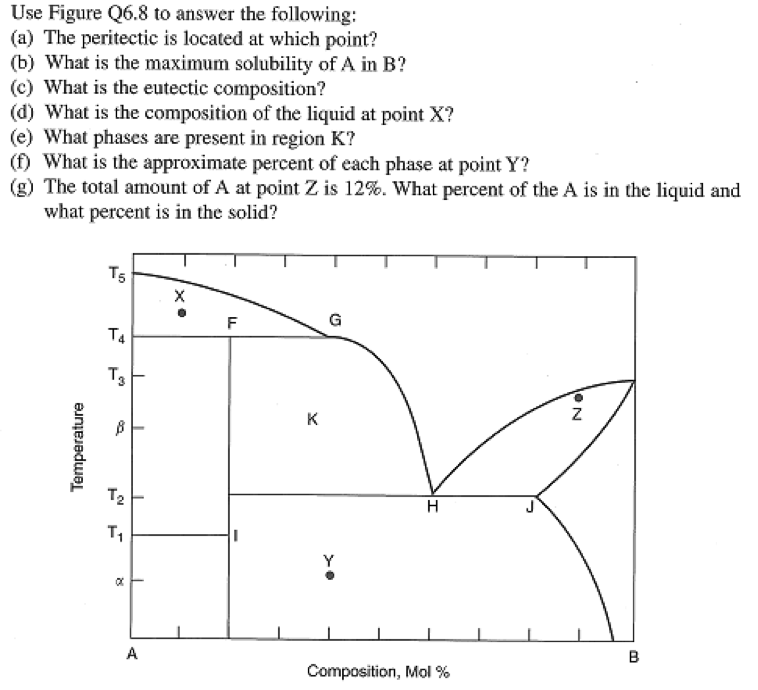
A material’s composition is often in multiple different phases. Sometimes, they are in a solid phase, sometimes a liquid, and sometimes a proportion of the two. So what happens when two of such compositions come together? Well, if the material is just at the right composition as well as the temperature, then the two phases will merge to forge a new phase known as a peritectic! Although peritectics are not as common as their simpler cousins eutectics and eutectoids, peritectics are just as much of a wonderful illustration of the laws of nature!

Eutectoid point

Eutectoid point

Eutectoid point

03/22/17

“Can a solid become two other solids under certain conditions?”
It is well known when a eutectic point, is reached, a material will instantly become a liquid. However, is it possible for such a reaction to occur but for the two products to become solids instead/ This is the primal idea behind a reaction in Materials Science known as the Eutectoid point, and can be found on a material’s phase diagram