The New York-New Jersey Harbor and Tributaries Study (HATS)

The New York-New Jersey Harbor and Tributaries Study (HATS)

The New York-New Jersey Harbor and Tributaries Study (HATS)

10/05/25

“How is the New York-New Jersey Harbor region preparing for coastal storms?”

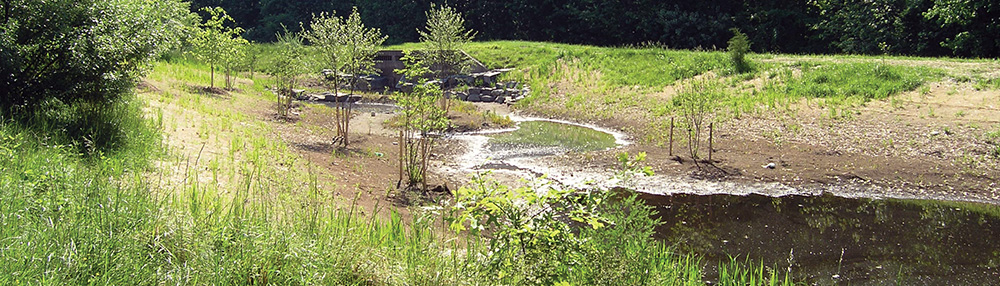
Hurricane Sandy shook the New York-New Jersey region in 2012. Dozens of lives, tens of thousands of homes, and billions of dollars were destroyed by the storm. This prompted many localities to reconsider how they will prepare for the next big storm event. The New York-New Jersey Harbor region is working with the U.S. Army Corps of Engineers to investigate risks and amelioratory actions through The New York-New Jersey Harbor and Tributaries Study (HATS). The HATS project looks to identify water resources problems and opportunities, existing and future conditions, and plan formulation/evaluation/comparison/selection. The US Army Corps tentatively plans to focus on the East Riser Ditch Channel in New Jersey and the Harlem River and Oakwood Beach in New York. 

Soil Boring Tests

Soil Boring Tests

Soil Boring Tests

10/04/25

“How can we determine the conditions and composition of the soil beneath our feet?”

Construction projects are usually built over soil. The soil’s properties have a sizable impact on the project’s design. To understand the soil conditions and composition, people can drill a hole into the ground, extract a soil sample, and then analyze the results. These Soil Boring Tests are an essential part of construction activities, helping people understand a multitude of important information, ranging from stormwater infiltration rates to support stability.

Image credit: https://punchlistzero.com/

Hard Water

Hard Water

Hard Water

10/03/25

“What’s special about water with high mineral ion content?”

Water will change depending on what it’s exposed to. When water percolates through limestone, chalk, or gypsum deposits, it might pick up ions such as calcium and magnesium. When this Hard Water comes into contact with soap, the fatty acids can react with the minerals to create a chalky precipitate that sticks to surfaces, leading to difficulty in cleaning, plumbing, appliance performance, and HVAC heating system efficiency. Water softening can reduce a water’s hardness

Image credit: https://baileyokc.com/

Collect Pond NYC

Collect Pond NYC

Collect Pond NYC

10/02/25

“How did a former pond have a massive influence on the development of Manhattan?”

When we think of Manhattan, we imagine tall skyscrapers resting upon impervious concrete and flanked by hordes of honking cars in one of the most densely populated parts of the world. But hundreds of years ago, when Manhattan was under its rightful indigenous land stewardship, the island was mostly lush forest with plentiful fresh water. On the lower end in what is now Chinatown was a body of water that the colonizers later called Collect Pond. The A subdivision of the Lenape people lived in a settlement by the southwestern shore of Collect Pond. A while after the land was stolen by Europeans, the pond was used for fishing and later a summer picnic and winter ice skating rink. Businesses later discharged their contaminated wastewater into the pond, resulting in severe public health hazards. The city decided to drain Collect Pond by building a canal to the north and filling the pond with soil in 1811. This development paved the way for the creation of the modern Canal Street in New York City, forever altering the structure of the metropolis.

Image credit: https://upload.wikimedia.org/

Microirrigation

Microirrigation

Microirrigation

10/01/2025

“How can we make more optimal irrigation techniques using a low-pressure, low-flow approach?”

Traditional irrigation techniques might result in landscape overwatering, leading to wasted water and damage to foliage. We can avoid these issues if we apply more efficient, low-pressure, low-flow-rate techniques that bring water directly to the roots of a plant. These Microirrigation techniques can save large percentages of water applied to the system.

Image credit: https://ksnmdrip.com/

Osmotic Pressure

Osmotic Pressure

Osmotic Pressure

09/30/25

“What’s the pressure needed to stop osmosis?”

Imagine a semi-permeable layer dividing a container of freshwater from a container of saltwater, each with equal volumes. Now imagine that the semi-permeable layer is small enough for water particles to pass through, but not for salt particles. Since there are more water particles on the saltwater side than on the freshwater side, there will be a water particle migration until there’s an equal amount on both sides. This will lead to a pressure differential in the direction of the salt water. The pressure necessary to overcome this imbalance and begin the reverse osmosis process is called the Osmotic Pressure, given by the equation pi = phi * (n/V)RT, where pi is the osmotic pressure, phi is the osmotic coefficient, n is the number of moles in the solute (in this case, salt), V the volume of the solvent, R the universal gas constant, and T the absolute temperature.

Image credit: https://cdn1.byjus.com/

Distillation

Distillation

Distillation

09/29/25

“How can we use boiling to separate two substances mixed together?”

Substances mixed together in a liquid can be difficult to separate. But applying a bit of chemical knowledge can help us. If the two mixtures have significantly different boiling points, then one will vaporize before the other. So what if we were to capture this vapor and condense it into another reservoir to separate the substances? Well, this is the idea behind Distillation. Water treatment systems can apply distillation to separate water from contaminants. If the boiling points between the different substances are less than 100 degrees ˚C apart, then operators must use a special fractional distillation technique.

Henry’s Law

Henry’s Law

Henry’s Law

09/28/25

“What describes the relationship between the amount of gas dissolved in a liquid and the partial pressure above the liquid?”

Pressure forces gas to move. If gas is in a container with a liquid and high pressure is acting on the gas, there is more force to move more of the gas into the liquid. If there is low pressure acting on the liquid, then more of the gas will escape from the liquid. This behavior is described by Henry’s Law, which is described by the formula C = k_H*P, with C being the concentration of the gas dissolved in the liquid (mol/L or mg/L), k_H the Henry’s Law constant (mol/liter-atm or dimensionless), and P the partial pressure of the gas in the air above the liquid (atm). Henry’s Law is a vital part of mass transfer analysis for many applications.

Volatile Organic Compounds

Volatile Organic Compounds

Volatile Organic Compounds

09/27/25

“What makes chemicals that have high vapor pressures at room temperature special?”

Substances with high vapor pressures become gases at low temperatures. Carbon-containing substances with high vapor pressures are classified as Volatile Organic Compounds, or VOCs. There are upwards of over ten thousand VOCs identified, ranging from perfumes to greenhouse gases. VOCs are the sources of most of the scents that humans can smell, and many VOCs contribute to air quality issues.