Category: Physics

Kirchoff’s laws

Kirchoff’s laws

Kirchoff’s laws 03/06/16
One of the most pertinent, practical, and sublime tools for understanding circuit theory in electronics is Kirchoff’s laws. Kirchoff’s first law states that the quantity of current going through a junction is conserved going out a junction, or I=0. For a more mechanical analogy, visualize water going through a pipe. In an ideal case all of the water going through one of the pipes will either be distributed to the other two or it will collide with another one to go down the third. Kirchoff’s laws work the same way. Kirchoff’s second law states that the change in voltage across a loop always amounts to zero. One can derive this analytically using the fact that the voltage drop is the same across two parallel lines in a circuit, so consequently their voltage must equal each other and their voltage drop must equal to zero.

Magnetic fields

Magnetic fields

     Magnetic fields  03/05/16
The study of magnetic fields are one of the most pertinent applications to the study of physics. Magnetic fields emanate out of the “North pole” of a magnet and emanate towards the south pole of a magnet (so technically the naming of the poles of the Earth are switched around). As a consequence of Maxwell’s equations, moving charges emit electric fields, so there is always magnetism around currents. The magnetic field only has an effect on moving charged particles that are not parallel in direction to it, since the equation for magnetic force is  F=qv x B, With q being the charge v being the charge velocity and B being the magnetic field.

Gauss’ law

Gauss’ law

Gauss’ law 03/03/16


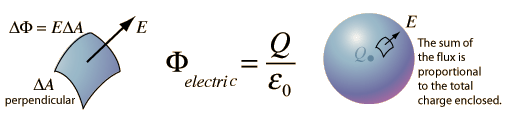
A very interesting way to find the number of charges in an electromagnetic system is to use a technique known as Gauss’ law. Gauss’ law states that if you were to create a geometric surface surrounding the charge distribution and if you were to summate the normal of the total number of electric field lives going through the surface, you would obtain the charge divided by the vacuum permittivity. To put this symbolically, Eda=q0, We can use this concept to find the electric fields in a much simpler fashion that using coulomb’s law.

Birefringence

Birefringence

Birefringence  03/02/16


One of the most perplexing phenomena in the field of optics is that of birefringence. Birefringence is an optical property that depends on the polarization and direction of light. As a result of a peculiar chemical lattice structures, when light strikes birefringent materials, the light splits into two angle of incidences, causing two beams of light to shine. This effect can be induced in a number of ways, one of which is mechanical stress being applied. This effect was stdied by Sir Isaac Newton when he decided to investigate a material known then as the Iceland Spar.

Electric current

Electric current

Electric current 02/26/16


Have you ever wondered how electricity flows? This phenomena has been labelled by Scientists and Engineers as electric current. When there is a voltage difference within a conductive wire, a flow of electrons occur between this voltage difference. The formula for current is given by the equation I=dqdt, where qis the amount of charge flowing and tis the time. There are two types of current found in Engineering, DC (direct current) and AC (alternating current). In direct current, the flow of electrons is a constant, perpetual unidirectional motion, while in Alternating current it oscillates back and forth.  

Hooke’s law

Hooke’s law

   Hooke’s law  02/25/16


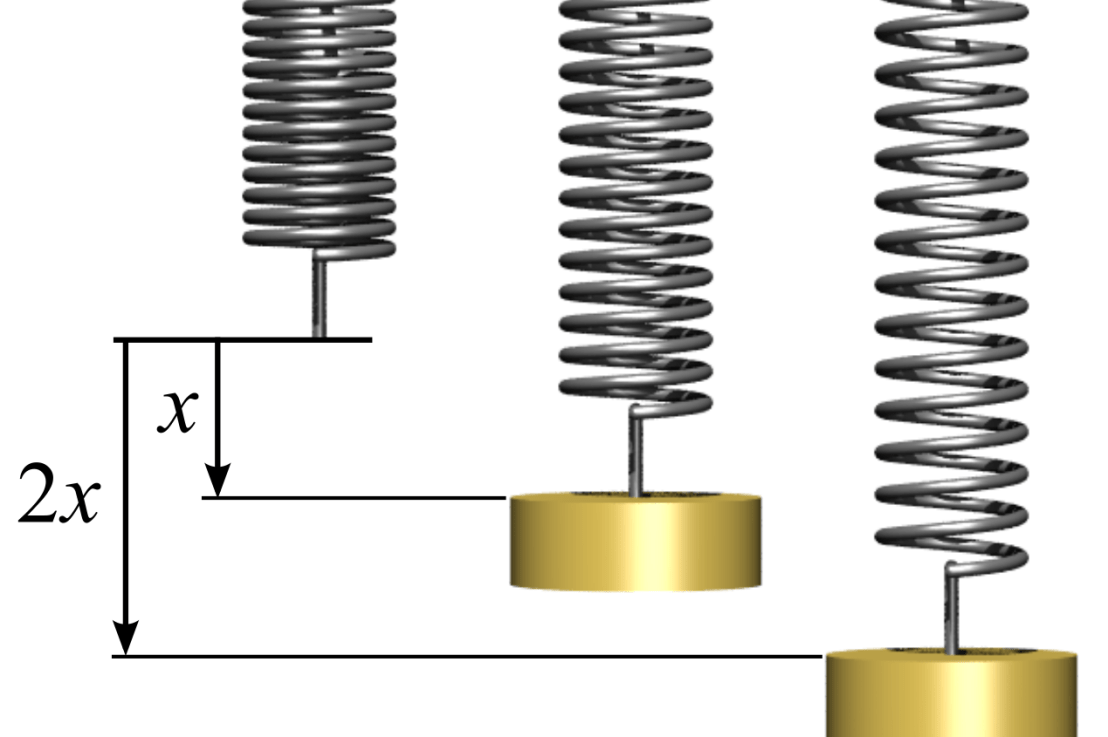
Have you ever wondered why the force of a spring appears to grow stronger as you pull it out? This physical phenomena can be explained with the simple use of Hooke’s law. Hooke’s law states that the force of a string can be measured with the equation Fspring=k*x, with k being the spring constant and xbeing the change in distance from the resting point. The Spring constant can be found empirically by measuring the force’s change over a distance and finding the slope. we can integrate this equation in respect to x to find the potential energy of the object to obtain Uspring=12*k*x2. As one can infer, the more we stretch it out, the more potential energy is in the system, and consequently the more kinetic energy it will have when it reaches the starting point, allowing it to reach a further displacement once again.

Young’s modulus

Young’s modulus

Young’s modulus        02/24/16
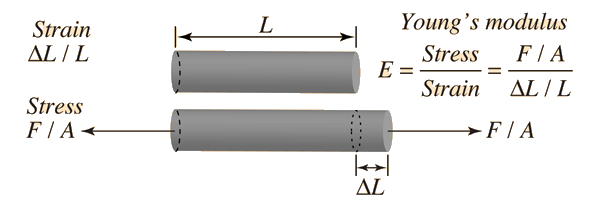
Have you ever wondered why a solid body deforms when stress is applied to it? This is a consequence of Young’s modulus. To get the big picture, Young’s modulus is a property of mechanical bodies that defines how much the body deforms under stress. Before we begin, we must define the terms stress and strain. Stress is the internal forces that neighboring molecules of an continuous material apply to each other (equation is ()=FA0, Force over original area), while strain is the measure of deformation of a material (=LL0, change in length over original length). Young’s modulus is the measure of the proportion of these factors E=()which results in F*L0A0*L. The higher a bodie’s young modulus is the more resistant it is.

Angular momentum

Angular momentum

  Angular momentum   02/21/16
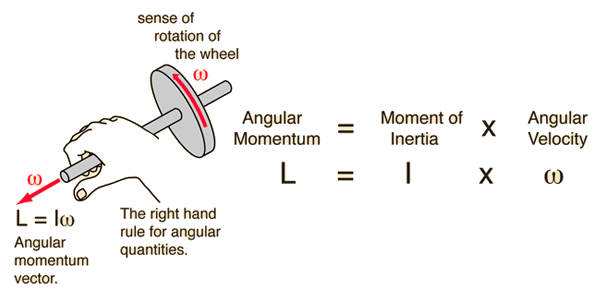
During one’s course of study of physics, one may encounter a concept known as angular momentum. Since momentum is defined as the product of the mass and movement of an object, wouldn’t it follow that there would be a special type of momentum for rotational systems, even if there was no translational movement? This quantity is known as Angular momentum. The mathematical formulation for angular momentum is given as L=I, where Iis the moment of inertia of the system and is the rotational velocity. Angular momentum can also be reformulated as L=r x p, where is the radius, pis the linear momentum and the angular momentum is the cross product between them. Like linear momentum, Angular momentum is always conserved.

Energy Efficiency

Energy Efficiency

Energy Efficiency 02/21/16

As a result of the second law of thermodynamics, the phenomena of a one hundred percent energy efficient system exists in human imagination only. Consequently, the energy efficiency of systems can be measured. If you take the percentage difference between the input power of a system and the amount of work it does, then you have just measured the energy efficiency. This has a pertinent application to the field of Engineering, where maximum efficiency is paramount. For example, the energy efficiency of most commercial solar cells is between 15-20%, so 15-20 percent of the energy taken in from the sun is transferred into usable work.