Category: Physics

Thermoplastics

Thermoplastics

Thermoplastics         

        04/22/16


Thermoplastics are plastic materials that become pliable once a certain temperature threshold has been reached and revert back to being rigid once cooled to a certain temperature. The amorphous nature of thermoplastics are less susceptible to chemical attacks and environmental stress cracking due to lacking such a clearly defined structure. Teflon is an example of an application of thermoplastics

Simple Machines

Simple Machines

Simple Machines      04/15/16


Simple machines are devices that change the direction or magnitude of force. In summation, they can be generalized as objects that utilize Mechanical advantage to modify the force values. The six machines identified as simple machines by renaissance scientists include the Lever (a beam fixed on a pendulum or fixed fulcrum), the Wheel and axle (A wheel attached to an axle and allowed to rotate which causes a force transmission), the Inclined plane (A flat planar surface tilted at an angle which is used to lift or lower loads), the wedge (A triangular shaped portable inclined plane), and the Screw (an object that translate rotational motion into linear motion)

Mechanical advantage

Mechanical advantage

Mechanical advantage 04/14/16


Mechanical advantage is the measurement of force amplification achieved by using a tool. In theory, power is conserved along along an object. In a linear object like a lever being spun around in a circle the velocity of a particle existing on a point along the lever increases with distance, which can be represented symbolically by equation  (1) v=*r. The equation of power is (2) P=F*v, and since power is conserved along the object, comparing a location  Ato a location Bcan be represented as Pa=PbFa*va= Fb*vbwhich can be stated as vavb=FbFa, and by inserting equation (1) we can finally arrive at ab=FbFa, thereby proving our force amplification effect.

Thermal runway

Thermal runway

Thermal runway 04/10/16


Have you ever wondered if an increase in temperature could cause a further increase in temperature? This simple idea is the basis of a phenomena known as a thermal runway. In Chemical Engineering, a thermal runaway can happen if a reaction rate increases due to an increase in temperature, which causes a further increase in temperature and spins out of control. In Electrical Engineering, joule heating may diminish resistive elements which further increases current which further increases heating.


If one thinks about it, couldn’t this phenomena simply be modeled with differential equations?

Earth’s magnetic field

Earth’s magnetic field

Earth’s magnetic field        04/08/16


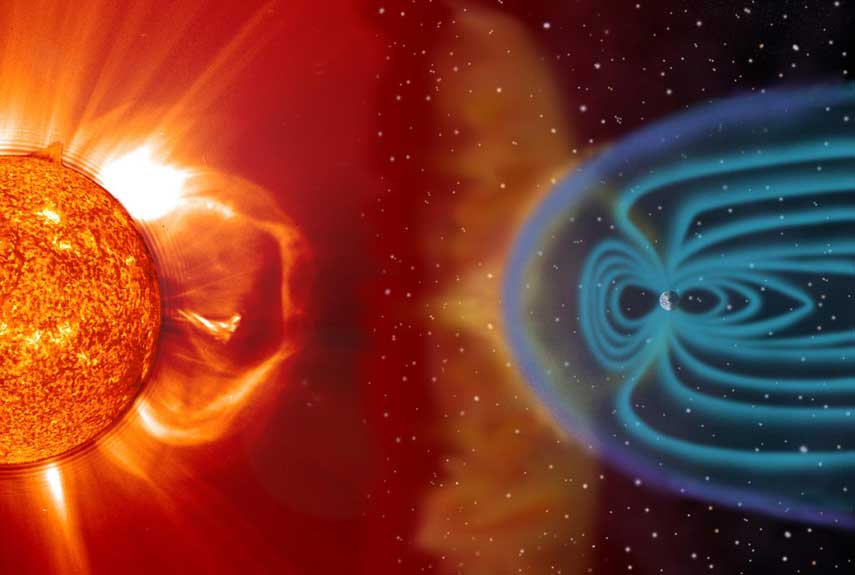
One of the main reasons why the Earth is capable of sustaining life is because of the ever present Magnetic field that it encases. The Earth’s magnetic field usually has an intensity of around 0.65 Gauss, which is enough to deflect charged particles from solar wind aimed at the planet. Also, the magnetic south pole is actually located near the Hudson bay in Canada (the poles are switched around in respect to our conceptual geographic location), so most compases do not point directly north. Every so often the Earth goes through a magnetic field reversal, in which the poles switch from one point to another. The magnetic field is thought to originate from moving iron magma in the outer core of the Earth. Some animals are thought to be able to detect the magnetic field of the earth through the use of biomagnetism, in which a piece of magnetite in the brain of the animal is able to respond to the magnetic field, acting as a sixth sense.

Spontaneous combustion

Spontaneous combustion

  Spontaneous combustion    04/06/16


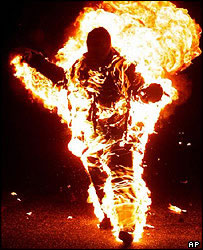
Spontaneous combustion is when an object catches fire through the effect of self-heating. First, objects with low ignition temperatures begin to release heat. If such heat is unable to escape, then the heat re-enters the system. The combustion temperature will rise, and eventually if ignition point is reached and an oxidizer is present, then spontaneous combustion will occur. Hay is an example of an object that reaches combustion quickly.   

Sunspots

Sunspots

Sunspots           04/04/16


Sunspots are a most peculiar phenomena occurring in the solar system. Sunspots are regions of the sun that are darker and (relatively) cooler than the surrounding photosphere. Sunspots are a temporary phenomenon, usually with a lifespan lasting from several hours to several months. Sunspots can be carried around by the internal rotation of a stellar object. Consequently, the amount of sunspots on a sun have a sinusoidal variability (meaning that the amount of sunspots on the spot goes up and down with time) and this causes the sun to be slightly cooler during times of high sunspot activity. Sunspots also have a high magnetic activity, which in turn can be correlated with events such as coronal mass ejections.

Convection zone

Convection zone

Convection zone         04/02/16


The Convection zone is a layer of a stellar object that is unstable to convection. In this area of a star, all of the energy of this layer is driven completely by convection. This layer is “cool” enough to have heavier ions such as Calcium, nitrogen, carbon, and nitrogen. The convection zone is an important part for any star.

Coronal mass ejection

Coronal mass ejection

       Coronal mass ejection                   04/01/16


Coronal mass ejections are a very intriguing part of solar physics.During filament eruptions, a large amount of hot plasma encapsulated in a magnetic field may be released. Coronal mass ejections will then drift throughout space and if it comes into contact with the Earth, then a Geomagnetic storm may ensue. If the revolution of the magnetic field lines of the CME is in parallel with the magnetic field lines of the Earth, then there will be a large amount of magnetic interference and power grids will be completely shut off.