“What are the residuals left behind by drinking water treatment?”
Treating water for toxins is a vital part of modern infrastructure. However, these processes will leave behind Water Treatment Residuals such as coagulants or sediments. Water infrastructure engineers must handle these residuals to create a healthy, sustainable system.
Water will collect over land when there are insufficient infiltration capabilities. If this water has no place to drain, it will coalesce into a sizable puddle. This Ponding process can produce small bodies of water that can carry pollutants, become mosquito nesting grounds, and even damage building structures if it collects on a small roof.
“How can we quantify the maximum amount of water a watershed can hold before runoff?”
Watershed geologies can hold a certain amount of moisture before runoff occurs. We can measure this through the Potential Maximum Retention, a hydrological quantity that represents the maximum amount of water a watershed can absorb before starting runoff.
“How can we quantify the initial rainfall losses before runoff begins?”
Rainfall will lead to water hitting the ground. Before anything happens, some of the rainfall will get intercepted by vegetation or infiltrate into the ground and get lost from the system. Hydrologists represent this value as the Initial Abstraction. Initial abstraction is an important quantity in hydroshed and stormwater studies.
“How can we conceptualize the total potential of a fluid’s pressure?”
We know that a fluid that is higher than another will usually flow downwards if they’re connected. However, if the lower fluid has a high enough pressure or velocity, then it can overpower the higher fluid and move upwards. One way to conceptualize this is to imagine that the pressure and kinetic energy of each fluid adds extra height, and whichever fluid has the highest theoretical “height” will govern the direction of flow. This is the concept behind Hydraulic Head, as illustrated by the equation h = P/(rho_w * g) + z + v^2/(2*g), where h is the hydraulic head, P the fluid pressure, rho_w the fluid density, g the gravitational constant, z the fluid elevation, and v the fluid velocity.
“What happens when stormwater runoff enters a regulated body?”
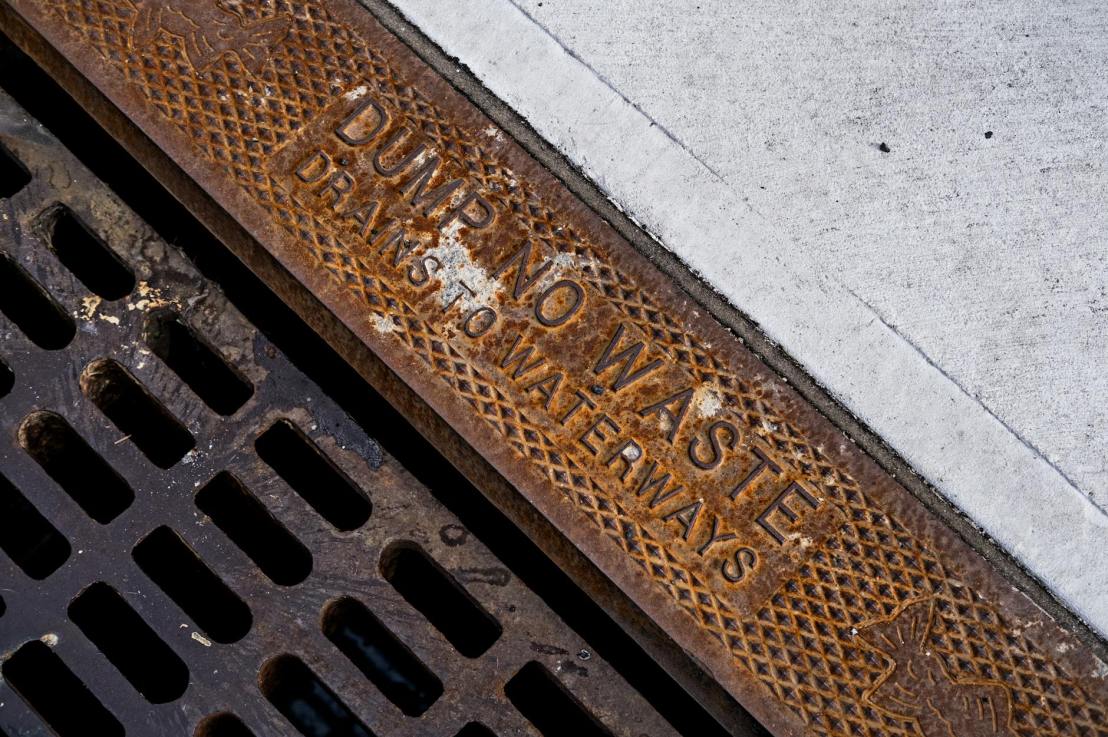
Stormwater runoff is the water from rain that flows over the ground instead of seeping into it. Some of this rain may enter a regulated body, such as a stream or a storm drain. This water, known as Stormwater Discharge, may contain pollutants it picked up during its journey on the surface. Infrastructure operators should treat stormwater or prevent it from getting polluted before it enters water bodies. Engineers and planners must design public facilities around predicted peak stormwater discharge values and holding times.
“How can we get a base estimate of a small watershed’s discharge potential?”
Runoff events vary by storm and watershed. However, we may want to compare the discharge potential of different watersheds without having to account for variations in different storms. So, what if we were to calculate how much peak discharge each watershed would produce for a 1-inch rain event, regardless of its area? Well, this is the idea behind Unit Peak Discharge, which is measured in flow rate per area per runoff amount. Calculating unit peak discharge is essential in estimating peak discharge using the TR-55 graphical method.
“How can we use simplified procedures to estimate runoff and peak discharges in small watersheds?”
Predicting runoff and peak discharges for watersheds can be a very difficult task. There are so many factors that you have to consider without great precision. However, for small watersheds in the US, the Natural Resources Conservation Service of the U.S. Department of Agriculture has developed a procedure called TR-55 to handle these. TR-55 uses empirically derived data and hydrological modeling to determine runoff and peak discharges.
“How do we classify the amount of stormwater runoff that can be captured and kept out of the stormwater system?”
Rain brings stormwater runoff. And when stormwater runoff is too large to control, it can lead to damaging flooding and pollution. But suppose systems, natural or human-made, are designed clever enough. In that case, they can capture some of this stormwater and prevent it from entering stormwater handling infrastructure through absorption, infiltration, evaporation, or reuse. Whatever amount of stormwater is handled through this manner is classified as Runoff Reduction Volume. Interventions like rain gardens and bioswales can increase the expected runoff reduction volume.




 Isaac's Science Blog