Category: Chemistry

Alkalis

Alkalis

Alkalis

10/08/25

“What makes bases that dissolve in water so special?”

Bases in chemistry come in all forms. Some of them dissolve in water. These soluble bases, or Alkalis, are vital for helping water absorb acids. Examples of bases include sodium hydroxide (NaOH) and calcium hydroxide (Ca(OH)2).

Image credit: https://www.polyestermfg.com/

Lime Softening

Lime Softening

Lime Softening

10/07/25

“How can we use lime to remove magnesium and calcium ions from water?”

Water with an overabundance of magnesium and calcium ions requires water softening to prevent soap scum buildup. One way to accomplish this is to add limewater (calcium hydroxide) to the water to raise its pH level, forcing the magnesium and calcium to precipitate out by bonding with carbonate molecules. This process, often referred to as Lime Softening, is an effective way to soften water for practical use.

Image credit: https://samcotech.com/

Dissolved Oxygen

Dissolved Oxygen

Dissolved Oxygen

10/06/25

“How do we measure the amount of oxygen in water?”

Water usually contains free, unbonded oxygen molecules. This oxygen enables marine species and bacteria to breathe and facilitates wastewater treatment reactions. The amount of oxygen in water is measured as Dissolved Oxygen in mg/L. Water’s ability to hold dissolved oxygen decreases with increased salinity and temperature.

Hard Water

Hard Water

Hard Water

10/03/25

“What’s special about water with high mineral ion content?”

Water will change depending on what it’s exposed to. When water percolates through limestone, chalk, or gypsum deposits, it might pick up ions such as calcium and magnesium. When this Hard Water comes into contact with soap, the fatty acids can react with the minerals to create a chalky precipitate that sticks to surfaces, leading to difficulty in cleaning, plumbing, appliance performance, and HVAC heating system efficiency. Water softening can reduce a water’s hardness

Image credit: https://baileyokc.com/

Osmotic Pressure

Osmotic Pressure

Osmotic Pressure

09/30/25

“What’s the pressure needed to stop osmosis?”

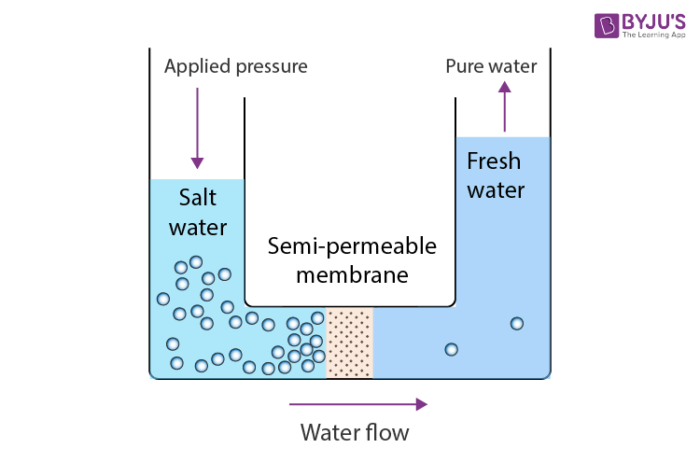
Imagine a semi-permeable layer dividing a container of freshwater from a container of saltwater, each with equal volumes. Now imagine that the semi-permeable layer is small enough for water particles to pass through, but not for salt particles. Since there are more water particles on the saltwater side than on the freshwater side, there will be a water particle migration until there’s an equal amount on both sides. This will lead to a pressure differential in the direction of the salt water. The pressure necessary to overcome this imbalance and begin the reverse osmosis process is called the Osmotic Pressure, given by the equation pi = phi * (n/V)RT, where pi is the osmotic pressure, phi is the osmotic coefficient, n is the number of moles in the solute (in this case, salt), V the volume of the solvent, R the universal gas constant, and T the absolute temperature.

Image credit: https://cdn1.byjus.com/

Distillation

Distillation

Distillation

09/29/25

“How can we use boiling to separate two substances mixed together?”

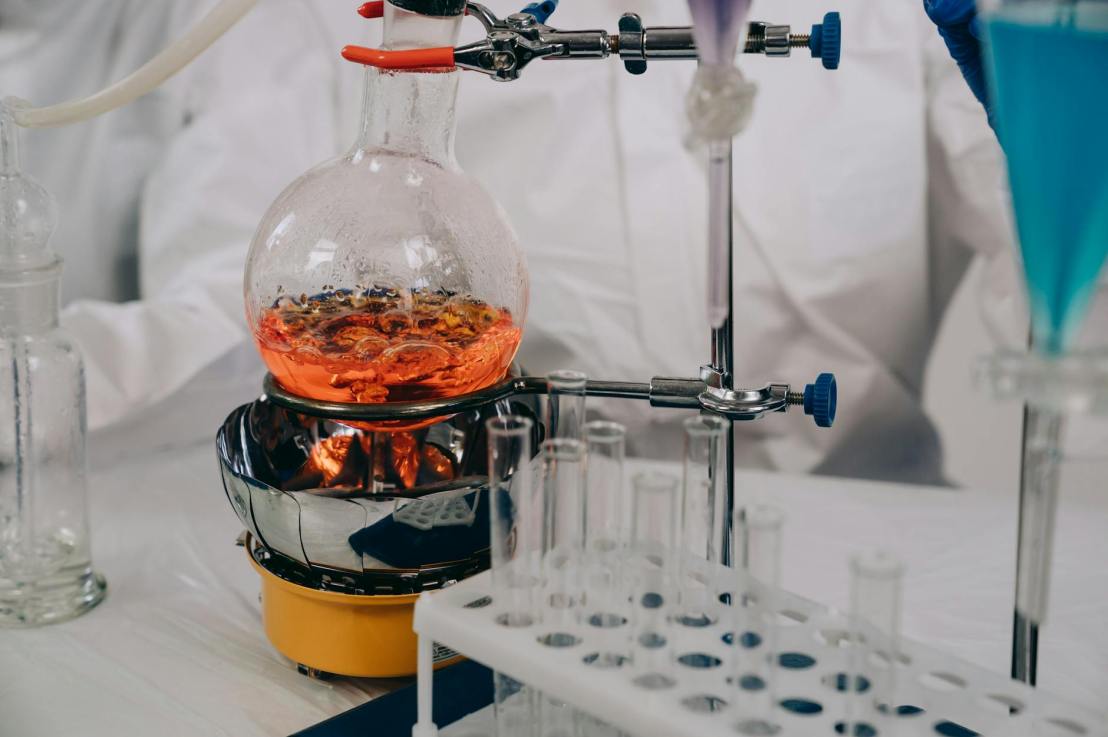
Substances mixed together in a liquid can be difficult to separate. But applying a bit of chemical knowledge can help us. If the two mixtures have significantly different boiling points, then one will vaporize before the other. So what if we were to capture this vapor and condense it into another reservoir to separate the substances? Well, this is the idea behind Distillation. Water treatment systems can apply distillation to separate water from contaminants. If the boiling points between the different substances are less than 100 degrees ˚C apart, then operators must use a special fractional distillation technique.

Henry’s Law

Henry’s Law

Henry’s Law

09/28/25

“What describes the relationship between the amount of gas dissolved in a liquid and the partial pressure above the liquid?”

Pressure forces gas to move. If gas is in a container with a liquid and high pressure is acting on the gas, there is more force to move more of the gas into the liquid. If there is low pressure acting on the liquid, then more of the gas will escape from the liquid. This behavior is described by Henry’s Law, which is described by the formula C = k_H*P, with C being the concentration of the gas dissolved in the liquid (mol/L or mg/L), k_H the Henry’s Law constant (mol/liter-atm or dimensionless), and P the partial pressure of the gas in the air above the liquid (atm). Henry’s Law is a vital part of mass transfer analysis for many applications.

Volatile Organic Compounds

Volatile Organic Compounds

Volatile Organic Compounds

09/27/25

“What makes chemicals that have high vapor pressures at room temperature special?”

Substances with high vapor pressures become gases at low temperatures. Carbon-containing substances with high vapor pressures are classified as Volatile Organic Compounds, or VOCs. There are upwards of over ten thousand VOCs identified, ranging from perfumes to greenhouse gases. VOCs are the sources of most of the scents that humans can smell, and many VOCs contribute to air quality issues.

CT Value (Water Disinfection)

CT Value (Water Disinfection)

CT Value (Water Disinfection)

09/26/25

“How can we quantify the effectiveness of chemical disinfection treatment?”

Chemical disinfection processes have a wide range of effectiveness. But what variables govern how much impact a certain process has? Well, it turns out by multiplying the concentration (C) in mg/L of a chemical by the amount of contact time (T) with the water, we can obtain the CT Value. While increasing concentration is generally helpful for CT values, it can also increase chemical byproducts, making increasing contact time more effective. Water treatment operators have lab data giving the CT values needed to destroy specific microorganisms.