Author: Isaac Gendler

Body centered cubic structure

Body centered cubic structure

Body centered cubic structure

02/15/17

“How are materials such as Tungsten arranged on the molecular level?”
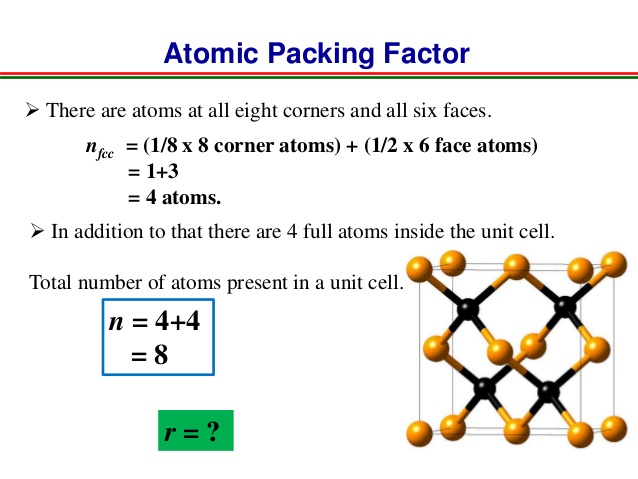
There are countless forms of materials that can be found in the universe. And the reason why these materials are different rests on the geometry of their subatomic arrangement. So let’s take a look at an arrangement called the body centered cubic structure. The atomic arrangement of the body centered cubic structure (commonly referred to as the BCC structure) can be discretized into a chain of cubic divisions. Each cube will contain two atoms, one in the center and ⅛ of another at each corner, giving this a packaging factor of 0.68. Because of this arrangement, materials that use a BCC structure such as tungsten and chromium are typically harder and less malleable than the average atomic arrangement.
Atomic packing factor

Atomic packing factor

Atomic packing factor

02/14/17

“How can we quantify how much of a crystal structure is occupied by its particles?”
When working with crystals, it can be easy to forget that the entire volume of the structure is not occupied by its constituent particle. Because of this, it can be useful to quantify how much space is actually filled with material. After years and years of hard work and careful research, Materials Scientists have come up with a conceptual tool called an atomic packing factor. The atomic packing factor is calculated by taking the total number of particles in a crystal volume, multiplying it by their volumes and then dividing it by the total volume. This relationship can be quantitatively organized using the equation APF = (Number of atoms *Volume of atoms )/Volume of crystal. This procedure is useful for research in sustainable energy, as one would be able to analyze the properties of different types of photovoltaic crystals for solar panels.

Radius of gyration

Radius of gyration

Radius of gyration

02/13/17

“What would happen if we were to take the entirety of the object’s mass and concentrate it at a point?”
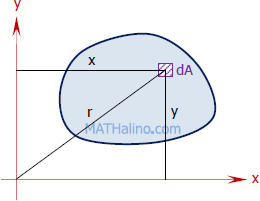
During one’s study of statics, one will have to work with the mass and moment of inertia for objects. However, could there be any ways in which we could simplify our calculations just a tad bit? Well, let’s think about it. Everything could be much simpler if we were to take the mass of the object and concentrate it at a single point away from the axis so that the resultant moment of inertia would be equivalent to original moment of inertia? This is the fundamental idea behind a concept known as the radius of gyration, and can be found with the equation k=Im, with k being the radius, I being the moment of inertia, and m being the mass.

Nuclear power generation

Nuclear power generation

Nuclear power generation

02/12/17

“How exactly is Nuclear power generated?”
We hear about nuclear power very frequently in our lives. However, how exactly does it work? Well, to start let’s look at the process. The fundamentals of nuclear power start with two elements, uranium-238 and uranium 235. U238 composes the majority of uranium in a nuclear power plant, but perhaps the most important of the two is u235. Uranium 235 is very unstable and will decompose rapidly through nuclear fission. When U235 decomposes, it’s neutrons will be thrust throughout space. When these neutrons collide with U238, the element will be shattered into a stream of different particles, which will hit other elements. This quickly sets up a chain reaction which produces a large amount of heat. This heat is then used to boil water to generate steam to move a turbine which generates electricity.

How the poor will be disproportionately affected by climate change

How the poor will be disproportionately affected by climate change

How the poor will be disproportionately affected by climate change

02/11/17

“Is it true that fighting climate change will also fight poverty?”
In the current political discourse over climate change, there seems to be people camped on to two sides, those who value action to increase the impact of sustainable systems and those who value fighting poverty. However, if one were to analyze this issue scientifically, then one would realize that this is a false dichotomy. An increase in global temperatures would cause a corresponding devastation in agriculture. Not only would this inhibit the daily productivity of impoverished farmers worldwide, but it would also cause a rise in food prices. Since the global poor spend the majority of their income on food, this would cripple their livelihoods. On top of this, since much of the developing world lives near the equator, increased global temperatures will make this already balmy region even hotter, throwing the entire system out of equilibrium and devastating people of lesser economic means. Therefore, if you see a politician talk about how investing in sustainability is a “waste of money” please tell them to analyze the facts and then make an informed decision.

A new way to power rural communities

A new way to power rural communities

A new way to power rural communities

02/10/17

“How is Nigeria combating climate change and rural poverty in a most ingenious way?”
Nigeria is a country in western Africa which is home to nearly one hundred million people without electricity. In addition, because of it’s geographic location, it will be disproportionately affected by climate change. Luckily, this country is not a complacent one, and has already begun fighting back. A company called Lumos based in the Netherlands has developed a “micro micro grid” for the Nigerian market in which a single 80W solar panel will be attached to a housing unit which provides energy to a suitcase size battery which will power a home. These units have an upfront cost of only $75.00, and the electricity can be paid for using simple mobile phone text. after four years of using a model, the users will no longer have to pay for ongoing electricity use! This technology has the potential to electrify millions of rural homes in a safe and sustainable manner.

The wind turbines on the Eiffel tower

The wind turbines on the Eiffel tower

The wind turbines on the Eiffel tower

02/09/17

“Is renewable energy becoming so popular that even the Eiffel tower is starting to use it?”
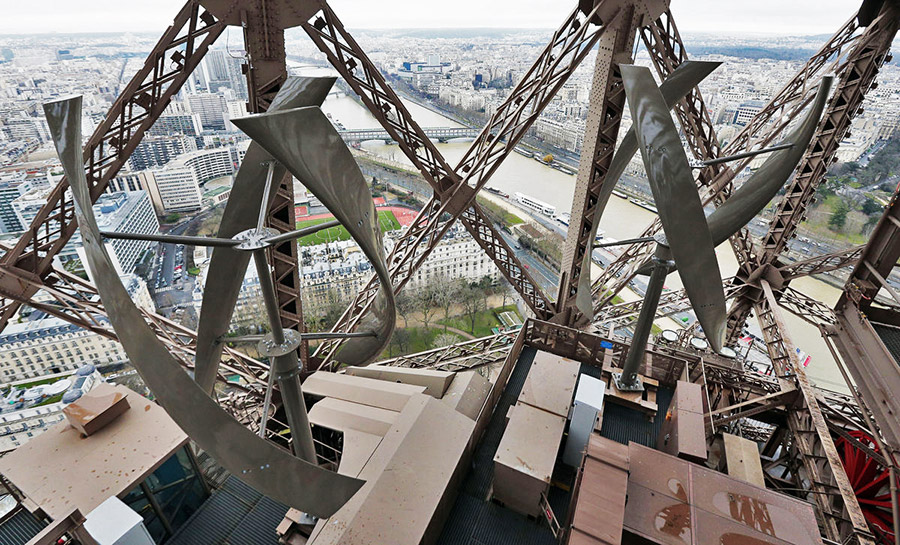
Interest in renewable energy is skyrocketing around the world. Investors have taken note that prices have fallen so low in many areas that renewables are now cheaper than their pollutive non-renewable counterparts. In fact, renewable energy is becoming so popular that even national monuments are starting to use them. As of 2015, The Eiffel tower in Paris, France has become outfitted with two wind turbines to increase power generation. These turbines utilize a vertical axis design that is 5.2 meters in height and 3.2 meters in width which can be expected to produce 10,000 kilowatt-hours of electricity per year!

Overhead power lines

Overhead power lines

Overhead power lines

02/08/17

“What structures are put in place to transmit electricity along long distances?”
Human civilization in its present form has a tremendous energy requirement to sustain itself, which is provided through the use of complex energy generation systems. However, such infrastructure tends to be placed a large distance away from inhabitation, so how can we transfer the generated energy safely into where humans need them? Well, we can accomplish such a task through the use of overhead power lines. Overhead power lines are constructed by using one or more conducting lines being suspended through strong mechanical beams. These conducting lines will be able to safely insulate from the external world and transfer it to other locations, while the beams will be able to support the weight. Overhead power lines are a cost effective way to distribute energy and are used around the world from the mountains of California to the streets of Istanbul.

Focal point

Focal point

Focal point

02/07/17

“Why is the point that light will hit for a concentrated solar power system so special?”

Concentrated solar power is famous for its use of parabolic cylinders to concentrate solar energy. However, what special physical property gives it its strength? Well, let’s use a little bit of scientific thinking to find out. Since all light rays contain energy, and these solar systems work by absorbing energy from concentrated sunlight, would it not be logical that we would just place the water at the point of maximum sunlight? If we do enough experimentation, then we will find out that this point is where all of the rays will converge! This point has been termed the focal point and is used for a variety of other applications ranging from photography to telescopes.