Why Fires are Growing at an Exponential Rate in the Brazilian Rain Forest?
08/22/19
“Why are there so many more fires in the Brazilian Amazon now and what are the consequences?”
One of the worst ecological disasters ever recorded is happening as we speak. Brazil has recorded an increase of wildfires by 80% compared to last year. Much of this increase is human-caused and concentrated in the Amazon, where the new government is trying to develop it for commercial purposes. This is incredibly dangerous, as the Amazon rain forest is one of the largest sinks for carbon dioxide but could become a carbon source if it becomes deforested and dries out. This is Why Fires are Growing at an Exponential Rate in the Brazilian Rain Forest.
If you would like to take action, please take a look at the organization Amazon Watch.
“What makes 5G 5G and what are the benefits and drawbacks?”
5G is poised to disrupt the world of mobile communications. This is being driven by its greater radio frequency spectrum. 4G devices can receive signals ranging from 3 kHz to 6 GHz, while 5G can go up to 300 GHz! Although these Millimeter Waves allow for more connections, they also lack the ability to penetrate hard surfaces such as trees and buildings. This makes it one of the biggest barriers to mass 5G deployment, and will need to be solved by further research and innovation.
A revolution in the mobile world is coming. As traditional 4G networks are nearing their limit, the next generation of mobile internet connectivity, 5G, is just starting to spread. By using new millimeter wave technology, 5G networks have an order of magnitude faster connection, reaching speeds as high as a gigabyte a second! These fast speeds will catalyze the development of the internet of things, autonomous vehicles, and a host of other applications not yet thought up yet.
When air quality is talked about, usually the discussion is focused on the exterior environment. However, the air quality inside a building can fluctuate as well. The Indoor Air Quality, also known as IAQ, is contingent upon a multitude of factors, such as type of ventilation, exterior air quality, processes occurring inside the building, and building materials. IAQ can have drastic effects on its inhabitants.
“What happens when a municipality runs out of water?”
Around the world, increasing temperatures, population, and levels of consumption are putting a strain on municipal water supplies. In fact, many of these areas can now even predict the day that they run out of water. To avoid this Day Zero, municipalities need to consider resilience strategies in regards to their water supplies, and even take measures as drastic as Cape Town’s.
“How can shutting down electricity loads help stop grid failures?”
The electrical grid is one of the most complex machines in the world. However, like all machines, it can be prone to failure from overuse. One thing we can do to prevent this is take inspiration from demand side response and commit to load shedding unnecessary assets when the supply cannot keep up with demand. This way the grid can be stabilized before a black start is necessary. This is Why Load Shedding Can Increase Grid Resilience.
Why Buildings in Polluted Areas Need Higher Ventilation Rates
08/16/19
“Why do buildings in polluted areas need higher ventilation rates?”
Ventilation is used to ensure high quality air in interior spaces. However, since external air can seep in through cracks, ventilation rates need to be higher to ensure higher levels of circulation. This is Why Buildings in Polluted Areas Need Higher Ventilation Rates.
This project concerns the effects that a sudden loss of electricity has upon other infrastructure systems and how citizens can adapt to it. This was completed at Carnegie Mellon University’s Engineering and Public Policy Department during the Summer of 2019 under the guidance of Professor Parth Vaishnav with funding provided by the Sally Casanova Scholars Program.
The Effects of Cascading Electricity Failures on Interdependent Infrastructure Systems.
Denizens of the industrialized world take a constant and consistent energy supply as given. But although chances of occurrence are low, mature energy infrastructure is prone to crashing, best exemplified by events such as the 2003 Northeastern US blackout which left over 50 million individuals without power, billions of dollars of damage, and a whole world in shock. Much of this damage is driven by the tightly interwoven interdependencies which exist between different infrastructure systems, as the loss of electricity can have catastrophic effects on transportation, water supplies, communications, medical stability, and numerous more. Given the paucity of literature on this subject, it would only be reasonable to explore this subject matter more and speak with individuals who have been personally affected by this issue.
Review of Terminology
Resilience can be thought of as the capacity to anticipate critical events as well as maintain operations during, and recover from disastrous events. In engineering literature resilience plays a decisive role in the study of critical infrastructure systems. Most research regarding the resilience of critical infrastructure systems focuses on single, isolated systems, such as the electric grid, transportation, or water without consideration to surrounding systems. These models fail to take into account the effects that the interdependence between these infrastructures have.
Modern critical infrastructures are incredibly interconnected. Electricity powers the stoplights, light detectors, and subways which compose the modern transportation sector. Entire metropolitan areas are provided water which is moved and sanitized by industrial-sized energy driven pumps. If the electricity supply is damaged, then the operations of these systems will be disrupted as well. Modern critical infrastructures are incredibly interconnected. Roads provide commercial vehicles the ability to move diesel fuel to industrial areas. If there is even a small perturbation to one of these systems, then it could have cascading effects on the other. Models that do not capture these conditions will provide a much worse description of reality.
These interdependencies can be analyzed through the lens of a framework developed by Rinaldi et, al 2001. Infrastructure failures fall into many different types. The ones that we will be focusing on are known as cascading infrastructure failure, or when failure in one infrastructure system causes a failure in another to unfold, leading to catastrophic damage. The intensity in which infrastructure systems are related to one another is governed by their degree of coupling, coupling order, and the linearity or complexity of their actions. A higher degree of coupling means a faster response time, the coupling order indicates if they directly influence one another or if there is an intermediary, and the linearity/complexity of their actions indicate if a change in the system causes a linear or complex disturbance.
One of the most prominent effects on infrastructures is their infrastructure environment, or the social and economic fabric in which the operators and owners govern the use of such infrastructure. The nature of the infrastructure environment is discussed in more detail in chapter 2 of Litte, Richard G’s book Disrupted Cities. In his research, he explains that modern-day infrastructure has become more and more closely coupled and therefore less resilient. To him, the biggest threat to a system’s resilience is not the engineering or human errors that are typically analyzed in failure analysis but institutional cultural errors. Specifically, institutions which focus more energy on economic profits or efficiency over safety create systems which are much more vulnerable to infrastructure errors. Organizations and institutions which operate in high risk scenarios and experience few mishaps do so because of their insistence on following Core Values and placing security above efficiency. Electricity utilities should take note of this.
The 2003 Northeastern Blackout
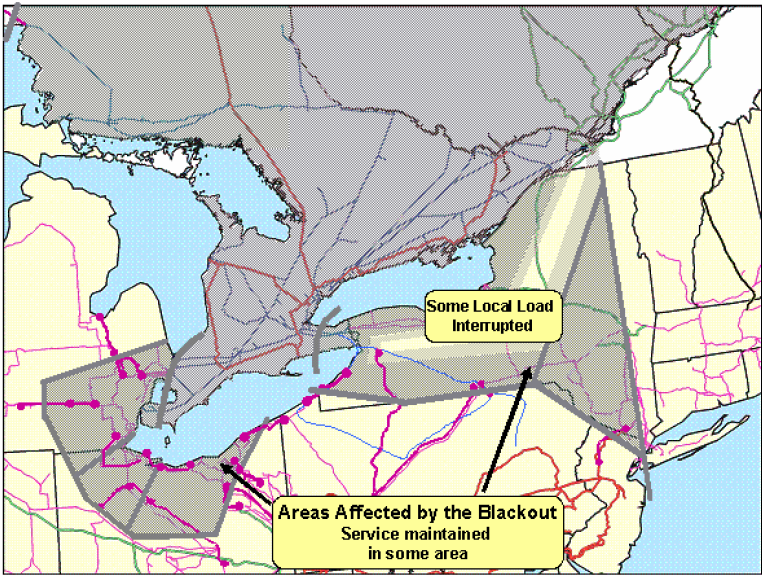
Due to its sheer magnitude and wide variety of affects, the 2003 Northeast blackout is an exemplary case study for the effects of cascading power outages on interdependent infrastructure systems. The blackout started with the loss of a power-line in Northeastern Ohio beginning on August 14th. Since the control center for the local utility was unable to see the loss and react in time, the power overflow continued to knock-down power lines, cascading until a large-area blackout had occurred, affecting 50 million people in total. The geographic extent of this can be seen in figure 1.
This electricity failures on other infrastructures left a dire strain on the transportation, water, medical, and communications infrastructures.
Figure 1. Areas affected by the blackout (Council, N. A. E. R. (2004))
The February 2019 Pittsburgh Windstorm Cascading Electricity Outage
On February 24th 2019, record-breaking wind speeds caused a number of electric utility poles in Western Pennsylvania to fall down, leaving thousands in the city of Pittsburgh without power (Serrano, P. 2019). Due to the significance in the local region, this event was also used as a case-study.
Impact of Cascading Electricity Failures on Transportation.
With the proliferation of electronic communications onto all walks of life, the transportation sector has become much more reliant on electrical power. Traffic lights, cameras, and light detectors all utilize electric power for their operations. Subways and light rail systems use electromagnetic motors for propulsion between stops. With the absence of power, these systems collapse, spawning a lack of transportation organization and urban chaos. A fine illustration of this event occurred in several locations during the 2003 Northeast blackout. In the Detroit-Windsor Tunnel, a three-to-four hour backup had occurred on the entrance to Canada due to the lanes temporarily shutting down after the power went out (DeBlasio et. al. 2004). Not only did these delays disrupt commerce, but also impeded the flow of medical workers based in Ontario to Detroit area hospitals. In New York City, the subways stopped moving (forcing approximately 40,000 passengers out onto the streets) and bus drivers lost communication with one another. Combined with the fact that 11,600 signalized intersections lost power, major traffic ensued, resulting in heavy obstruction until 11:00 pm at night. However unlike much of the other effects from the blackout, vehicle gridlock proved to be transient in nature. As the blackout continued onto the next day, people did not go into work and stayed home, thus causing traffic to die down.
Impact of Cascading Electricity Failures on Water Infrastructure.
Although commonly thought of as two mutually exclusive resources, water and electricity are tied together in many ways, form what researchers call a water-energy nexus. Water infrastructure is highly dependent on electricity supplies, as water is commonly carried from one area to another through pumps that require energy for input. Furthermore, treatment of this water requires energy to be used to wash away bacteria, parasites, and all other contaminants which may have a negative impact on human health. Sewage treatment centers also release waste into bodies of water during blackouts due to overfill, leading to the potential to cause a whole series of health issues. As a result, downed electricity systems are disastrous for water supplies.
An example of these types of failure can be seen in the 2003 Northeast Blackout. During the prime of the emergency, water pump and treatment facilities we shut off, not only causing the water pressure to drop precipitously but also sending gallons of sewage into surrounding bodies of water. This lead to large-scale contamination of drinking water, prompting cities and municipalities to not turn on water supplies for upwards of 72 hours to ensure that water would become potable again.
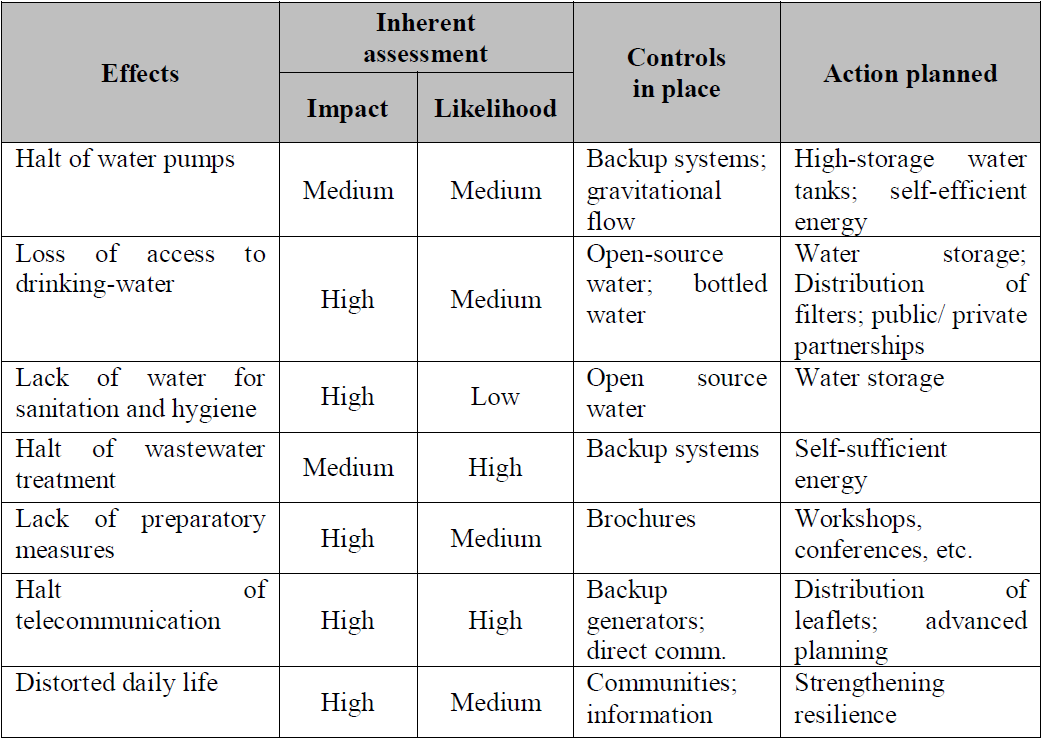
Methods to build resilience can be seen in table 1.
Table 1. Strategies to build resilience to support water resilience (Mank, I. (2015))
Impact of Cascading Electricity Failures and Water Shortage on Human Health.
Perhaps one of the most devastating consequences of interdependent infrastructure failure is the effect it has on human health. Not only will lack of power tarnish perishable food and shutdown HVAC systems, but also disrupt the electrical supply, temperature control, and water that modern medical technology relies on to perform operational procedures.
This can be seen most clearly during the course of events that occured in Detroit-area hospitals during the 2003 Northeast Blackout. Once the electricity switched off, backup generators were activated on to provide much needed power. Even through the generators were able to keep the hospital moving, the generators were running off fuel which only had a limited supply. The lack of clean and available water resulted in a multitude of problems for the medical facility. Instead of being able to provide patients with tap water, emergency water bottles had to be used to nourish patients. Furthermore, the loss of electricity also caused water pressure to become lost, which ends up compromising the ability for many essential building operations to take place. Toilets were unable to operate, taking away any methods to flush commodes and fecal matters. Other sanitary procedures were also down, such as faucets dispensing water to clean hands or sterilize instruments. Since there was no water pressure to get water to the air conditioning condenser, air conditioning systems malfunctioned, leading to discomfort to patients and workers in the hospital. (Klein et. al, 2005)
Impact of Cascading Electricity Failures on Communications
As a result of the buildup of mobile electronic devices, the communications sector has become heavily dependent on power. Infrastructure such as radio towers, cell phone charge levels, and pager communications can be greatly harmed with the loss of power. The interconnectedness brought about by communications and its loss compounds onto recovery of other sectors. Transportation recovery is stalled as communications between traffic coordinators and bus drivers are halted (DeBlasio et. al. 2004). The lack of responsive communications impinges the ability of medical practitioners to take care of their patients and run their facilities. (Klein et. al, 2005)
Visualization of interdependencies
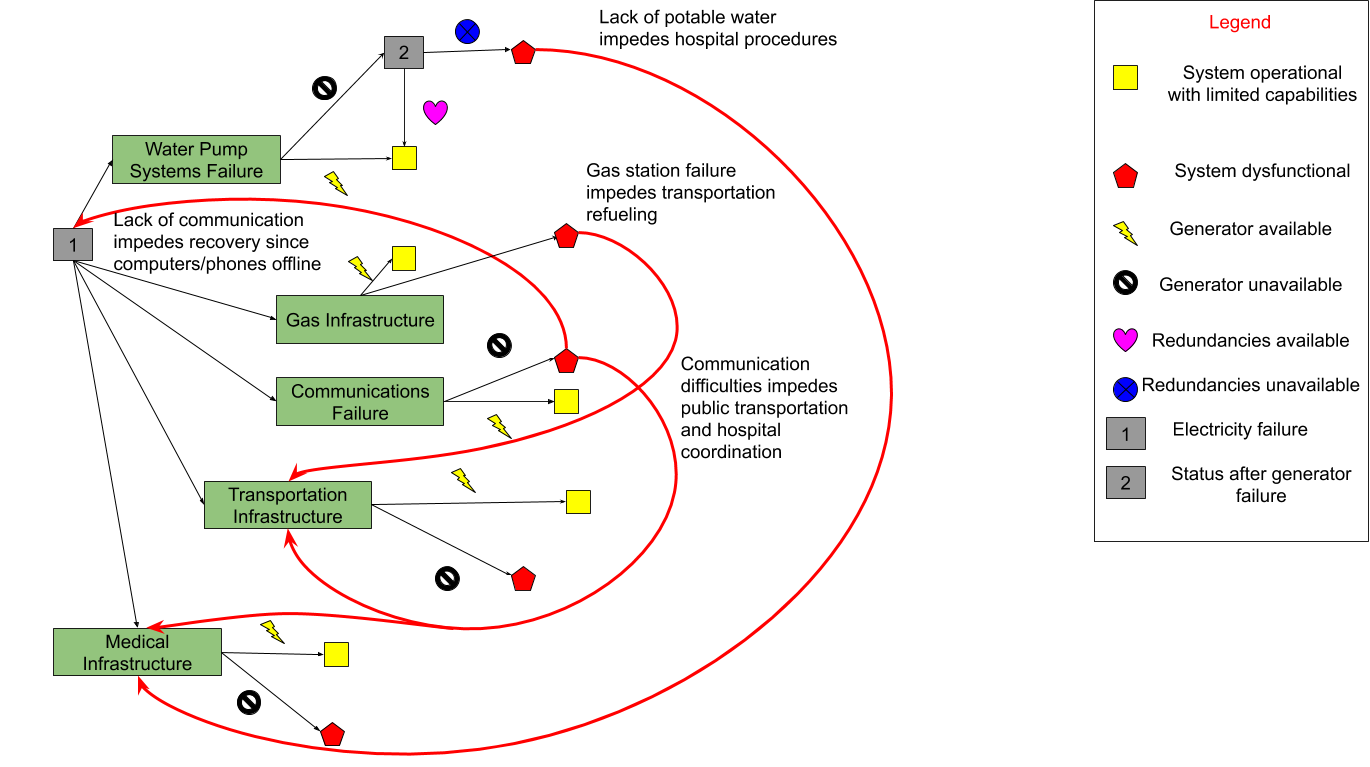
A visualization of the interdependent links between electricity failures and other infrastructures in can be seen in figure 2.
Figure 2. Interdependent influence diagram given the loss of electricity
What would have happened if things went on for longer in 2003.
If the blackout had occurred for longer, then much more systematic damage would have ensued. Since people do not enter work during a power outage, if the event stayed on for longer then local municipalities would suffer economic damages from the lack of commerce. Critical facilities such as hospitals which used generators to provide electricity would become fuel starved and may need to ration when electricity is being used in order to preserve supplies. There would also be more discharge into bodies of water from the water-treatment plants malfunctioning, exacerbating health issues and making recovery times longer.
How people coped with the Pittsburgh winter storm disaster
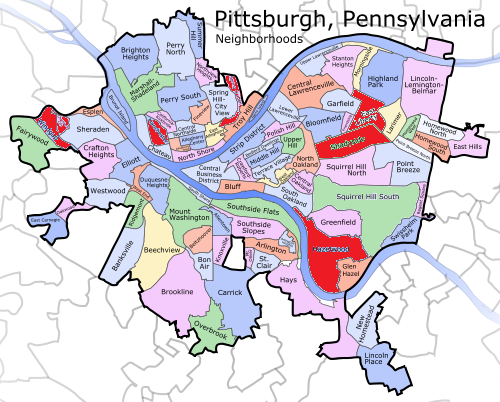
With the loss of power during the Pittsburgh February 2019 windstorm, residents had turned to a variety of methods to cope with the effects. According to various news reports, a substantial number of residents either checked-in to nearby hotel rooms or stayed with family. (Webvtt 2019). Others used non-electrical heating systems such as gas ovens to warm their houses. These actions were driven by frustration of living conditions and desire for basic amenities such as hot water. In addition, Residents also stayed at warming centers provided by volunteer and religious organizations (McNulty, 2019). Information about these centers were spread by media outlets such as regional news outlets and Twitter. The neighborhoods affected by blackouts can be seen in figure 3
Figure 3. Location of outages in Pittsburgh. Red indicates that a power outage occurred in the neighborhood.
What needs to be done
With the advent of climate change and distributed energy resources, the grid is going to be more stressed than ever. To ensure the safety of critical infrastructure, more emphasis needs to be placed on infrastructure interdependence with electricity on all levels of engineering and policy. Civil engineers, municipality planners, and building operators need to be proficient in multiple areas of resilience protection so in case one system goes down which affects others they will be able to handle all of the side-effects which may occur. Guidelines for handling such failures must also be developed such that responses can be automated and controlled with situational awareness instead of having to deal with each case uniquely. Utilities and other institutions can practice this by having more cross-infrastructure communication and training drills. Utilities can also have redundant supplies available so in case of an event such as a winstorm knocking out transformers a quick response can be made. When designing the future of infrastructure systems, all interdependencies must be taken into consideration.
Paramount to preventing such failures will be to ensure that there is a constant supply of electricity to all forms of infrastructure. If this is not achievable and a power outage does ensue, then backup generators should be present to provide some form of stability. As stated earlier, generators will only be able to provide a portion of the energy needed for complete operation. The introduction of more energy efficiency components into critical infrastructure systems will ensure that a higher portion of power can be met by backu-up generation. Backup generation can be complemented with onsite generating assets such as solar panels and batteries integrated through a microgrid. The power requirements for critical infrastructure should be verified through power assessments by qualified professionals.
The prevention work for critical infrastructure operators should be as follows. First, top level goals (i.e what systems are the most critical for operation) need to be defined. Afterwards, the “bare-minimum” energy requirements need to be defined along with internal infrastructure requirements. Finally, external requirements need to be developed so utilities and gasoline providers can provide the right coordination.
The public needs to be engaged in restoration and resilience efforts. Personnel such as communication managers or public information officers can get the word out to residents through news broadcasts, radio messages, and social media accounts. If properly informed, residents will remain calm during the course of the blackout and can take the proper procedures. (EPA 2019).
Acknowledgments
Although I am the one who has completed and presented this work, none of it could have been possible if it weren’t for a few salient individuals and organizations. First and foremost, I would like to thank Maridith Janssen and everyone at the Sally Casanova Pre-Doctoral Program for arranging for such a wonderful experience. The Summer I spent working on this project was one of the most productive time periods of my career. This was my first time researching hybrid engineering/policy systems, working on infrastructure resilience, and living outside of California. Professor Beverly Grindstaff, thank you for spending the time to meticulously review my essays for the Casanova fellowship and guiding me through the program. I will never forget it. Professor Furman, thank you for taking the time to write a high-quality letter of recommendation which helped get me into this program. Finally, thank you Parth Vaishnav and the Engineering and Public Policy Department at Carnegie Mellon University for acting as a mentor and allowing me to work on such a vital and interesting topic. I’ll be sure to use the knowledge I’ve gained from this experience to help communities and institutions in need.
References
Council, N. A. E. R. (2004). Technical analysis of the august 14, 2003, blackout: what happened, why and what did we learn?. NERC, Princeton, NJ, Tech. Rep.
EPA. (2019). Power Resilience: Guide for Water and Wastewater Utilities (Rep. No. 1). Washington DC, DC: U.S Environmental Protection Agency.
Fema. (2017). Power Outage Incident Annex to the Response and Recovery Federal Interagency Operational Plans Managing the Cascading Impacts from a Long-Term Power Outage (Rep. No. 1). Washington DC, DC: The Federal Emergency Management Agency.
Klein, K. R., Rosenthal, M. S., & Klausner, H. A. (2005). Blackout 2003: preparedness and lessons learned from the perspectives of four hospitals. Prehospital and disaster medicine, 20(5), 343-349.
Little, Richard G. “Managing the risk of cascading failure in complex urban infrastructures.” Disrupted Cities. Routledge, 2010. 39-52.
Mank, I. (2015). Energy blackouts and water outages: A risk management approach towards raising awareness and assuming responsibility (Master’s thesis). TU Wien.
Rinaldi, S. M., Peerenboom, J., & Kelly, T. I. Understanding, and Analyzing Critical Infrastructure Interdependencies. IEEE Control Systems Magazine (December).–2001.–Pр, 11-25.
“How can we completely recirculate the air in an interior space?”
Air recirculation for interior spaces is useful in the case of a lack of desirable air for ventilation. However, sometimes the exterior might be so toxic that it may be advisable to completely cut off contact. To accomplish this, Complete Air Recirculation can be used such that all of the supplied air for ventilation comes from the inside.