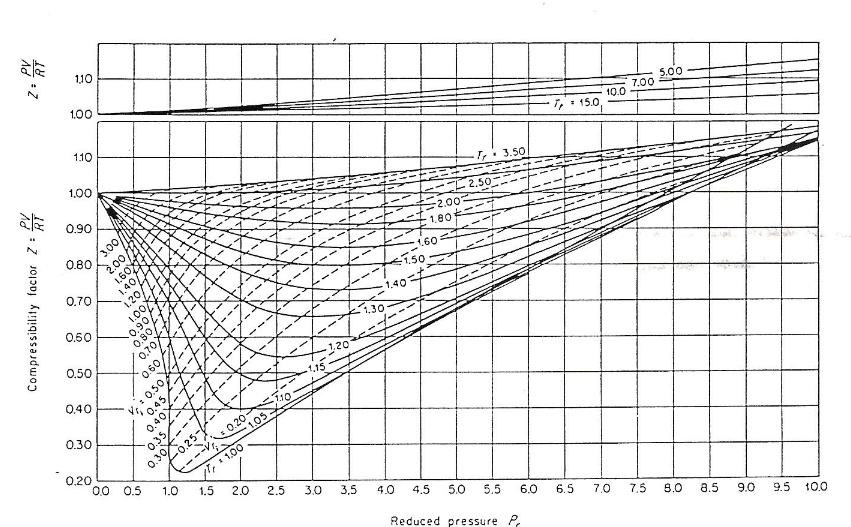
The Compressibility Factor
09/23/17
“How can we quantify how much a gas deviates from its ideal form?”
In introductory chemistry and physics classes, all gases are assumed to be completely ideal. However, in the real world gases usually are not so easy to work with. So how can we quantify a gas’ deviation from its ideal form? Well, let’s start from the basics. We know that all of the gas’s properties can be completely related to one another through the ideal gas equation p*v_specific=r*T. It would logically follow that if we were to divide the product of the pressure and the product of the specific volume by the universal gas constant times the temperature, we should end up with a ratio of 1/1.So what if we were to find out a gas’s specific volume, temperature, and volume of a gas in its non-ideal form, take their ration, and use that as a constant in a modified ideal gas equation? This is known as the compressibility factor and is commonly represented as z in the non-ideal gas equation p*v_specific=z*r*t.
 Isaac's Science Blog