Month: May 2017

Magnetic domains, hysteresis, and hard/soft magnets

Magnetic domains, hysteresis, and hard/soft magnets


Magnetic domains, hysteresis, and hard/soft magnets

05/22/17

“How do magnetic fields come about and how can we apply this knowledge?”


The subatomic interactions in a magnetic object from material properties give rise to its macroscopic phenomena. Magnetic materials are composed of divisions known as magnetic domains that have a random magnetic field direction. When an external magnetic field is applied to a material, all of these domains will align with said field and produce a magnetic force. The magnitude of this magnetic force emanating from the object will be the result of the summation of the magnetic fields from all of the individual domains.

This theory can be applied using a hysteresis loop operates as follows. Take a piece of metal. Now run a coil around it. Generate an AC voltage. At t = 0, there will be magnetic activity in neither the metal nor the coil. When the voltage is increased, it will cause the domains to line up, eventually reaching a maximum value. Now pull the voltage in the other direction. When the voltage is equal to zero, the metal will have some residual magnetic field in it as a result of the shifting domains. If we pull the voltage into a negative state, then eventually it will reach another maximum (at the negative of the original boundary). If we reverse the direction of the current again to zero, then we will also have some residual magnetic field at zero. And if we increase the voltage in the positive direction, then we will reach the maximum again (Schuster, Doc).


Based upon their hysteresis profile, a material may be classified into either a hard magnet or a soft magnet. The former has a large profile, and are often used for energy intensive applications such as permanent magnets, while the latter has a smaller profile ideal for use in low energy loss application such as transformers.

Atulasimha, Jatulasimha. “Magnetism.” Magnetism for General Audience. Virginia Commonwealth University, 8 Nov. 2015. Web. 22 May 2017.


Callister, William, and David G. Rethwisch.Materials Science and Engineering: An Introduction. 9thed. , John Wiley & Sons, Inc., 2014.


Magnetic Hysteresis or I KNOW WHAT YOUR MAGNET DID LAST SUMMER | Doc Physics. Dir. Doc Schuster. Perf. Doc Schuster. Youtube. Doc Schuster, 25 Feb. 2014. Web. 22 May 2017.

The cause of ocean currents

The cause of ocean currents

The cause of ocean currents

05/21/17

“What exactly causes ocean currents?”


When someone says the word ocean, what do you picture in your mind? Most people probably think of deep blue waves crashing against a beach with more grains of sand than stars in the universe. However, a scientist will think just a tad bit differently. Instead of being limited by immediate sensory perception, they will try to understand the underlying reason of what causes the ocean currents. If this scientist gives in to this curiosity, then they will find out that such disturbances in fact have two possible causes, one form the winds and the coriolis effect and another from internal temperature differences.

Cross-linking

Cross-linking

Cross-linking

05/20/17

“What happens when polymer chains link together?”
Polymers are famous for their absolutely long chains. However what happens when these chains link together? Well, let’s use our scientific mindsets to find out. If we look carefully, then we will observe that the density of the materials will go down (since now all of its composing elements will no longer be able to be squeezed together so easily) but the strength will increase since the there are now three-dimensional impediments to dislocations.

Elastomers

Elastomers

Elastomers

05/19/17

“How can we have flexible polymers?”
Polymers are widely utilized in a swath of industries for their malleable properties. But is it possible to make such things flexible? Well, let’s use our scientific mindset to find out. Polymer molecules are often arranged in a disordered manner due to the second law of thermodynamics. However, when pulled upon, some of these materials can actually become more ordered and will revert to their original shape once the force is removed, giving them an elastic property. These materials are known as elastomers,and are commonly used for flexible materials such as rubber. Elastomers are usually thermosets, have a low young’s modulus, and a higher failure strain.

Composites

Composites

Composites

05/18/17

“What happens when two materials of vastly different properties come together?”


When working with plastics, we often need to enhance their properties somehow. So it would be logical if we could think of a scientific way that we can engineer this? Since such a material would be composed of more than 2 different discrete materials, it will have two different layers, one being a reinforcement or fiber that provides the material with strength, and the other one is a matrix that binds the material together and insulates it from the external world. This type of material is known as a composite and is used for all sorts of applications, ranging from the cement that we use to kevlar armor to the space shields used by NASA!

Vulcanization

Vulcanization

Vulcanization

05/17/17

“How can we improve the properties of rubber using engineering?”


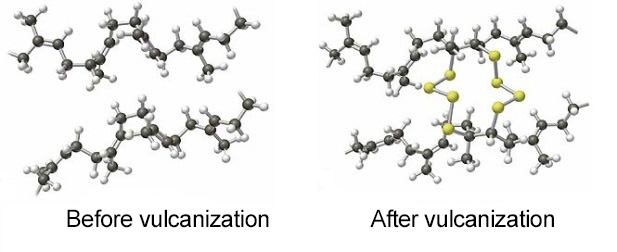
Rubber is a very useful material. It can be found in almost every facet of life, from the cars for our commute to the gloves that we wear to the soles of shoes. However, how can we make this material even stronger? Well, let’s use our engineering mindset to find out. Rubber is naturally composed of strands of singular polymer chains. However, if we were to introduce some sulfur into this medium, then some of the C-H bonds will be broken and replaced with C-S bonds, resulting in a cross-linked material. This makes the structure much stronger and more rigid while maintaining its elasticity. This process is known as vulcanization and is used in the manufacturing procedure of a wide range of items, such as hockey pucks and bouncing balls.

Thermosetting polymers

Thermosetting polymers

Thermosetting polymers

05/16/17

“Can certain plastics become harder with heat?”
Thermoplastic materials are widely used for their behavioral effects to induced heat. However, is it possible that some materials might become harder with temperature in an irreversible process? Well, let’s use our scientific mindset to find out. We know that when polymers become cross-linked, they become harder and tougher. So it would follow that when heated, they would be stronger when compared to a non-cross-linked material. What more, because these polymer chains are bonded to each other, they will not change shape after reheating! Thermosetting polymers have applications to be found everywhere, from latex gloves to erasers to bicycle tires.

What happens when two lenses are placed together?

What happens when two lenses are placed together?

What happens when two lenses are placed together?

05/15/17

“How do we solve a physics problem with two lenses placed together?”
When doing a geometric optics problems, we often assume the lenses to be discrete from one another. However, what happens when we have two lenses right next to each other? Well, let’s think about it using our mathematical mindset. If we look carefully, then we will notice that the same amount of light will be incoming and outgoing for both sides. This is similar to how the voltage drop on two parallel resistors is the same. So what if we were to treat our optical system in a similar manner? Well, after much research into this matter, opticists have shown that both lenses can be replaced with an equivalent lens with a focal length given by the equation 1/f_combined=1/f1+1/f2.

Concave mirrors

Concave mirrors

Concave mirrors

05/14/17

“How does a mirror that bends inwards behave?”
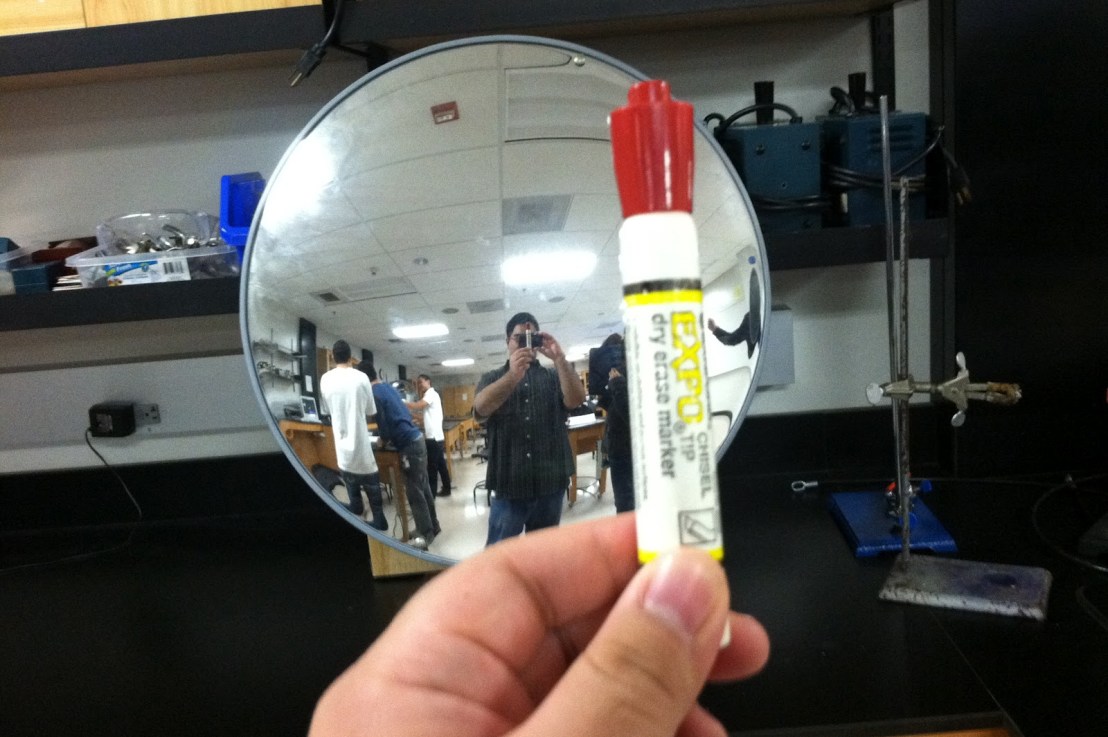
Mirrors come in all different shapes and sizes. Some are straight like a piece of paper, some bend outwards, some inwards. However, what are some of the defining physical characteristics of mirrors? Well, let’s analyze it with our scientific mindsets. When an object is beyond the center of curvature, then an image real, inverted, and minimized will be produced. If the object is at the center of curvature, then a real inverted image of equal size will be produced. If the image is between the center length and focal point, then an image real, inverted, and magnified will be produced. If the object is at the focus, then the image will form at – infinity. And if the object is just beyond the focal point, then a magnified virtual image will be formed. Concave mirrors have numerous applications, ranging from the headlights of cars to shaving mirrors and even to visual bomb detectors!