Month: November 2016

Hypersphere

Hypersphere

Hypersphere

11/12/16

“What does a four-dimensional sphere look like?”


Let’s think about something. A circle can be classified as an object in 2-dimensional space whose boundary is composed of all of the points equidistant from a center point, where the radius is composed of two cartesian coordinates ( r=sqrt(x^2+y^2)) and the area is proportional to the square of the radius (A=pi*r^2). A sphere in turn is the 3-dimensional version of this, where all of the points equidistant from a center makes up the object, with the radius being composed three cartesian coordinates and the volume is proportional to the cube of the cube of the radius (V=4/3 * pi * r^3 ), and if were to take a two-dimensional cross-section, we would obtain a circle. .But what if we were to take this concept into higher dimensions? Well, let’s explore the concept. A four-dimensional sphere (termed a hypersphere by mathematicians) would have to be described with four cartesian coordinates, and the “hyper-volume” would be proportional to the fourth power of the radius (V= ½ * pi^2 * r^4),and if were to take a three dimensional cross section of a hypersphere, we would find a regular three-dimensional  sphere. 

London dispersion

London dispersion

London dispersion

11/11/16

“What is the weakest of the intermolecular forces and how does it form?”


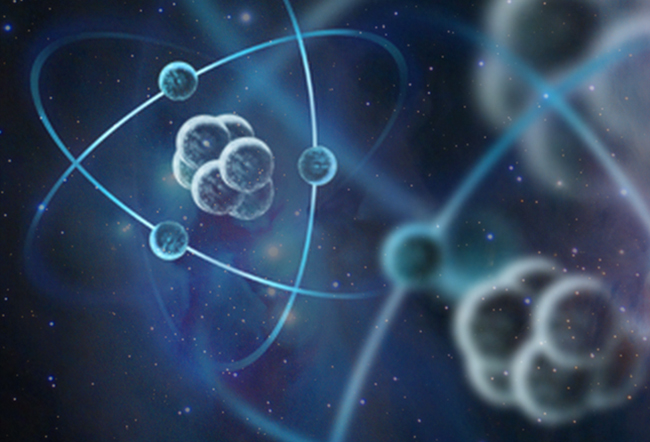
As a result of the nature of quantum mechanics, we know that in atomic structure, electrons do not orbit around the nucleus in a newtonian fashion, but instead are located in probability densities surrounding the core. Since electrons will move around in such a manner, the charge distribution of an atom is bound to become slightly asymmetric with time. Consequently, these asymmetric atoms will interact with other asymmetric atoms to form very subtle electric dipoles, resulting in a very weak intermolecular force. Scientists and Engineers have termed this phenomena to be London dispersion, and it is found to be the weakest of all the intermolecular forces. Despite this, as a result of it’s universal nature, all molecules are found to exhibit london dispersion
  

Microbeads

Microbeads

Microbeads

11/10/16

“What component of personal care products cause a high amount of pollution?”


Cleanliness is a necessity for modern day civilization. And as human civilization advances, so does our standards and means obtaining cleanliness. And one such advancement comes in the form of microbeads. Microbeads, also known as microplastics, are solid plastics that are less than 5mm in diameter that are used as exfoliating agents (meaning that they can wipe off dead skin cells) This small size combined with the cleansing property poises microbeads to be very useful in personal care products, but they come with a most unfortunate environmental consequence. When flushed down the drain, microbeads are able to pass through filters normally designed to catch larger pollutants, allowing them to seep into a body of water. The microbeads will stay around for a long period of time due to their lack of biodegradability, and nearby fish will consume these products  (believing them to be small eggs) which in turn will cause physiological harm. In an interesting turn of events, these fish can be harvested and consumed by humans, therefore causing detriment to ourselves. In summation, microbeads are a stalwart example of how humanity impinging on the environment will cause long-term impairment on humanity. Microbead pollution has become so prevalent that the Rhine river in central Europe is thought to contain one million particles per square kilometer! Luckily, numerous governments are already taking action, and in the United States the Microbead-Free Waters Act of 2015 will phase out microbeads in rinse off cosmetics by July 2017.

How quantum mechanics poses problems with reality

How quantum mechanics poses problems with reality

How quantum mechanics poses problems with reality

11/09/16

“What are some of the most counter-intuitive aspects of quantum mechanics?”


At the turn of the 20th century, physicists began discovering that the Newtonian mode of the universe was inadequate. In classical mechanics, one is able to predict the entire motion of an object using only a simple set of equations, giving the universe a deterministic structure. However, this simplicity collapses as one enters the quantum scale. Instead, every time objects collide with one another, only a probability of possible trajectories can be given by a mathematical tool known as a wave function. Since this phenomena is so strange, physicists are divided into two discrete worldviews regarding the properties of the wave function; instrumentalists believe that the wave function is only a conceptualization invented by humans, and that there is no absolute way of knowing reality, while naturalists believe that the wave function is in fact a property of nature itself. Whatever it is, a most intriguing aspect of this facet of nature is that all of these semi-random chaotic quantum processes will eventually coalesce to emerge into the materialist universe that we can observe and experience. So everytime you think that everything is dull and boring, just think about the myriad of secluded wondries going on in the smaller scale!

The mathematics of gerrymandering

The mathematics of gerrymandering

The mathematics of gerrymandering

11/08/16

“What is political gerrymandering and how does it work?”

In honor of election here in the United States, I thought that it would be reasonable to do my part and use my scientific skills to explain the mathematics behind a political process known as gerrymandering.

First of all, for those of you unfamiliar with the American political system, the political map of the United States during elections is divided into “districts” of where around 500,000 people will live. People in this area vote for which political party they want, and at the end of the day whoever obtains the largest amount of votes will win the entire district! So in an ideal world, each district will be drawn so that it would fairly represent the population. In this way, political representation would be completely fair. However, individuals who are in power have the power to redraw these districts during times of census, allowing them to manipulate things in to a way that would represent their own interests. For example, let’s imagine a state with 2 million people, half of them voting for one party and half of them voting for another. If all of the districts were drawn to fairly represent this population, then the vote would be split evenly among 4 districts. However, if the districts were redrawn so that three of them would contain even a majority for one party and only one district would contain a majority for another, then the first party will win by a landslide! This issue is more than just a theory, it is a very real thing, and please take action as a citizen and do your part to make sure that the political system can be fair for everyone. And as always, a little bit of knowledge of mat can go a long way.

Adhesive forces

Adhesive forces

Adhesive forces

11/07/16

“What causes liquids to stick to surfaces?”


Have you ever wondered why liquids seem to have sticky properties? Well, let’s think about it. We know that molecules of a liquid substances are attracted to each other through the phenomena of intermolecular forces, but since all materials in the universe are made up of molecules, wouldn’t it be logical that molecules of these liquid substances could also be attracted to molecules outside of the substance? This is the fundamental idea behind adhesive forces. Because of adhesive forces, liquids have the ability to “stick” to the containers in which it rests. And most peculiar application of adhesive forces are utilized by the insect known as water striders, who can literally glide upon water.

Cohesive forces

Cohesive forces

Cohesive forces

11/06/16

“What causes liquids to stick together?”


Liquids are a most peculiar state of matter. Their shape will change depending on the container that they’re in (just like gases) , but at the same time their volume will remain consistent (just like solids). Why do liquids have this paradoxical combination of features? Well, let’s investigate it. On a microscopic level, the molecules of liquids move around in semi-free state, not being as rigidly bound as a solid but not having the level of separation as a gas. The molecules of a liquid are attracted to one another through a phenomena known as cohesive forces, in which molecules of the same type experience an intermolecular force attracting one another. Now with this fact, we can deduce something very interesting. Volumes of a material are composed of units of molecules. And since molecules in liquid experience cohesive forces that makes them stick together, the amount of molecules in this liquid will not change unless a more powerful force rips away some of the molecules, therefore giving liquids a constant volume! Due to cohesive forces, liquids can be fluid like gases but maintain their volumes when poured into another container or experience mechanical stresses, or exhibit properties such as surface tension.   

Intermolecular forces

Intermolecular forces

Intermolecular forces

11/05/16

“What exactly keeps groups molecules together?”


Have you ever wondered why even through objects are made of molecules moving around in space, they seem to be able to keep their form? Well, let’s think about it. First of all, let’s view everything from a microscopic standpoint. When molecules are close to one another, they have a tendency to form associations with one another resulting from a phenomena called intermolecular forces. The forces (in increasing order of strength) include london dispersion (in which all molecules experience), dipole-dipole interaction (when two or more electrically charged molecules come in close proximity within one another), and hydrogen bonding (when a hydrogen atom of one molecule comes into close proximity of an oxygen[O], nitrogen[N], or fluorine[F] of another). What I find personally amazing is how billions of these forces over time will manifest into the everyday material objects that we experience everyday!

Vapor Pressure

Vapor Pressure

Vapor Pressure

11/04/16

“What happens to water in a closed container?”

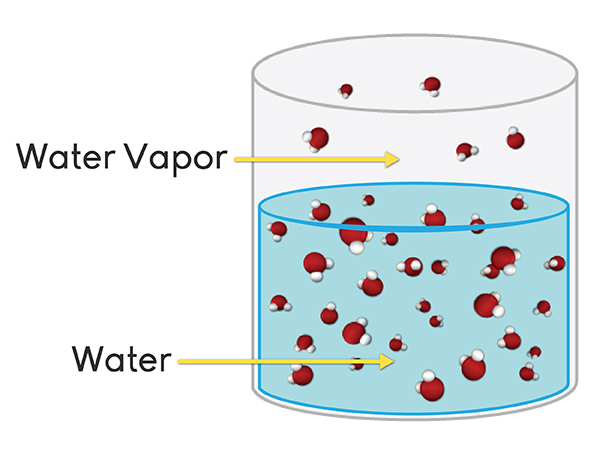
Liquids have many fascinating facets, and one of the fascinating facets about them is when put in a closed container, a gas will gradually form over time. What is this substance and how does it affect the surrounding environment? Well, let’s start by looking at it from a microscopic viewpoint. Well, first of all we know that molecules in a liquid move around in a semi-free fashion but are held together by cohesive forces resulting from intermolecular interaction. But what happens if the energy of one of these moving molecules overcomes such internal forces? As it turns out, this molecule will be freed from the constraints of the liquid substance and be allowed to float around as a gas. And if this liquid is trapped inside a closed container, then the gas molecules will be too. Some of these gas molecules will eventually lose kinetic energy and in turn will be dragged back into the liquid. Eventually, a steady state will be formed with the number of molecules leaving the liquid will equal the number returning to the liquid. As a result, this steady gas will exert a vapor pressure on the liquid beneath it.

Now here is where things become interesting. If one were to increase the temperature of the liquid, then then the kinetic energy of the molecules of the liquid will increase, causing a greater amount of liquid to be released into the gas, therefore increasing the vapor pressure of the gas!