Transformers 03/12/16
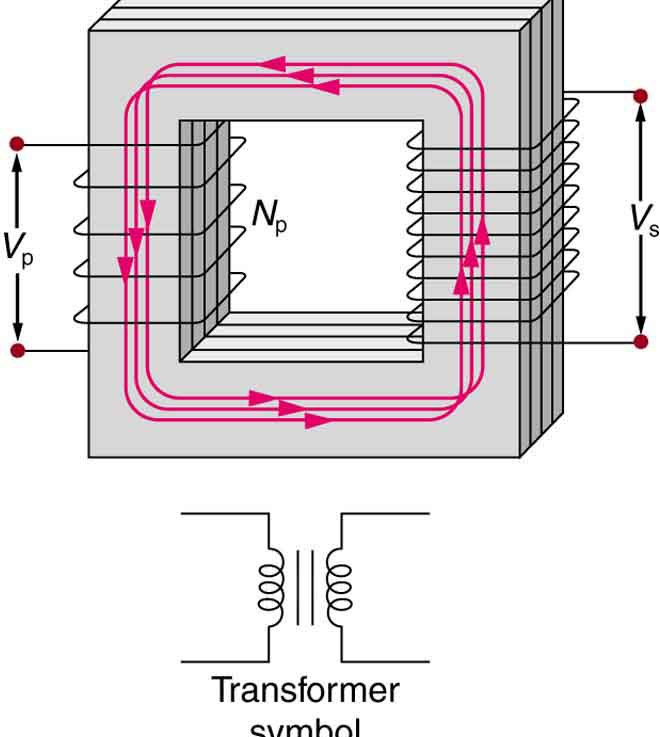
One of the most pertinent devices in the field of electrical engineering are transformers. The function of a transformer is very simple, it changes the potential difference from one value of wiring to another. The mechanism works a follows; The will be two wirings of coil, one on each each side of the transformer. The wire on the left will be hooked up to an alternating current which in turn will cause a magnetic field to be produced. As a by-product of Maxwell’s equations, there will be an voltage difference induced on the second coil. The voltage potential depends on the number of loops that the wire makes. If the wire has more loops then more voltage will be produced and it will be called a step up transformer. If there is less wiring there will be less voltage and it will be called a step down transformer. The equation for a transformer is VsVp=NsNp, with Vsbeing the secondary voltage Vpbeing the primary NsBeing the number of loops in the secondary and Np being the number of loops in the primary. As one can observe, The voltage ratio is directly proportional to the Loop ratio. Power also is assumed to be conserved for Mathematical purposes, so we can derive that V1I1=V1I1by using the fact that P1=P2and that P=IV.
 Isaac's Science Blog