Secondary Differential Equations 03/08/16
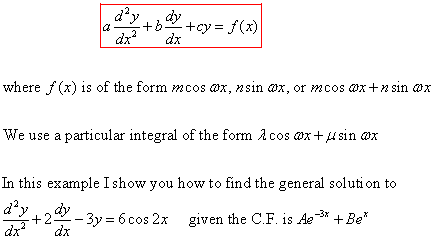
During one’s course of study of mathematics, a most peculiar set of problems will arise. These problems involve not only a variable and it’s derivative of the derivative of it’s derivative! Mathematicians have labelled the problems secondary differential equations. SDQs are often written in the form ad2ydx2+bdydx+cy=0, with a,b, and c being constants. The solution for such differential equations is as follows, one supposes that the solution for yis y=erx, with r being a constant. We then substitution this postulation into the equation and factor the result. Depending on how the constants work out into the quadratic formula, if b2-4ac>0, then the solution will be y= C1er1x+C2*er2x, since the quadratic will have two distinct roots, with C1and C2being different constants as well as r1and r2. If b2-4ac=0, then the solution will be y= C1erx+C2*x*erx, with only one rsince the quadratic will only have one root. If b2-4ac<0then the solution will be y=C1*ex*cos(x)+C2*ex*sin(x)because it’s an irrational root, with and being constants.
 Isaac's Science Blog