Tag: Climate Change

Climate Change Adaptation for Infrastructure

Climate Change Adaptation for Infrastructure

Climate Change Adaptation for Infrastructure

04/22/18

“How will infrastructure need to adapt for climate change?”


Climate change is already having drastic effects all over the world. From rising sea levels to increased flood frequencies to omnipresent droughts, things are changing for sure. As a result, we will have to change the way we use our infrastructure to meet the needs of the future. To illustrate, let’s take buildings as an example. Because of the effects of climate change, newer buildings must now use less water as well as be able to withstand all forms of drastic weather conditions. By undergoing climate change adaptation for infrastructure, we can prevent losses from further environmental catastrophes.

The Water-Food-Energy Nexus

The Water-Food-Energy Nexus

The Water-Food-Energy Nexus

01/29/18

“What is the link between food, water, and energy?”


Although commonly thought of as separate issues, our use of food, water, and energy are actually highly interrelated. For example, agricultural produce is the largest consumer of freshwater resources and takes up to a quarter of energy use, while outdated energy generation techniques such as fracking consume a voluminous amount of water during operation. Because of this, the United Nations has created the concept of  The Water-Food-Energy Nexus to educate people about this phenomenon. This problem will become more apparent with the advent of an increasing population.

Zone of saturation

Zone of saturation

Zone of saturation

09/20/17

“What is the area underground where the pores and cracks are filled with water?”


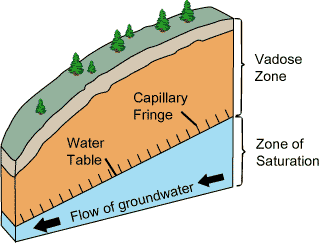
Aquifers are natural underground water storage tanks. So naturally, if there are open areas nearby some of the water might seep out. This water usually ends up filling the pores of a region known as the Zone of Saturation, also known as the Phreatic Zone. Zones of alienation worldwide are being polluted by unsustainable practices and depleted by global warming

Climate change and the receding of Arctic sea ice

Climate change and the receding of Arctic sea ice

Climate change and the receding of Arctic sea ice

09/08/17

“How is climate change affecting the Arctic sea ice?”


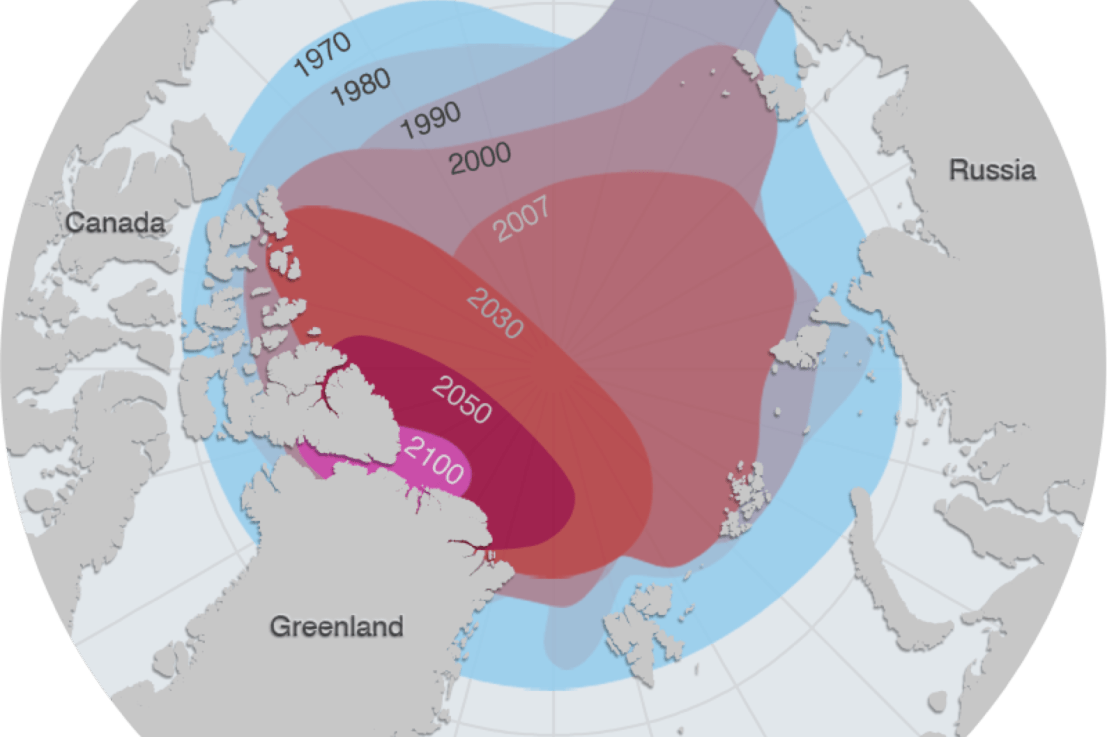
Let’s think about something for a moment. We know that ice is more likely to melt when it is immersed in higher temperatures. And we know that the northernmost pole of the Earth (the arctic) is composed mainly of ice, and that climate change is causing global temperatures to rise. So wouldn’t it be logical that such a phenomena would be causing the arctic sea ice to recede? Well, it turns out that according to empirical evidence this is exactly what is happening, as ever since we have started taking satellite measurements of the polar ice caps in 1979 we have seen a 35% decrease in landmass!

How we can infer climate change from the ocean

How we can infer climate change from the ocean

How we can infer climate change from the ocean

09/07/17

“Can we learn about climate change just by looking at ocean data?”


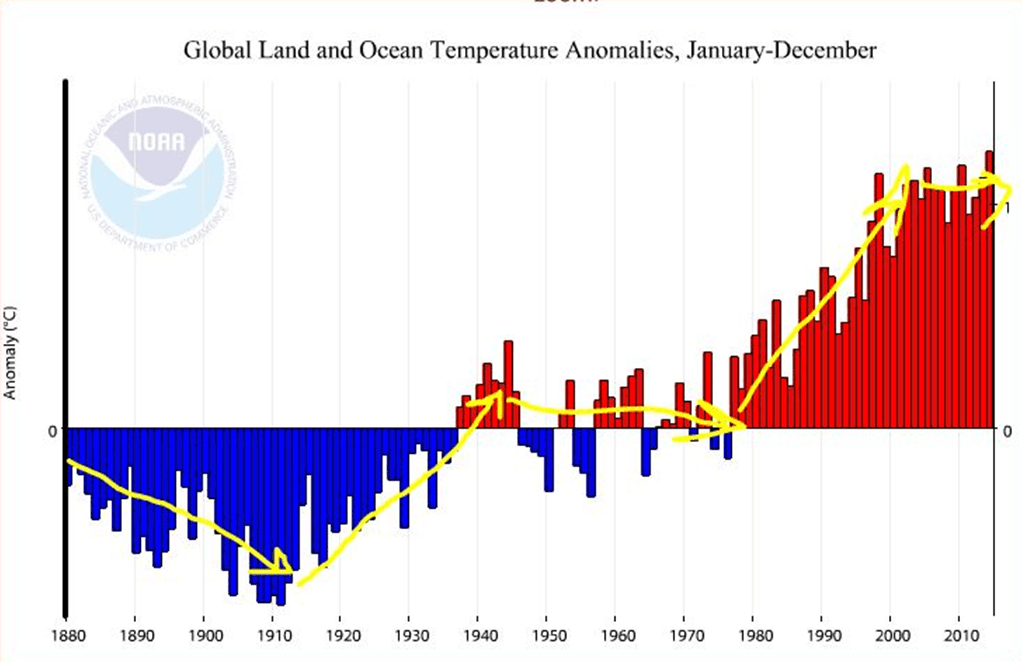
Climate change is something that is talked about every day. However, how can we get some evidence for it? Well, what if we were to look at the temperature of the most massive body of heat storage on the Earth, the ocean! By carefully observing its temperatures, we can observe that the ocean has gained 0.1-degree Celsius since 1969^1. Even though this does not seem like a significant deviation, we must remember that our global ocean is composed of around 1.4 * 10^24 worth of water (a substance with a substantial heat capacity), so any temperature change even an order of magnitude close to our observed value is quite drastic. 


  1. Levitus, et al, “Global ocean heat content 1955–2008 in light of recently revealed instrumentation problems,” Geophys. Res. Lett. 36, L07608 (2009).