Planetary gears 03/11/16
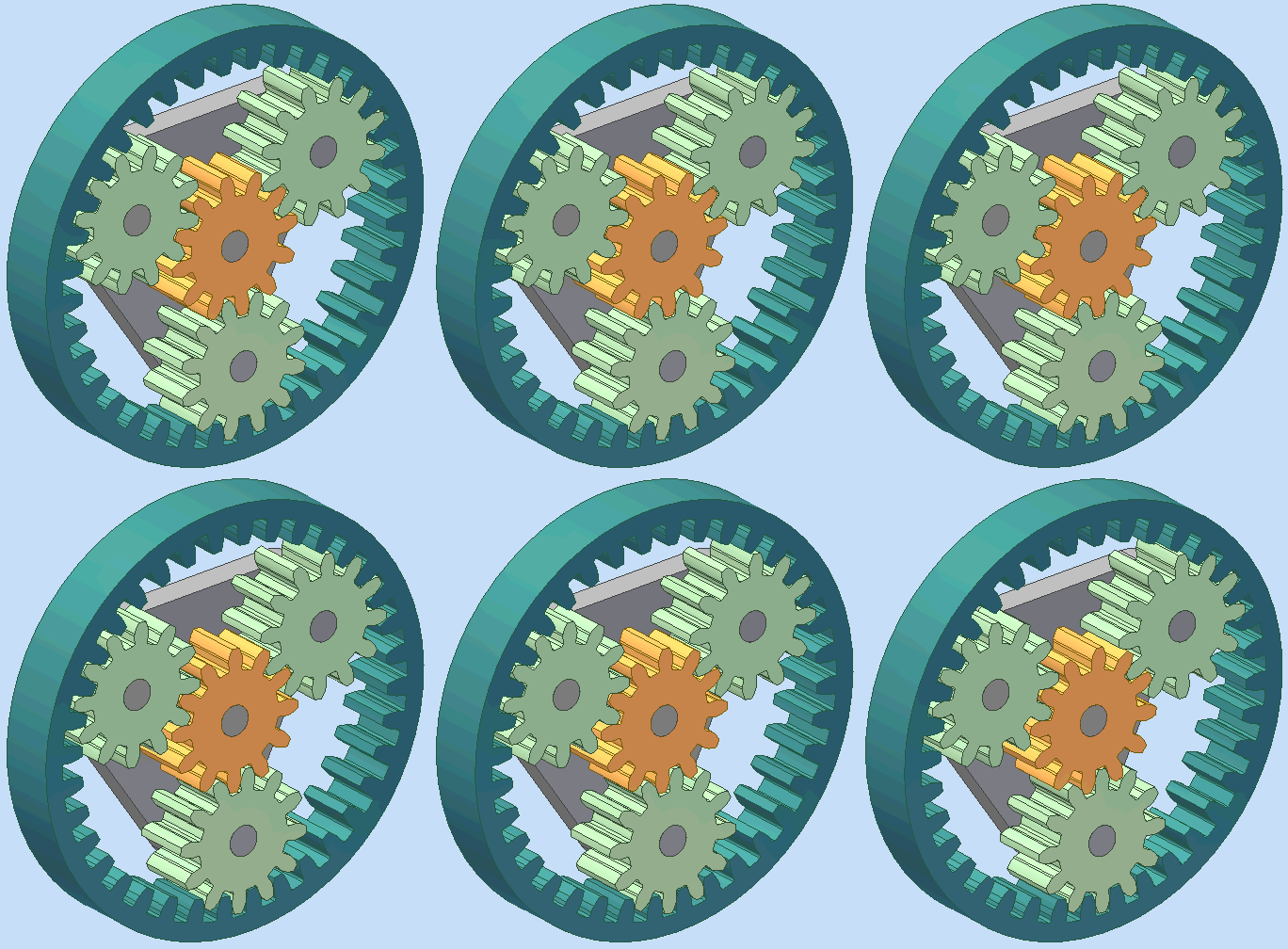
One of the most interesting inventions ever created by the human species is are planetary gears. A problem come across by many Engineers is as follows: How can we make a smaller gear turn a larger gear while being encapsulated in it? The solution is to use a planetary gear mechanism. The trick is to use a central (smaller) gear called the sun gear to turn a multitude of other gears called “Planet gears” in the opposite direction which in turn which turn the circumferenced gear (called the “Planet gear” ) which in turn will turn. This is used frequenly in autombiles.
Category: Engineering
Inductor
Inductor 03/07/16
Inductors are some of the most fundamental components of the modern day circuit. An inductor usually consists of conducting wire wrapped into a coil, and since a current will run through this wire, a magnetic field will be produced. As a result of Maxwell’s equations, the energy stored in the magnetic field will try to oppose any change in current and a voltage will be created in the inductor. The strength of an inductor is measured by it’s inductance. Inductance is defined as L=i, with Lbeing the inductance , being magnetic flux and ibeing the current. The voltage across an inductor can be symbolically derived by faraday’s law of inductance v=ddtwhich by using substitution leads to v(t) =L*didt. Inductors are widely used to tune out certain frequencies
Kirchoff’s laws
Kirchoff’s laws 03/06/16
One of the most pertinent, practical, and sublime tools for understanding circuit theory in electronics is Kirchoff’s laws. Kirchoff’s first law states that the quantity of current going through a junction is conserved going out a junction, or I=0. For a more mechanical analogy, visualize water going through a pipe. In an ideal case all of the water going through one of the pipes will either be distributed to the other two or it will collide with another one to go down the third. Kirchoff’s laws work the same way. Kirchoff’s second law states that the change in voltage across a loop always amounts to zero. One can derive this analytically using the fact that the voltage drop is the same across two parallel lines in a circuit, so consequently their voltage must equal each other and their voltage drop must equal to zero.
Incandescent light bulb
Incandescent light bulb 03/04/16
One of the most important inventions ever created in human history was the incandescent light bulb. The incandescent light bulb works works by passing an electric current through a filament and heating it until it reaches an extremely high temperature. Once this high temperature is reached, light will start radiating out of the light bulb due to spectrum emission. Incansdescent lightbulbs are highly inefficent, as they only use 2.2% of the energy passed in to them.
Turbines
Turbines 02/28/16
During one’s study of Mechanical Engineering, one of the most pertinent aspects of focus is turbines. Turbines are mechanical devices that are used to collect useful energy from fluids and turn it into usable work. Usually, when a fluid becomes contingent with the blades of a turbine, then some of the kinetic energy is imparted on to the turbine, causing it to spin and thereby creating work. Turbines are used for a plethora of tasks, such as making energy through steam turbines or propelling ships such as dreadnoughts.
Dreadnoughts
Dreadnoughts 02/27/16
One of the most riveting ships in all of naval design is the dreadnought. The dreadnought uses a steam turbine driven engine to propel itself at great speeds. In addition, the dreadnought had a “big gun” design in which much of the focus of construction went into manufacturing a vast array of insurmountably powerful heavy weapons. In addition, the metallic armor made shielded the dreadnought from many potentially fatally lethal attacks. This combination of speed and power encased in a metallic fortress made the dreadnought strike fear into the hearts of all enemies. Dreadnoughts were introduced by the British navy in 1906, and were soon retired after WW1.
Electric current
Electric current 02/26/16
Have you ever wondered how electricity flows? This phenomena has been labelled by Scientists and Engineers as electric current. When there is a voltage difference within a conductive wire, a flow of electrons occur between this voltage difference. The formula for current is given by the equation I=dqdt, where qis the amount of charge flowing and tis the time. There are two types of current found in Engineering, DC (direct current) and AC (alternating current). In direct current, the flow of electrons is a constant, perpetual unidirectional motion, while in Alternating current it oscillates back and forth.
Hooke’s law
Hooke’s law 02/25/16
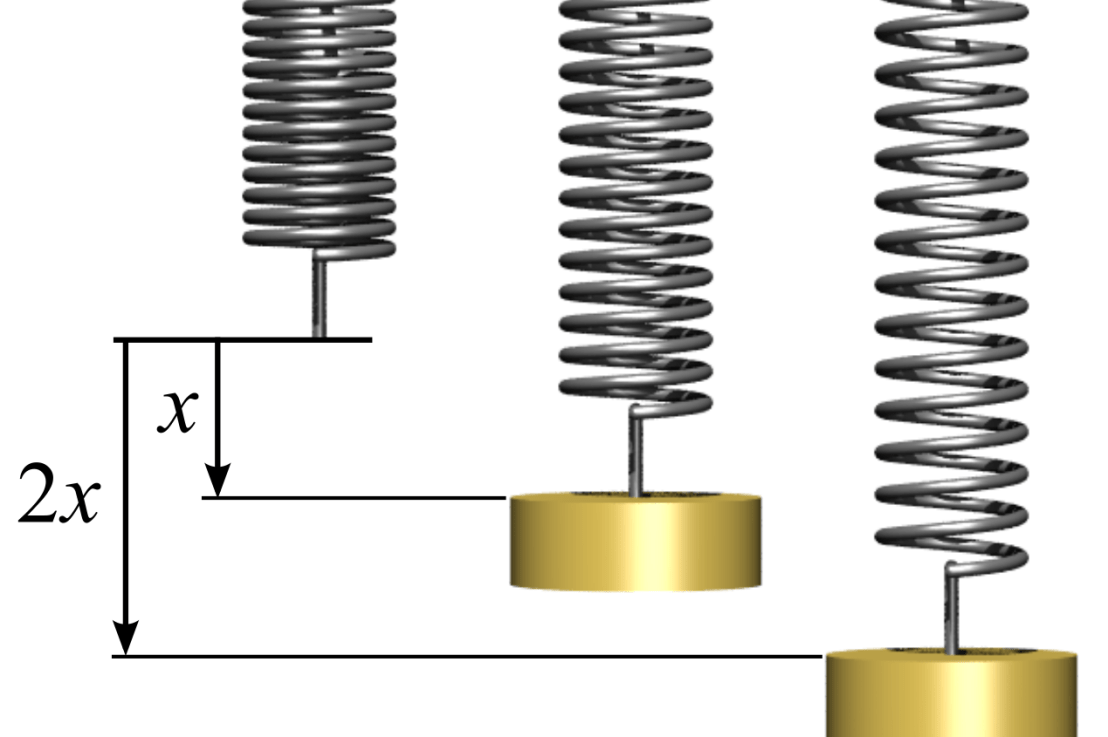
Have you ever wondered why the force of a spring appears to grow stronger as you pull it out? This physical phenomena can be explained with the simple use of Hooke’s law. Hooke’s law states that the force of a string can be measured with the equation Fspring=k*x, with k being the spring constant and xbeing the change in distance from the resting point. The Spring constant can be found empirically by measuring the force’s change over a distance and finding the slope. we can integrate this equation in respect to x to find the potential energy of the object to obtain Uspring=12*k*x2. As one can infer, the more we stretch it out, the more potential energy is in the system, and consequently the more kinetic energy it will have when it reaches the starting point, allowing it to reach a further displacement once again.
Young’s modulus
Young’s modulus 02/24/16
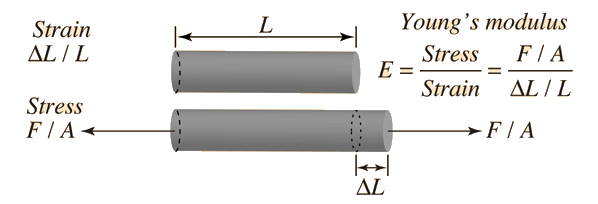
Have you ever wondered why a solid body deforms when stress is applied to it? This is a consequence of Young’s modulus. To get the big picture, Young’s modulus is a property of mechanical bodies that defines how much the body deforms under stress. Before we begin, we must define the terms stress and strain. Stress is the internal forces that neighboring molecules of an continuous material apply to each other (equation is ()=FA0, Force over original area), while strain is the measure of deformation of a material (=LL0, change in length over original length). Young’s modulus is the measure of the proportion of these factors E=()which results in F*L0A0*L. The higher a bodie’s young modulus is the more resistant it is.