Rivers carry water from one source to another. Sometimes, the rivers run straight. But other times, the land on one side of the river offers less resistance than the other. This makes it easier for the river to bend towards this side. When that happens, more water will flow to that side, and less to the other, creating a bulge in the side of less resistance. The water will then slam harder into the other side after moving through the bulge, creating a sinusoidal bulge pattern for the river. This River Meandering is a fundamental part of how rivers affect local landscapes.
“What makes the Kalahari Basin in Southern Africa so special?”
The Kalahari Desert is a marvel to see, with its brilliant orange sands stretching over vast plains. And right in the center of it is The Kalahari Basin, an endorheic basin inhabited by complex life.
“How do we classify watersheds that don’t drain into an ocean?”
Most watersheds drain into an ocean. However, sometimes a watershed does not. These inland watersheds, known as Endorheic Basins, are self-contained watersheds that never leave the landmass they’re on. Examples of endorheic basins include the Caspian Sea in Central Asia and the Tarim Basin in East Turkestan.
“How do we classify groundwater that’s been contained for thousands of years?”
Confined aquifers can hold groundwater for large periods of time. Groundwater that’s been confined for millennia is known as Fossil Water. Large fossil water aquifers are found in the Eastern Sahara Desert in Northern Africa, the Kalahari Desert in Southern Africa, and the High Plains in the Central U.S. Fossil water is typically non-renewable, so people need to conserve the water carefully.
Clouds come in all shapes and sizes. But how do we describe their lowest visible parts? Well, just like the beginning of any structure is called a “base”, the lowest visible region of a cloud is termed a Cloud Base. Cloud bases are measured as the distance from mean sea level or the Earth’s surface.
“How do we classify aquifers located above regional aquifer water tables?”
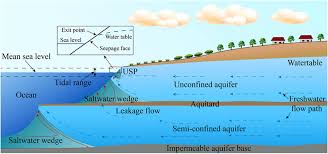
The water table above a regional aquifer is normally below any other groundwater bodies. However, sometimes there are small aquitards located above. This leads to Perched Aquifers above regional aquifers. Perched aquifers can be the source of springs.
“What do we call ground layers that slow water discharge between aquifers?”
Aquifers store water underground. Sometimes, a portion of the underground layer will limit the water discharge to and/or from an aquifer. These Aquitards are made of low-permeability materials that can drastically reshape subterranean water systems.
“How do we classify dark and moderately rainy clouds?”
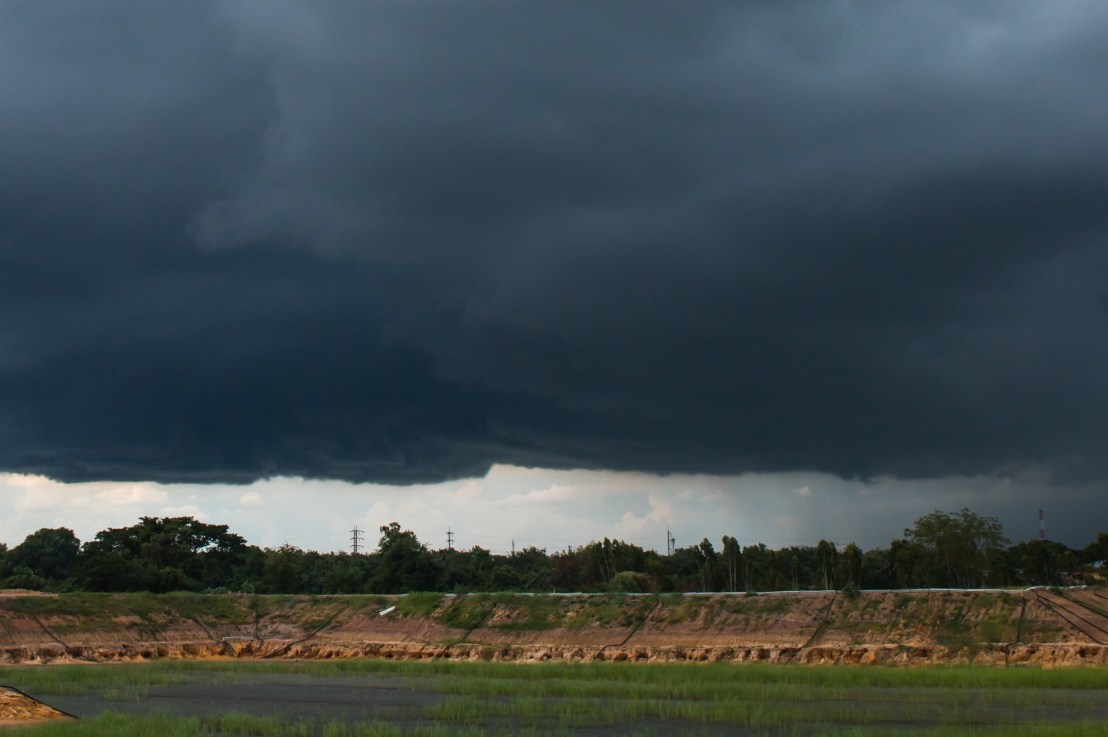
Clouds come in all shapes and sizes. During warm fronts, moisture may rise into the atmosphere and create dark clouds. These Nimbostratus Clouds produce constant streams of rain with (usually) no lightning or thunder. Nimbostratus clouds typically form around 2 – 4 kilometers in the middle level of the troposphere.
“Why do country-sized garbage patches circle the oceans?”
Ocean gyres rotate water between continents like a conveyor belt. When people release garbage into the ocean, it can get sucked into this rotation. Over time, this waste has accumulated into giant Garbage Patches in Ocean Gyres. The largest by area, the Great Pacific Garbage Patch, is estimated to be around twice as large as the U.S. state of Texas! These garbage patches are not continuous, solid masses, but rather similar to a mirky soup soup.



 Isaac's Science Blog