Category: Biology

Lipids

Lipids

Lipids

Isaac Gendler

“What is your fat made out of?”
Everyone has fat on their bodies, but have you ever wondered what it is made out of? Well, it turns out that body fat is composed of an interesting class of molecules called lipids. Lipids are molecules that contain hydrocarbons and are insoluble in water due to their non-polar structure. This composition also makes them hydrophobic. These liquids form an essential part of a creature’s biology. In fact, we can obtain a reasonable amount of lipids by consuming the fat of other animals.

Extremophiles

Extremophiles

Extremophiles

09/07/16

“Are there organisms that can thrive in the most hazardous of environments?”


The extreme has always fascinated humankind. Whether it be extreme sports or extreme beliefs, our brains are wired to love it when the  pre-conceived safety boundaries are pushed beyond recognition. Extreme environments are no exception, with many captivated by the almost alien-like structure of locations such as the bottom of the ocean. Now, in these most extraordinary of places, is it possible for something such as life to exist? Believe it or not, there in fact are. Extremophiles are life-forms that are adapted to exist within the most dangerous of environments, such as hydrothermal vents. In fact, these organisms can even survive in locations with no oxygen! Extremophiles are able to accomplish these feats with the use of a special enzyme called extremozymes. Examples of extremophiles include giant tube worms, which live on the bottom of the pacific ocean floor and withstand high levels of hydrogen sulfide, and water bears, half a millimeter creatures which can survive for 120 years with no food or water and withstand pressure 6 times what is found in the oceans, as well survive in temperatures just above absolute zero.  


Now, to take this idea a step further, if there are numerous creatures out there that can survive in alien-like conditions, could there be creatures that survive on alien worlds? Just think about it


Blood pressure

Blood pressure

Blood pressure

09/05/16

“What is blood pressure?”

When you go for a medical checkup, you will often hear a lot of talk about your “blood pressure”. But what exactly is this phenomena? Well, believe it or not, blood pressure is  actually a very simple concept. Your body is able to maintain it’s operations because the heart pumps blood (which carries oxygen) to all of it’s vital systems. This pumping motion causes blood to be pushed against the walls of your blood vessels, and we can quantify this force as blood pressure. Your blood pressure is usually measured in “millimeters of mercury” (or mmHg), and is given two values (for example, a stable blood pressure is considered to be 120/80 mmHg). But why on Earth will your blood pressure be given two values? Well, let’s think about it. When your heart pumps blood, it does not do so in a constant fashion. Instead, it acts like a piston, with a force changing in a beating nature. So your blood pressure will be the highest at the peak force (termed the systolic blood pressure), and lowest at the bottom (termed the diastolic blood pressure). The higher your blood pressure is, the higher you will have a risk of developing heart heart problems. For example, someone with a blood pressure reading of 135/85 mmHg is twice as likely to receive a heart attack as someone with a blood pressure of 115/75

Proteins

Proteins

Proteins

09/03/16

“Have you ever wondered about what protein exactly is?”

Do you know what  are the “worker” units of a cell are? Well, believe it or not, they are actually something that you hear of everyday, proteins. Now, you might find it a bit funny that such an important part of biology is named after a simple nutrient, but you will soon find out why they are so necessary.Proteins simply are polymers of smaller units called amino acids, of which there are twenty different types that can be combined to make a protein. These different combinations can specialize a protein to do different tasks. For example, one combination called an antibody is used to neutralize foreign particles (such as viruses and bacteria). Another combination is called an enzyme, which can carry out all of the chemical reactions within a cell and help out with the formation of new molecules by reading the genetic information within a cell. Messenger proteins can transmit different signals to correspond different processes between biological frameworks such as organs, tissues, and cells. A structural component protein gives a cell a framework for it to move, and a transport/storage protein can bind and carry small molecules within a body. So by consuming proteins, you can obtain many necessary units for your body’s function!

Cell theory

Cell theory

Cell theory

08/25/16

“What is the fundamental part of biological organisms?”


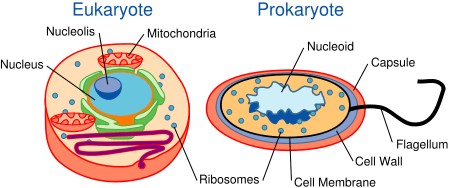
Have you ever wondered what is the most fundamental part of biological organisms? Well, believe it or not, all living beings are primarily composed of a form of matter called cells. Cells are defined as the simplest form of living matter. There are two types of cells, eukaryotic and prokaryotic cells . Eukaryotic cells contain a true nucleus (which houses DNA), and is contained in cell membrane to isolate itself from other cells. Prokaryotic cells are different from  eukaryotic cells because instead of having the DNA isolated in a protective membrane, it is wrapped up in a region called the nucleoid. Complex life such as plants, animals, fungi, and protists are composed of eukaryotic cells, while simpler life is composed of prokaryotic cells.

RNA

RNA

    RNA                06/09/16


Have you ever what is responsible for creating and transmitting genetic information? Then you have just wondered about RNA.  RNA stands for Ribonucleic acid. The geometric structure of RNA is one of a single helix, this structure making it more resistant to damage by virulent ultraviolet waves.

White blood cells

White blood cells

White blood cells           05/02/16


Have you ever wondered why your body is able to fight of malevolent invasive organisms? You can thank white blood cells for this. White blood cells are like the soldiers of your body, fighting to defeat the invading organisms.. White blood cells account for 1 percent of the blood cell count of your body. There are five types of white blood cells. Monocytes have a longer lifespan the average WBC and help break down bacteria. Lymphocytes create antibodies to help to defeat invaders. Neutrophils desecrate and digest invading bacteria and fungi. Basophils are the “alarm sounders” of your body, warning other cells to respond to the enemy invasion. Eosinophils attack and kill parasites, cancer cells, and ameliorate the effects of allergies.

Cross fertilization

Cross fertilization

Cross fertilization      04/03/16


Cross fertilization is one of the most important processes in life, since it deals with the reproduction of it. Cross fertilization begins with the fusion of male and female gametes (sex cells) from at least two distinct individuals of the same species. By combining genes, a greater motley of genetic diversity increases within a population and a species becomes stronger and more resilient to population catastrophies.