Author: Isaac Gendler

Eddy current braking

Eddy current braking

Eddy current braking

08/02/16

“How can we apply the theory of eddy currents to transportation?”

What separates scientists and engineers is very simple, scientists discover new phenomena about the natural universe, while engineers take this knowledge and apply it to accomplish something useful. For example, scientists might discover that a specific current forms when conductors had a changing magnetic flux is applied to it, and name it something like eddy current. Now, how could an engineer take a phenomena like this and make it do something productive for humanity?

Well, let’s think about it like an engineer. We know that this current occurs because of an external magnetic field. Furthermore, we know that when current interacts with an external magnetic field, a perpendicular force is formed on the medium of the current. So let’s go further and think about we can do with this force. Well, a force can oppose motion, so how about we take this physical phenomena and apply it to an area that involves motion, namely transportation.

Let’s suppose that we have wheels made out of a conductive material, and that these wheels are moving at a certain RPM. If we take a magnet, and put the wheels in between both poles, then the constantly moving wheels will experience a constantly changing magnetic flux since parts of the conductor will always be moving into and out of the field. This will in turn generate an eddy current, which will produce a force that opposes the motion of the wheel, which in turn will cause it to slow down and brake. Engineers have termed this mechanism eddy current braking. Eddy current are so popular that they are used in many different cases, whether it be recreational gym equipment or high speed electric trains!

Hallback array

Hallback array

Hallback array

08/01/16

“How can we create a one-sided magnet?

We have a problem. Suppose that we want to create a magnet, but with one very simple yet very difficult constraint, we want the magnetic field to be only present on one side.
Now that we have decided on the requirements, let’s use our engineering abilities to bring this idea into reality. Our main problem is that magnets fields are usually symmetric on both sides because the polarity of the entire material points in the same direction. Now, how can we get around this physical phenomena to acheive our goals? Well, luckily for us, there is another facet of magnets that could be quite cordial to our goal if applied correctly. If two magnetic fields interact with eachother and go in oppossite direction, then there would be a cancellation of force. Now, what if instead of having one continuous material with each part having the same magnetic direction, we were to fasten discrete blocks together, with each the polarity of each block being 90 degrees perpendicular to the block before it? With this method, the magnetic fields on one side of the blocks would cancel out while the fields on the opposite side would super-combine, giving us a nearly one sided magnet if the this pattern repeats. Scientist and Engineers have termed this type of arrangement a hallbach array. Believe it or not, you probably see hallbach arrays everytime time in the morning, as hallbach arrays are what what makes refridgerator magnets work!

Actinides

Actinides

Actinides

07/31/16

“What are the actinide elements?”

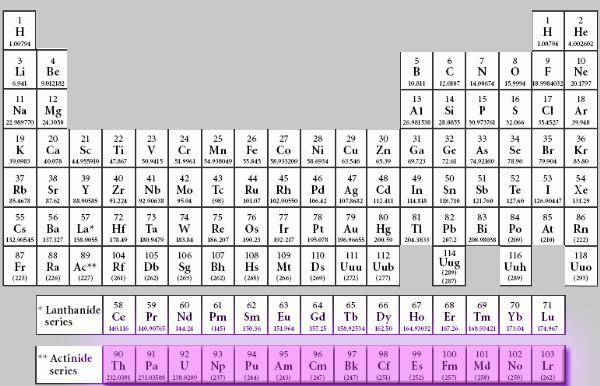
As we continue throughout our tour of the periodic table, we approach a most virulent group of chemicals known as the actinides. All of the actinides have relatively high density, plasticity, and level of radioactivity. The elements that make up the actinide metals include actinium [Ac], thorium [Th], protactinium [Pr], uranium [U], neptunium [Np], plutonium [Pu], americium [Am], curium [Cu], berkelium [Bk], einsteinium [Es], Fermium [Fm], Mendelevium [Md], nobelium [No], and lawrencium [Lr]

Lanthanides

Lanthanides

Lanthanides

07/30/16

“What are the lanthanide metals?”

Continuing on with our tour of the periodic table, we have come across a series of metals with atomic numbers 58 through 71 called the lanthanides. The lanthanides are bright, silvery, and are so soft that they could be cut with a knife. Lanthanides react with hot water to produce hydrogen gas. Lanthanides used to be called the rare metals, not because they were rare, but because it is very difficult to find the in their pure form. The elements that make up the Lanthanides include lanthanum (La), cerium (Ce), praseodymium (Pr), neodymium (Nd), promethium (Pm), samarium (Sm), europium (Eu), gadolinium (Gd), terbium (Tb), dysprosium (Dy), holmium (Ho), erbium (Er), thulium (Tm), ytterbium (Yb), and lutetium (Lu).

Reversable reactions

Reversable reactions

Reversible reactions

07/24/16

“Is it possible for atoms to revert to their original state after a chemical reaction?”


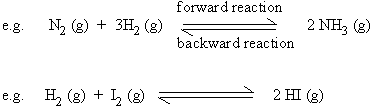
As we all know, when a series of elements undergo a chemical reaction, the elements and their composition will change as a result. However, is it possible for the products to reverse this change and revert to their original forms? Believe it or not, this is a common process. Products of a reaction can re-react and reform into the reactants! This phenomena is known as a reversible reaction, and the symbol for this process is shown in the picture.

Noble gases

Noble gases

Noble gases

07/28/16

“Are there any elements out their that are nearly completely non-reactive?”

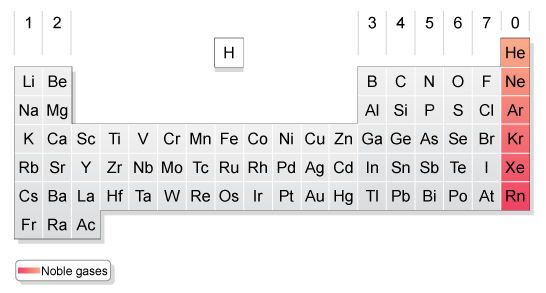
We are about to approach probably one of the most interesting parts of the periodic table, the small but important group known as the noble gases. The nobles gases are very special for one very peculiar fact about them: their outer valence shell is completely filled! This makes them chemically inert, which gives them an extremely nonreactive nature with other elements. Noble gases are called noble gasses because in addition to being  colorless, tasteless, odorless, and non-flammable, they also have a low melting and boiling point, which causes them to be gases at room temperature. The elements that make up the noble gases include helium [He], neon [Ne], argon [Ar], krypton [Kr], and xenon [Xe].

Halogens

Halogens

Halogens

07/27/16

“What does the halogen group do?”

During our tour of the periodic table we encounter a very interesting group in the column XVII called the halogens. When the halogens react with water, they form very strong acidic compounds that can made into salts. Halogens usually have an oxidation number of -1, which makes them some of the most reactive elements in science. In fact, halogens are so reactive that directly ingesting some of them can be fatal to the human body!. The elements that make up the halogens include fluorine [F], chlorine [Cl], bromine [Br], Iodine [I], and astatine [At].

Non-metals

Non-metals

Non-metals

07/26/16

“What are some of the properties of non-metals?”

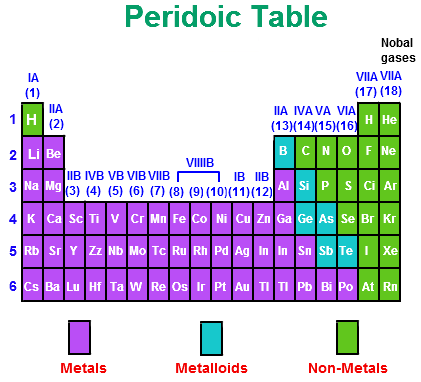
After reviewing the different type of metals and metalloids, you might be wondering, “What are some of the objects that are not metals at all, what are their properties?”. Well, when one thinks about it logically, if metals have one type of behavior, then it would not be too far fetched for the opposite type of material to have opposite properties? This is in fact the case with non-metals. Nonmetals in groups 12-14 in the periodic table. Non-metals do not conduct heat or electricity very well, and are very brittle. Non-metals usually have oxidation numbers of +/-4, -3, and -2 as a result of being on the far-right side of the periodic table. The elements that make up the non-metal category include hydrogen [H], carbon [C], nitrogen [N], oxygen [O], phosphorus [P], sulfur [S], and selenium [S]

Metalloids

Metalloids

Metalloids

07/25/16

“What’s a metalloid?”

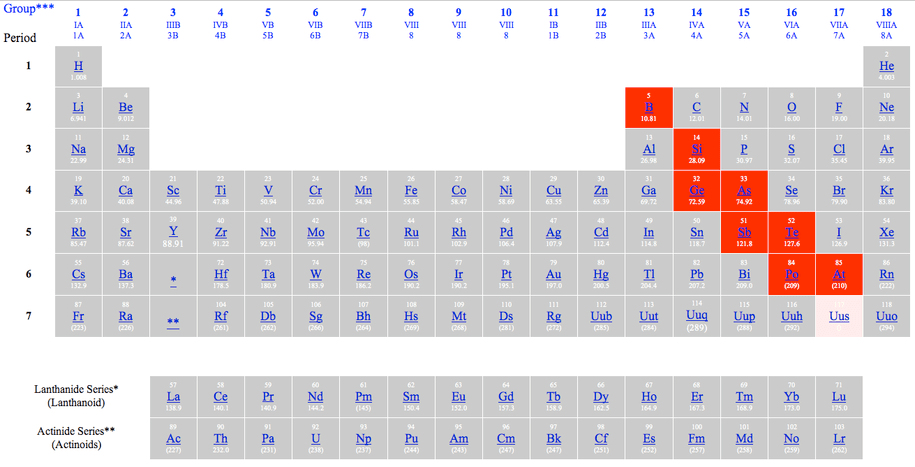
When browsing through the periodic table, you might see a group of elements that have a very strange description called metalloids. In short, metalloids are elements that have properties of both metals and non-metals. The elements that make up the metalloid group include boron [B], Silicon [Si], Germanium [Ge], Arsenic [As], Antimony [Sb], Tellurium [Te], Polonium [Po], and Astatine [At]. These elements are typically very brittle and have a fair amount of electrical conductivity. What makes metalloids especially interesting is that some of them (such as Germanium and silicon) have the properties of being semiconductors.