Osmotic Pressure
09/30/25
“What’s the pressure needed to stop osmosis?”
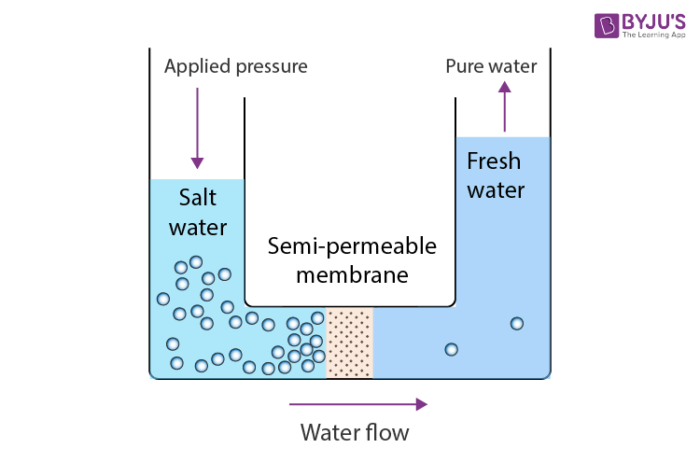
Imagine a semi-permeable layer dividing a container of freshwater from a container of saltwater, each with equal volumes. Now imagine that the semi-permeable layer is small enough for water particles to pass through, but not for salt particles. Since there are more water particles on the saltwater side than on the freshwater side, there will be a water particle migration until there’s an equal amount on both sides. This will lead to a pressure differential in the direction of the salt water. The pressure necessary to overcome this imbalance and begin the reverse osmosis process is called the Osmotic Pressure, given by the equation pi = phi * (n/V)RT, where pi is the osmotic pressure, phi is the osmotic coefficient, n is the number of moles in the solute (in this case, salt), V the volume of the solvent, R the universal gas constant, and T the absolute temperature.
Image credit: https://cdn1.byjus.com/
 Isaac's Science Blog