Month: September 2025

Osmotic Pressure

Osmotic Pressure

Osmotic Pressure

09/30/25

“What’s the pressure needed to stop osmosis?”

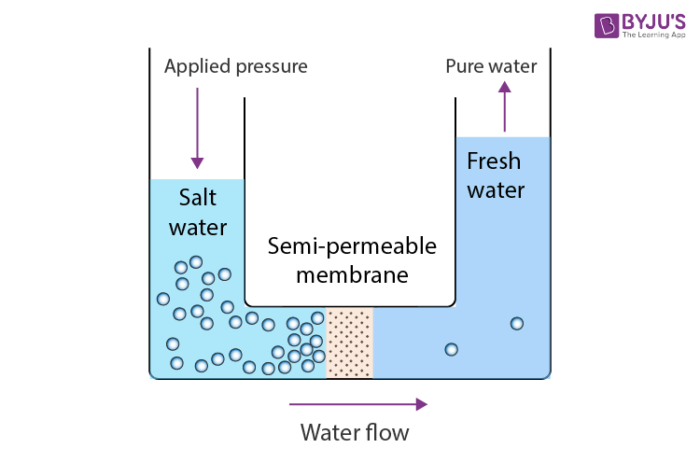
Imagine a semi-permeable layer dividing a container of freshwater from a container of saltwater, each with equal volumes. Now imagine that the semi-permeable layer is small enough for water particles to pass through, but not for salt particles. Since there are more water particles on the saltwater side than on the freshwater side, there will be a water particle migration until there’s an equal amount on both sides. This will lead to a pressure differential in the direction of the salt water. The pressure necessary to overcome this imbalance and begin the reverse osmosis process is called the Osmotic Pressure, given by the equation pi = phi * (n/V)RT, where pi is the osmotic pressure, phi is the osmotic coefficient, n is the number of moles in the solute (in this case, salt), V the volume of the solvent, R the universal gas constant, and T the absolute temperature.

Image credit: https://cdn1.byjus.com/
Distillation

Distillation

Distillation

09/29/25

“How can we use boiling to separate two substances mixed together?”

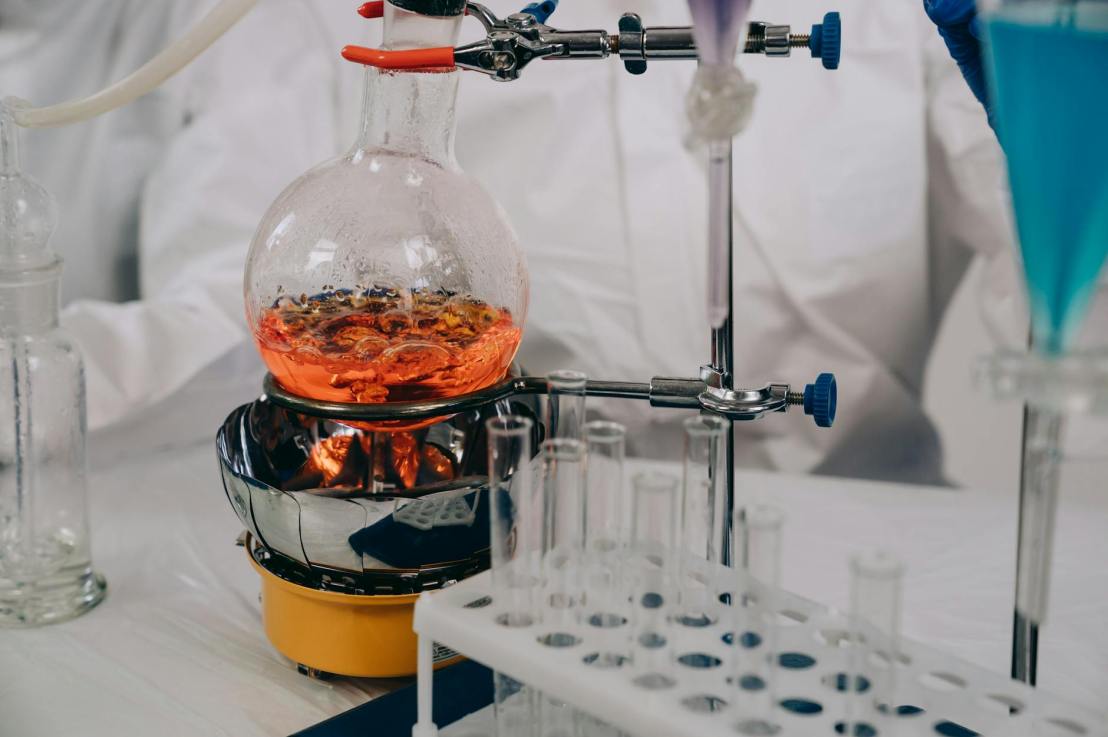
Substances mixed together in a liquid can be difficult to separate. But applying a bit of chemical knowledge can help us. If the two mixtures have significantly different boiling points, then one will vaporize before the other. So what if we were to capture this vapor and condense it into another reservoir to separate the substances? Well, this is the idea behind Distillation. Water treatment systems can apply distillation to separate water from contaminants. If the boiling points between the different substances are less than 100 degrees ˚C apart, then operators must use a special fractional distillation technique.

Henry’s Law

Henry’s Law

Henry’s Law

09/28/25

“What describes the relationship between the amount of gas dissolved in a liquid and the partial pressure above the liquid?”

Pressure forces gas to move. If gas is in a container with a liquid and high pressure is acting on the gas, there is more force to move more of the gas into the liquid. If there is low pressure acting on the liquid, then more of the gas will escape from the liquid. This behavior is described by Henry’s Law, which is described by the formula C = k_H*P, with C being the concentration of the gas dissolved in the liquid (mol/L or mg/L), k_H the Henry’s Law constant (mol/liter-atm or dimensionless), and P the partial pressure of the gas in the air above the liquid (atm). Henry’s Law is a vital part of mass transfer analysis for many applications.

Volatile Organic Compounds

Volatile Organic Compounds

Volatile Organic Compounds

09/27/25

“What makes chemicals that have high vapor pressures at room temperature special?”

Substances with high vapor pressures become gases at low temperatures. Carbon-containing substances with high vapor pressures are classified as Volatile Organic Compounds, or VOCs. There are upwards of over ten thousand VOCs identified, ranging from perfumes to greenhouse gases. VOCs are the sources of most of the scents that humans can smell, and many VOCs contribute to air quality issues.

CT Value (Water Disinfection)

CT Value (Water Disinfection)

CT Value (Water Disinfection)

09/26/25

“How can we quantify the effectiveness of chemical disinfection treatment?”

Chemical disinfection processes have a wide range of effectiveness. But what variables govern how much impact a certain process has? Well, it turns out by multiplying the concentration (C) in mg/L of a chemical by the amount of contact time (T) with the water, we can obtain the CT Value. While increasing concentration is generally helpful for CT values, it can also increase chemical byproducts, making increasing contact time more effective. Water treatment operators have lab data giving the CT values needed to destroy specific microorganisms.   

Filter Backwashing

Filter Backwashing

Filter Backwashing

09/25/25

“Why can we clean filters by pumping water backwards?”

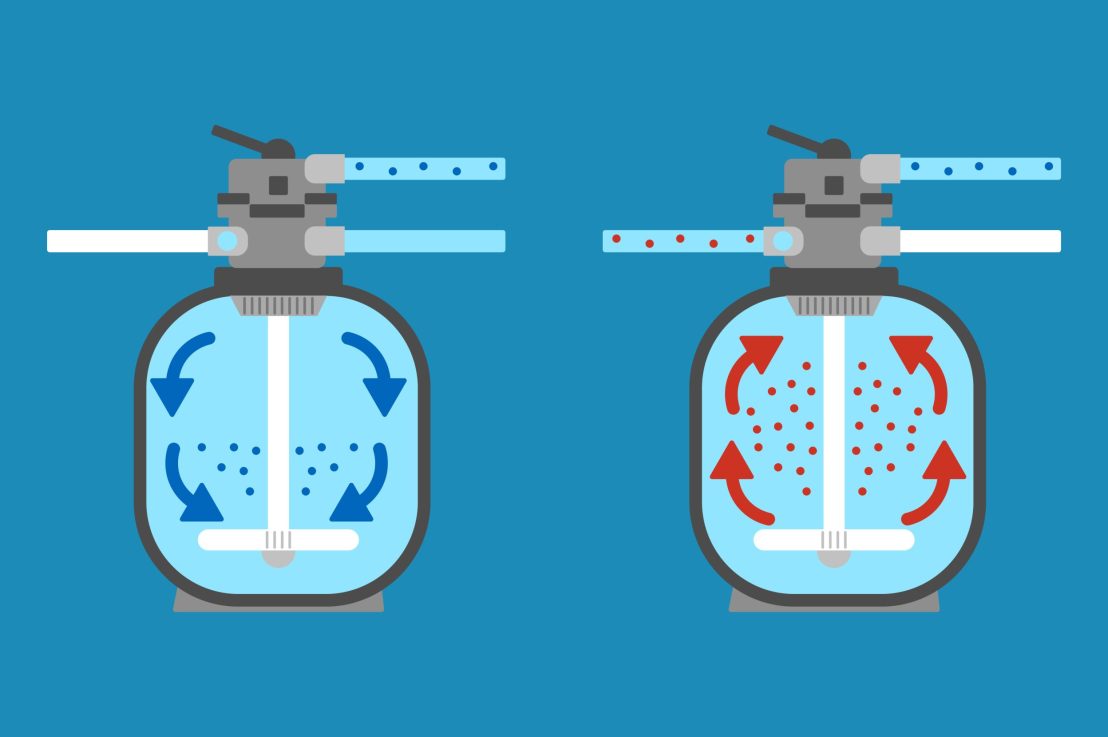
Filters collect trapped material over time. Sometimes this piles up so much that it hampers further treatment. To solve this, infrastructure operators can pump water in the other direction to remove water from filtration. This Filter Backwashing is vital for treatment maintenance.

Image credit: https://www.aquabluepools.net/

Rapid Mixing for Water Treatment

Rapid Mixing for Water Treatment

Rapid Mixing for Water Treatment

09/24/25

“Why is it important to rapidly mix water at the beginning of the coagulation process?”

Coagulation mixes coagulants with suspended particles to form larger, charge-neutralized molecules. However, the mixing needs to occur quickly (usually less than a minute) to ensure the coagulants are evenly distributed and the suspended solids are destabilized to effectively clump together during flocculation. This Rapid Mixing for Water Treatment is the first part of the larger coagulation-flocculation process, and is an example of how the brilliant systems that underpin everyday life for many.

Image credit: https://haoshpumps.com/

Alkalinity

Alkalinity

Alkalinity

09/23/25

“What’s the equivalent of inertia for resisting change in acidity in water?”

Water of different makeups reacts to a change in acidity in different ways. Just like how objects have inertia for resisting change in motion, water has Alkalinity for changing acidity levels. The higher a water’s alkalinity, the easier it can neutralize acid. The molecules carbonate (CO3), biocarbonate (HCO3), and hydroxide (OH) contribute to a substance’s alkalinity. Alkalinity is measured in milliequivalents per liter.

Temporary Water Hardness

Temporary Water Hardness

Temporary Water Hardness

09/22/25

“What’s a special type of water hardness that can be removed by boiling and adding lime?”

Water hardness comes from having too much dissolved magnesium and calcium in water. But some types of water hardness are easier to soften than others. If the magnesium and calcium are attached to bicarbonates, then they can be removed through boiling or adding lime. This type of water hardness is called Temporary Water Hardness.