Conventional Activated Sludge (CAS) Systems
04/10/25
“How can we filter wastewater using air and bacteria?”
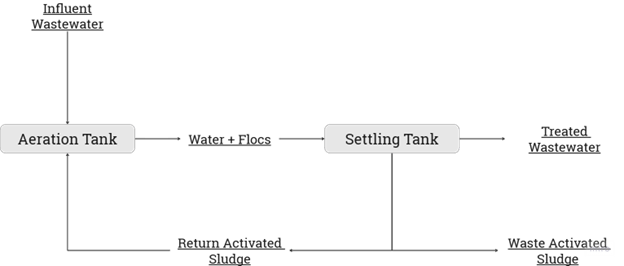
Conventional Activated Sludge (CAS) Systems are a cornerstone of modern wastewater treatment technology. CAS systems are composed of two tanks, an aeration tank and a settling tank. The CAS process begins with influent wastewater pouring into the aeration tank. The aeration tank aerates (adds air or oxygen) into the wastewater to activate microorganisms already present. These microorganisms break down the organic pollutants into less harmful biomass. Over time, the microbes and the waste will clump together to form flocs. The water and flocs are then transported to the settling tank (also known as a clarifier) where the heavier flocs settle to the bottom as sludge and clear water flows out as effluent. The sludge then leaves the settling tank, where part of it is removed from the CAS (Waste Activated Sludge) while the other portion is returned to the aeration tank (Return Activated Sludge) to provide extra microorganisms to new influent water. The attached image visualizes this process.
 Isaac's Science Blog