Root-mean-square speed
10/31/16
“How can we find the average kinetic energy of all of the atoms in a gas?”
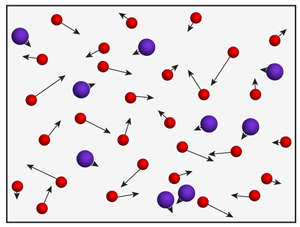
We see gasses everyday, whether it be the atmosphere that we breathe, the substances that drive pneumatic controls, or the air that flows through air conditioner. However, we also know that the temperature and kinetic energy of a gas is contingent upon the speed of the gas itself. The problem is, since gases are composed of individual particles moving with only weak connections to one another, measuring the average velocity of the entire system probably sounds like a near-impossible task! Luckily, due to the labors of countless scientists, it turns out that such an endeavor is not impossible at all with the use of a conceptual tool known as the root-mean-square-speed. The root-mean-square-speed states that the average speed of all of the individual particles in a gas is proportional to the square root of the temperature of the gas divided by the molar mass of the molecules that compose the gas, all of which can be represented symbolically as vrms=3*R*T/(Molar-mas) ., with R being the gas constant 0.08205 Liter atm/molar * k, and T being the temperature in kelvin.
 Isaac's Science Blog