Month: April 2016

Matrices

Matrices

Matrices          04/05/16

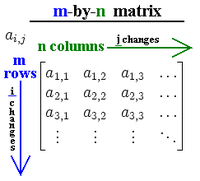
Matrixes are one of the most important facest of mathematics, especially in relationship to linear algebra. A matrix is a rectangular array of number, with m rows and n columns. One can think of matrices as vectors with 2 dimensions of organization. Two matrixes can be added and subtracted from one another given that they are the same size, and they can be multiplied together if they have the number of columns of Ais equal to the number of rows of b


Matrix addition is very simple, one just adds up all of the of the common elements together. For example, if the Matrixes aand b have elements in [2,3], then they will be added up and placed in [2,3] in the final matrix c. A matrix can also be multiplied by a constant number c, such that c*Awill multiply all of the elements contained in Aby c.Matrixes can also be multiplied by each other, in which each column of matrix awill be cross produced to each row of matrix bto make a new matrix of c, which is as large as the common elements of both matrixes. A matrix can also be flipped to such that a matrix of m x nwill become one of n x m, and can be represented by the modificationAT

Sunspots

Sunspots

Sunspots           04/04/16


Sunspots are a most peculiar phenomena occurring in the solar system. Sunspots are regions of the sun that are darker and (relatively) cooler than the surrounding photosphere. Sunspots are a temporary phenomenon, usually with a lifespan lasting from several hours to several months. Sunspots can be carried around by the internal rotation of a stellar object. Consequently, the amount of sunspots on a sun have a sinusoidal variability (meaning that the amount of sunspots on the spot goes up and down with time) and this causes the sun to be slightly cooler during times of high sunspot activity. Sunspots also have a high magnetic activity, which in turn can be correlated with events such as coronal mass ejections.

Cross fertilization

Cross fertilization

Cross fertilization      04/03/16


Cross fertilization is one of the most important processes in life, since it deals with the reproduction of it. Cross fertilization begins with the fusion of male and female gametes (sex cells) from at least two distinct individuals of the same species. By combining genes, a greater motley of genetic diversity increases within a population and a species becomes stronger and more resilient to population catastrophies.

Convection zone

Convection zone

Convection zone         04/02/16


The Convection zone is a layer of a stellar object that is unstable to convection. In this area of a star, all of the energy of this layer is driven completely by convection. This layer is “cool” enough to have heavier ions such as Calcium, nitrogen, carbon, and nitrogen. The convection zone is an important part for any star.

Coronal mass ejection

Coronal mass ejection

       Coronal mass ejection                   04/01/16


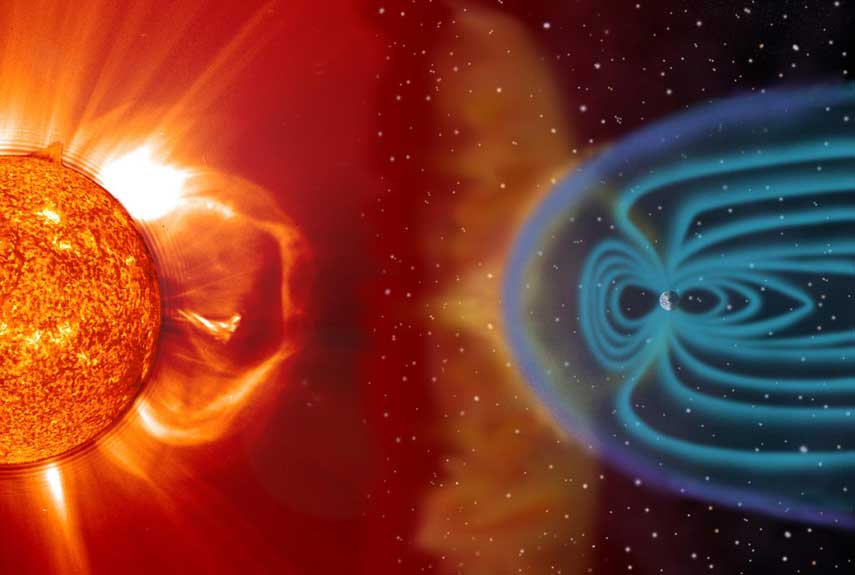
Coronal mass ejections are a very intriguing part of solar physics.During filament eruptions, a large amount of hot plasma encapsulated in a magnetic field may be released. Coronal mass ejections will then drift throughout space and if it comes into contact with the Earth, then a Geomagnetic storm may ensue. If the revolution of the magnetic field lines of the CME is in parallel with the magnetic field lines of the Earth, then there will be a large amount of magnetic interference and power grids will be completely shut off.