Month: April 2016

Mechanical advantage

Mechanical advantage

Mechanical advantage 04/14/16


Mechanical advantage is the measurement of force amplification achieved by using a tool. In theory, power is conserved along along an object. In a linear object like a lever being spun around in a circle the velocity of a particle existing on a point along the lever increases with distance, which can be represented symbolically by equation  (1) v=*r. The equation of power is (2) P=F*v, and since power is conserved along the object, comparing a location  Ato a location Bcan be represented as Pa=PbFa*va= Fb*vbwhich can be stated as vavb=FbFa, and by inserting equation (1) we can finally arrive at ab=FbFa, thereby proving our force amplification effect.
Pulleys

Pulleys

  Pulleys          04/13/16


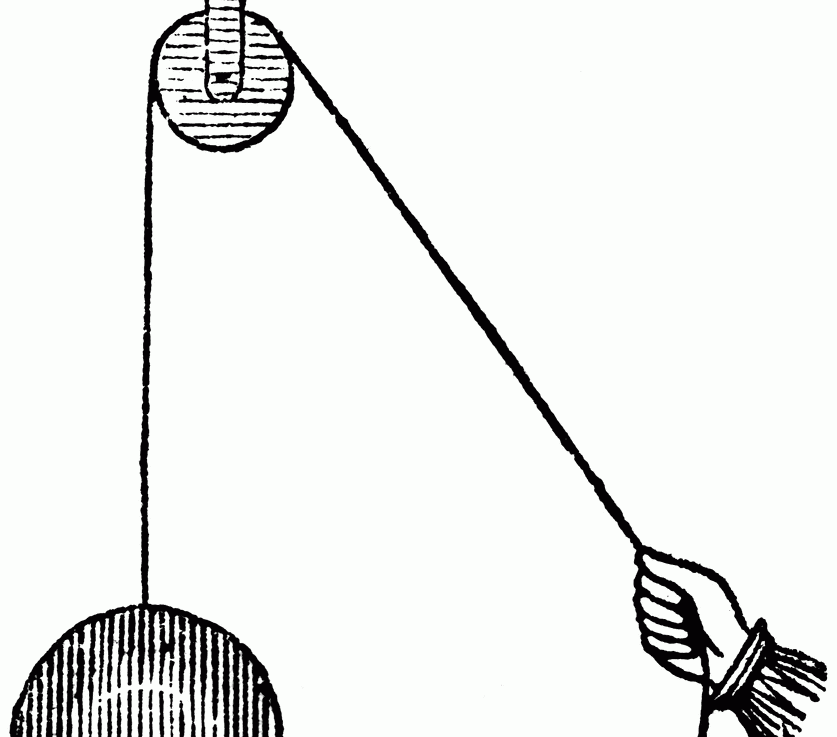
Pulleys are of the the machines that make up the six simple machines. On the surface, pulleys are wheels with a fixed axis that support a rope going around it. The movement of the pulley will move the rope in effect. There are three types of pulley systems: A Fixed Pulley system that involves an axle being mounted by bearings. A Movable pulley has an axle in a movable block and has a mechanical advantage of 2. A Compound Pulley is a pulley that is a combination of the two aforementioned systems. Belts and Pulleys ar eoften combined in to hybrid Belt Pulley systems

Conveyor systems

Conveyor systems

   Conveyor systems           04/12/16


Conveyer systems are systems that transports objects and materials from one endpoint to another in a consistent manner. Because Conveyer systems are often machine automated, they are quite applicable to transporting heavy materials from one endpoint to another. One of the most widely known parts of a conveyer system is the Conveyer belt. There are a myriad of diffuse number of conveyor systems. Pneumatic conveyer systems transport free-flowing materials such as dust or powders through tube vents by utilizing high velocity air. Vibrating conveyor systems use vibrations to move material through a U-shaped profile. Such machines are often used for industries such as agriculture where sanitation is paramount (The Vibrations shake off virulent materials). Flexible conveyor systems are conveyor systems that are able to twist in turn, making them useful for transporting merchandise. Vertical conveyor systems Use forks to transport heavy materials in the vertical direction. Heavy duty conveyors transport  materials that are in the excess of 225 Kilograms

Conveyor belts

Conveyor belts

 Conveyor belts           04/11/16


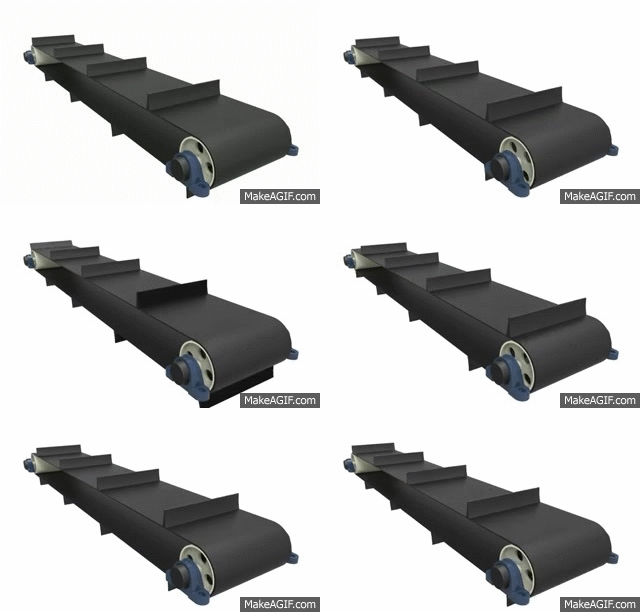
Conveyor belts are one of the most ubiquitous mechanical inventions known to humankind. The primary purpose of a conveyor belt is the smooth transportation of material (such as food or mineral ores) along a single axis. Conveyor belts are rather simple contraptions, requiring only a handful of parts. A Belt is wrapped around a series of parallel pulleys that rotate in the same direction. Conveyor belts are rather omnipresent in society, raging in locations from sushi restaurants to automobile factories.

Thermal runway

Thermal runway

Thermal runway 04/10/16


Have you ever wondered if an increase in temperature could cause a further increase in temperature? This simple idea is the basis of a phenomena known as a thermal runway. In Chemical Engineering, a thermal runaway can happen if a reaction rate increases due to an increase in temperature, which causes a further increase in temperature and spins out of control. In Electrical Engineering, joule heating may diminish resistive elements which further increases current which further increases heating.


If one thinks about it, couldn’t this phenomena simply be modeled with differential equations?

Eigenvalues and eigenvectors

Eigenvalues and eigenvectors

Eigenvalues and eigenvectors           04/09/16


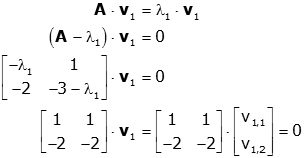
In Linear Algebra, Eigenvectors and Eigenvalues  are special sets of vectors and scalars respectively that  if one takes a Matrix A and multiplies it by some eigenvector xthen A*x=*x, with being the eigenvalue. To solve for the eigenvector, first set it up so the top right to bottom left diagonal values are subtracting an eigenvalue. Then take the determinant of the system and solve for zero. Those will be your eigenvalues. Then lug those eigenvectors in and solve for the equation to get your eigenvectors. I really have no fucking clue about how this works

Earth’s magnetic field

Earth’s magnetic field

Earth’s magnetic field        04/08/16


One of the main reasons why the Earth is capable of sustaining life is because of the ever present Magnetic field that it encases. The Earth’s magnetic field usually has an intensity of around 0.65 Gauss, which is enough to deflect charged particles from solar wind aimed at the planet. Also, the magnetic south pole is actually located near the Hudson bay in Canada (the poles are switched around in respect to our conceptual geographic location), so most compases do not point directly north. Every so often the Earth goes through a magnetic field reversal, in which the poles switch from one point to another. The magnetic field is thought to originate from moving iron magma in the outer core of the Earth. Some animals are thought to be able to detect the magnetic field of the earth through the use of biomagnetism, in which a piece of magnetite in the brain of the animal is able to respond to the magnetic field, acting as a sixth sense.

Mechanical belts

Mechanical belts

Mechanical belts             04/07/16


A belt is a loop of pliable material that can induce rotation on two mechanical objects. Belts are also used to transfer power and pull twists., and they are often the cheapest solution for such necessities. Belts are often used to connect two cylindrical mechanical objects in that are coplanar with one another. The power in a belt can be calculated by finding the difference in tension and multiplying it by the velocity, which can be symbolically represented as  P=(T1T2)*v. Belts are important because they can turn objects that are not coaxial.

Spontaneous combustion

Spontaneous combustion

  Spontaneous combustion    04/06/16


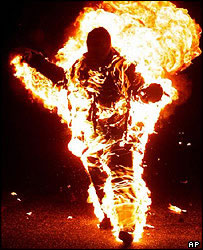
Spontaneous combustion is when an object catches fire through the effect of self-heating. First, objects with low ignition temperatures begin to release heat. If such heat is unable to escape, then the heat re-enters the system. The combustion temperature will rise, and eventually if ignition point is reached and an oxidizer is present, then spontaneous combustion will occur. Hay is an example of an object that reaches combustion quickly.