Air resistance 02/12/16
An interesting conundrums appears for students of physics when considering Newton’s first law. If objects are supposed to go on forever in the vacuity of a net force, then why do objects on Earth slow down in the horizontal direction? The answer lies in the fact that when objects move through Earth’s atmosphere, they experience a phenomena called air resistance. Because air is a fluid, solid objects can be suffused in it as a surrounding medium. Analogous to objects moving in water, when one moves through the atmosphere, it comes into contact with air particles, causing minor but emergent impinging effects on an object’s motion. When all of these collisions amalgamate, a phenomena known as a drag force appears. This drag force is what causes all of the impinging effects. Because drag force is based off collisions with air particles which in turn are based off Newton’s third law, the drag force is contingent on an object’s velocity, so the faster one moves, the more resistance one experiences. An application of this is terminal velocity in free fall, a peculiar phenomena that all objects in free fall experience. When an object is in free fall, it accelerates which in turn causes it’s velocity to rise, However, as it’s velocity rises, so does it’s drag force, and consequently the velocity of the object will reach an apex, with the drag force balancing out the gravitational force, therefore causing constant velocity as a result of Newton’s first law.
Month: February 2016
Nuclear force
Nuclear force 02/11/16
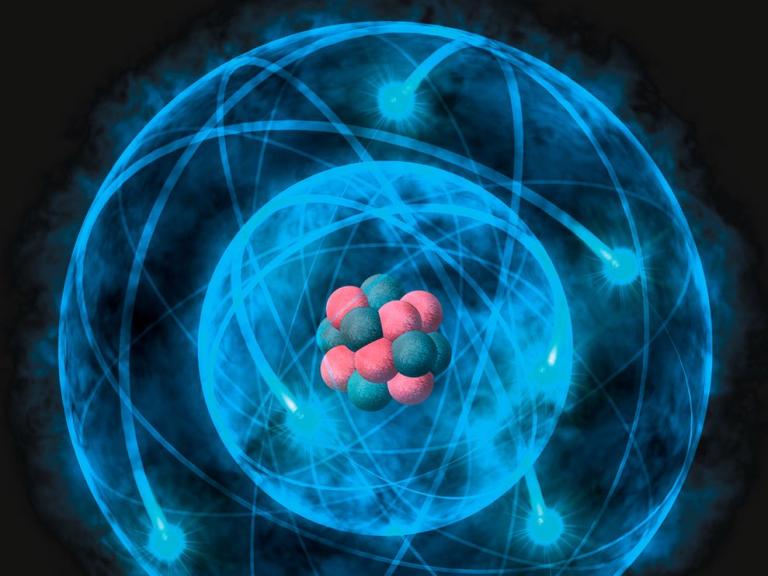
One comes in to an interesting quandary while studying the atom under Newtonian physics, if the protons and electrons are of opposite charges, then why don’t they attract each other and collide? The answer lies in the fact that there is a force present in the universe called the Nuclear force. The nuclear force is an enigmatic phenomena, being one of the most powerful forces in the universe but only present between particles at distances up to 1 ferometer (1*10^-15 m!). When active, this force is what keeps the electrons floating around in the orbit of the nucleus.
Neutrons
Neutrons 02/10/16
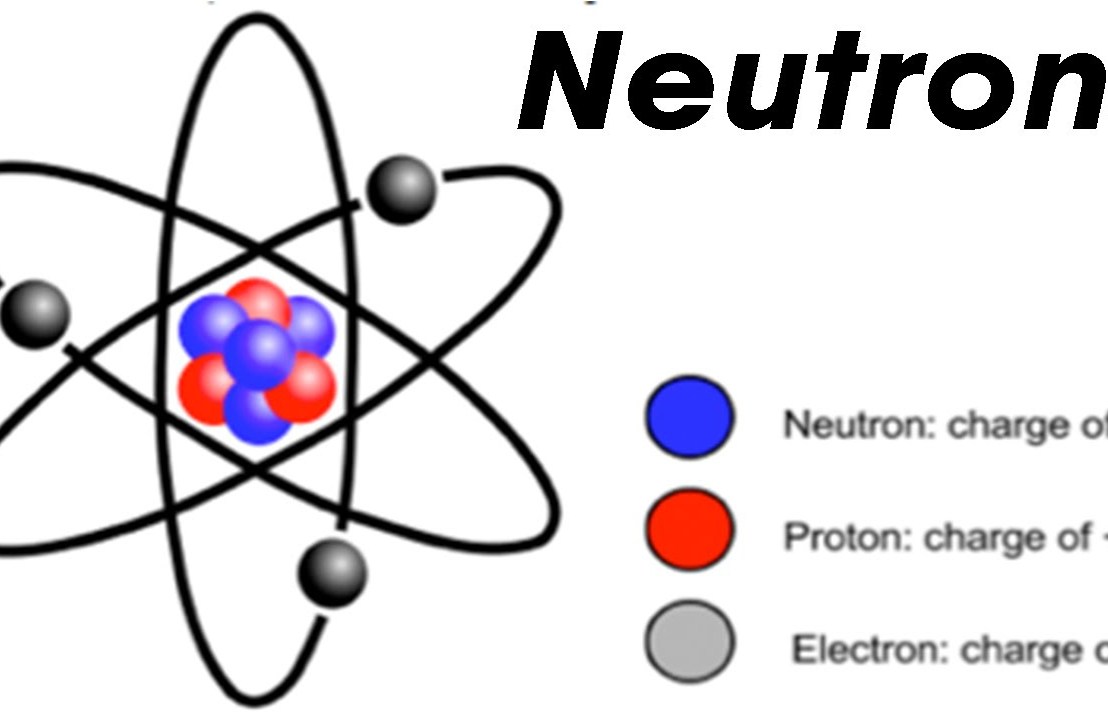
Neutrons are one of the most fundamental particles in the universe.Neutrons are located in the nucleus (along with protons) and have no observed electric charge, hence the name Neutron. Neutrons, protons, and electrons are bound together by the nuclear force, which will be explained later. An excess of neutrons in an element can make an atom a heavy one, which in turn makes it more prone to radioactive decay.
Conservation of momentum
Conservation of momentum 02/09/16
One of the most fundamental principles of Physics is the conservation of momentum. The theory of the conservation of momentum states that there is a quantity called linear momentum which is proportional to the product of an object’s mass and translational velocity. In addition, there is also angular velocity which is proportional to an object’s moment of inertia and angular momentum. This concept is one of the most pertinent to a student’s knowledge.
Molniya orbit
Molniya orbit 02/08/16
Molniya orbits are of of the most peculiar discoveries made by the old Soviet Union. As shown below, Molniya orbits have a highly eccentric Apogee and Perigee, and consequently they spend a large amount of time in orbit around certain latitudes (north being the most common ones). Molniya orbits were used by the Soviet union for communication satellites since the highly eccentric orbit meant that it spent a large amount of time in the Northern hemisphere, allowing for excellent communications coverage for the Soviet’s geographic position.
Geostationary Orbit
Geostationary Orbit 02/07/16
One of the most marvelous discoveries of modern Science and Engineering is the discovery and application of geosynchronous orbits. A geosynchronous orbit is a specific type of orbit in which the period of rotation around the earth is equal to the Earth’s revolution around its axis, an entire day in other words. This means that the orbiting satellite will stay above the same relative position of the earth for the whole time. This type of orbit is often used for telecommunication satellites. Unfortunately, such orbits can only be approximations due to impingement from solarwinds, geographic height shifts, solar wind, and gravitational influence of the moon.
Space elevators part II
Space elevators part II 02/06/16
Space elevators were conceptualized by the legendary Russian Scientist and Enginner Konstantin Tsiolkovsky. Space elevators can possibly work on less gravity intensive celestial bodies such as Mercury and Earth’s moon. Kevlar is one possible material to be used for this application. A space elevator can put objects in geostationary orbit, which means that objects can orbit the earth at the earth’s rotation speed.
Space elevators part I
Space elevators part I 02/05/16
Space elevators are some of the most riveting concepts in the field of Mechanical Engineering. Imagine if there was an elevator so tall that it broke the ionosphere and into geostationary orbit. Transporting objects across this medium would make rockets completely unavailing, and consequently would save an inordinate amount of energy. There is only one issue with this. In respect to earth’s gravity, there is no known material extant that is strong enough to support it’s own tensile weight.
Protons
Protons 02/04/16
Symmetry is one of the most omnipresent facets of the universe. Protons are the natural counterbalance to electrons. Protons are positively charged particles that surround the nucleons in the atomic nucleus. The number of protons are what determines an element (for example, water has one proton, if another proton is added, then it becomes Helium, and so on). Protons balance out the electrons, if there is an imbalance, then then the atom is called an ion. Ions are considered “positive” (cation) if there is a dearth of electrons ( since the total positive charge of the protons will outbalance the total negative charge of the electrons) and vice versa for negatively charged ions (anions).