Month: February 2016

Differential Equations

Differential Equations

Differential Equations    02/20/16


During one’s study of calculus, one may encounter a peculiar set of derivatives known as Differential equations. Differential equations ae equations in which the derivative of the function is proportional to the function itself, examples including dydx=kyand dydx=y+x. These equations can not be solved through ordinary integration since we would be integrating in respect to a separate variable (yand dx), so one must use a method called separating and integrating, which involves moving the dxto the right side and all of the y’s to the left side (our first example would become dyy=kdx)and then integrate in respect to their variables. This is how the Exponential function comes into existence. Differential equations have an extensive range of application to other branches of science, particularly Physics, Economics, Biology, and Engineering. In fact, Differential Equations are so useful that there is an entire class at Universities dedicated to them that all Physics and Engineering majors must take!

Electric force

Electric force

Electric force 02/20/16

A most usefull riveting concept found in the study of electromagnetism is the electric force. The electric force is defined as the at-a-distance interaction between two charge particles, described by the equation Felec=q1*q24**0*r2 . As one can discern, the Force is proportional to the strength of the two charges, a constant,  and the square of the distance between them. This equation is kindred in nature to the Universal Gravitation equation, substituting mass for electric charge and changing around the constants, a most intriguing symmetry found in physics. However, there is one glaring incongruity in the fact that the electrically charged particles can be either positive or negative, while mass can only exist in a positive value.

Exact Differential Equations

Exact Differential Equations

Exact Differential Equations 02/19/16


During a course of study through Differential Equations, one may encounter a set of problems known as exact differential equations. Exact Differential equations are usually from a result of a differentiation of a multivariable function, and usually come in the form M(x,y)+N(x,y)dydx=f(a,b)’=0 with f(a,b)=c and M(x,y)is assumed by be the partial with respect to x and N(x,y)is assumed to be the partial in respect to y. One can check if this is an Exact DE by differentiating M in respect to y and N in respect to x and checking if it’s valid (Since f(x,y)xy=f(x,y)yx). If these are equal, we then integrate M(x,y)in respect to x to get back f(x,y). However, instead of a constant, we use a function of y h(y)since differentiating a y-based function in respect to x will nullify it. We then derive our new f(a,b)in respect to y and set f(a,b)’=n(x,y)and use the remainder to find h(x,y)’. Once we do that, we integrate h(a,b)’with respect to y and then add it to our equation and set it all equal to 0 to complete everything. That is how we solve such equations

CAD software

CAD software

CAD software 02/18/16


In my humble opinion, CAD software is one of the single greatest inventions created by the human species. CAD is short for Computer Aided Design, and this software allows for humans to accomplish one very important goal, the geometric design of Engineering systems. For all of human history, humans were limited to simple 2-dimensional sketches which required abstract visualization and therefore was more taxing on the brain. CAD software, however, allows a user to edit a 3-D model of an object with a repertory of different tools, Which consequently allows Engineers to be more free form and dynamic in image generation. One starts by making a 2-dimensional “sketch” and then protruding to create a 3-dimensional image.One can also sweep and revolve an sketch for other forms of 3-dimensional manipulation. CAD software really brings out the creative side of Engineering in designing parts and tools for use. CAD software also lets users simulate stresses to test ut different parts of an element.


Power Homogeneous DE

Power Homogeneous DE

Power Homogeneous DE    02/16/16
Power homogeneous Differential equations are differential equations that can be written as a function of yx. One can easily recognize a power homogeneous Differential equation if it is written in the form y’= G(x,y)H(x,y). If the equation is in this form, then we can make a substitution v= yxand then put in all in terms of Y.

First Order Linear Differential Equations

First Order Linear Differential Equations

First order Linear Differential Equations   02/15/16
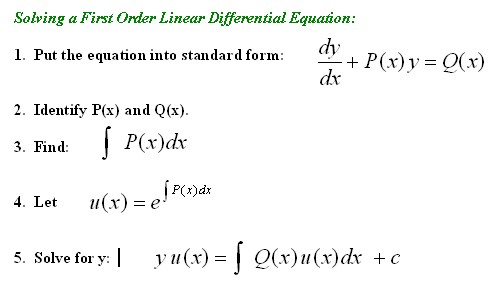
First order Linear Differential equations are some of the most fundamental types in equations found in an advanced calculus course. Differential Equations can be summarized in the form dydt +p(t)y=g(t). F.O.D.Es can be solved by using a handy teqnique known as the integrating factor, or (t) = ep(t). By multiplying both sides of the equation by this constant, the left hand side will be in the form of a result of a product rule derivative, and then can be neatly integrated

The Electric force

The Electric force

The Electric force         02/14/16
A most useful riveting concept found in the study of electromagnetism is the electric force. The electric force is defined as the at-a-distance interaction between two charge particles, described by the equation Felec=q1*q24**0*r2 . As one can discern, the Force is proportional to the strength of the two charges, a constant,  and the square of the distance between them. This equation is kindred in nature to the Universal Gravitation equation, substituting mass for electric charge and changing around the constants, a most intriguing symmetry found in physics. However, there is one glaring incongruity in the fact that the electrically charged particles can be either positive or negative, while mass can only exist in a positive value.

P N type semiconductors

P N type semiconductors

P N type semiconductors                  02/13/16
Silicon has an octet structure chemical structure, which means that it’s outer shell has four valence electrons. When sunlight strikes silicon, one of the electrons are jettisoned from the outer shell and is free to move around randomly within the material. However, for practical purposes, humans want it to move in one direction. This is accomplishable with the use of P and N type semiconductors. There  are two types, N and P type semiconductors. With the latter, a paltry amount of elements with 5 outer electrons are added, forming a bond with silicon as well as leaving one electron free. This free electron can be knocked in in a perfunctory manner by sunlight. P type semiconductors are bonded with elements that are one electron short ( a hole), therefore allowing for easy acceptance of an extra electron. N-type semiconductors conduct electric current through the transfer of electrons, while P-type conducts current through the transfer of “holes”. P and N types can then be amalgamated to create a P-N junction. In P-N junctions, the two types are put right next to each other, first causing an electrical exchange (the P-type will receive electrons and become negative and vice versa for N-types). When sunlight strikes the material, the free electron will be repulsed by the negatively charged P-type and be attracted to the positive N-type. And that is how solar panels work